
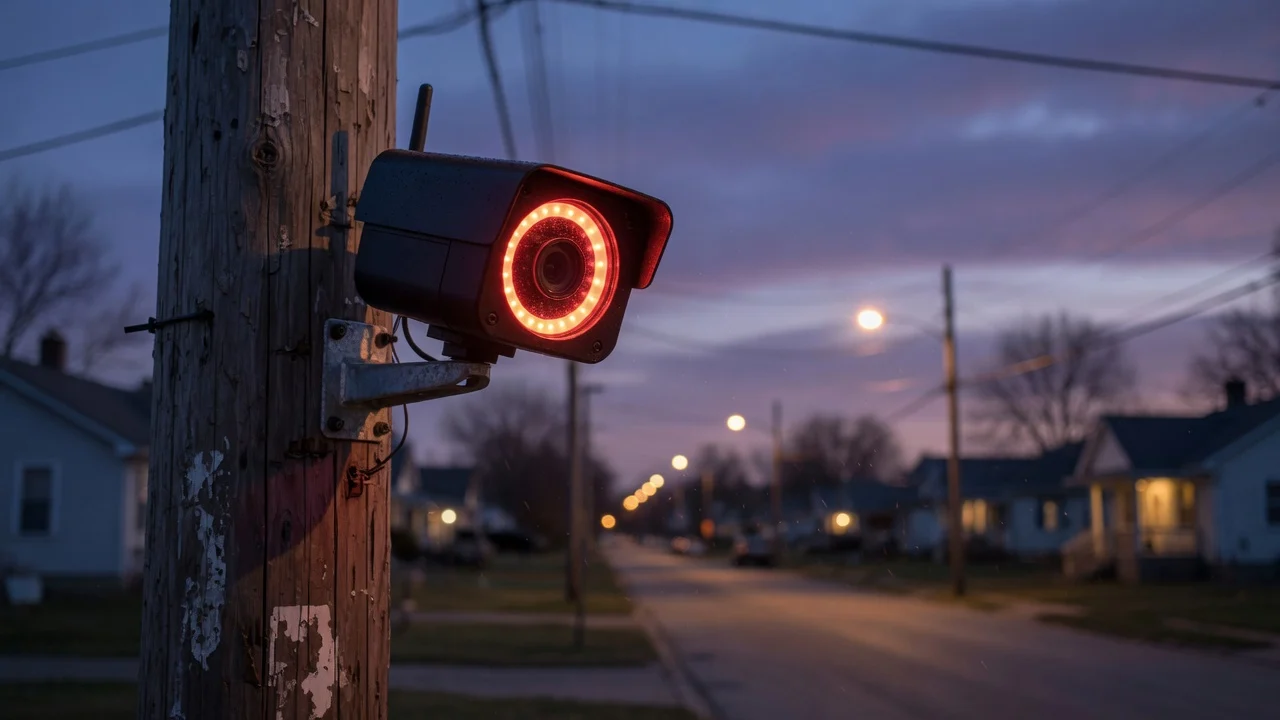
Here’s a number that should stop you mid-scroll: Flock’s license plate cameras have grown from roughly 80,000 units in 2024 to over 119,000 across 49 states by mid-2026 [1][2][3]. That’s not a niche pilot program anymore. That’s a nationwide surveillance network, and there’s a good chance one of these cameras photographed your car this week without you knowing it existed. So the question everyone’s typing into Google, “are Flock cameras legal,” deserves a real answer instead of a shrug. The honest answer is: yes, mostly, but the rules are being rewritten in real time, and that matters more than the yes.
What Flock Cameras Actually Do
Flock cameras are automatic license plate readers, ALPRs for short, mounted on poles, road signs, and even rideshare dashboards. They photograph every plate that passes, run it through AI to log the plate number, vehicle type, and color, then upload that data to a searchable cloud database. Nearly 90% of large sheriff’s offices with 500 or more deputies use this kind of ALPR technology, and every department serving a population over 1 million does too [1].
What makes Flock different from an old-school traffic camera is the network effect. Roughly 7,000 law enforcement agencies, about 40% of all police departments in the country, have contracts with Flock [1]. That means a camera in Denton, Texas can feed data that an officer in another state searches later, and departments as far apart as local sheriffs and federal agencies including the FBI, ICE, ATF, and CBP can tap into the same pool. Texas alone has more than 10,000 Flock or comparable ALPR cameras running right now [4].
This is the part that trips people up. A single camera photographing your plate on a public road isn’t new and isn’t really in legal dispute. The network stitching thousands of those cameras into one searchable, cross-jurisdiction database is the part nobody voted on.
The Legal Baseline: Public Roads, Public Plates
Courts have generally held that you don’t have a reasonable expectation of privacy in a license plate you’re displaying on a public street. That’s the legal foundation Flock and its law enforcement customers lean on, and it’s held up in most challenges so far. If a camera can see it from a public vantage point, capturing it is broadly lawful.
But “lawful to capture” and “lawful to store, share, and search indefinitely” are two different questions, and that’s exactly where the courts and city councils are still arguing. Sedro-Woolley and Stanwood, Washington got hit with a judge’s ruling that the cities wrongfully withheld Flock images requested under public-records law and failed to preserve records before they auto-deleted [5]. In Texas, the state attorney general ordered the city of Conroe to release its Flock contracts, policies, camera locations, and search logs after a resident asked for them [6]. Neither ruling says the cameras are illegal. Both say the secrecy around how they’re used isn’t holding up.
San Jose, California is the sharpest example of where this is headed next. Nonprofits sued the city over warrantless database searches, and the case is now working through Santa Clara County court to decide whether the suit even proceeds [7]. That’s not a settled question. That’s a live one.

The Part Flock’s Marketing Doesn’t Lead With
Flock’s public pitch centers on solved crimes and recovered vehicles, and there’s real substance behind some of that. Costa Mesa police credited Flock with helping recover stolen vehicles, find missing persons, and solve sexual assault cases over the course of a year [8]. That’s a genuine, measurable win, and it’s worth acknowledging instead of waving away.
But the picture gets murkier once you look at how the system actually gets used day to day. The Electronic Frontier Foundation pulled public records showing more than 12 million searches logged by over 3,900 agencies between December 2024 and October 2025, including searches tied to protests and abortion-related travel [9]. That’s not “we ran a plate after a hit-and-run.” That’s a dragnet, used far more often than the missing-persons stories suggest.
Atlanta is a good test case for whether all this camera coverage even delivers what it promises. The city has scaled up to 28,000 cameras, yet clearance rates for crimes haven’t meaningfully risen. Some independent reporting has gone further, arguing the FBI’s own data shows Flock’s surveillance hasn’t actually moved the needle on solving cases in a way that matches the scale of deployment [10]. Flock counters with its own numbers, claiming its system supported roughly 1 million law enforcement investigations and helped locate over 10,000 missing persons in a single year, and that its data contributes to about 20% of cleared cases among participating agencies [11]. Both things can be true at once: real wins in specific cases, and a system whose overall crime-fighting impact is genuinely disputed.
 From the shopIt Worked Before the UPDATE$18.45Shop →
Flock Blinked First, and That Tells You Something
In August 2026, Flock cut its default data retention from 30 days down to 7 [12][13]. It also added something called “Evidence Mode” and started requiring case numbers before agencies can run searches [12]. Flock’s own blog post framed it plainly: “Today, we are updating our recommendation and default to a 7-day retention,” adding that customers own the data and decide who can access it [14].
CEO Garrett Langley defended the move as proactive, telling Bloomberg the shift to mandatory protections, rather than optional ones, gives cities more control [15]. Maybe. But a company doesn’t rewrite its default retention policy and add mandatory audit trails because everything’s going smoothly. This was a response to sustained pressure, not a routine feature update, and it’s worth reading it that way.
The ACLU wasn’t satisfied. Its response argued that ALPR systems like Flock “violate our privacy” by photographing every vehicle and building a nationwide database that lets someone reconstruct a person’s daily movements, adding pointedly that legal permission doesn’t equal legitimacy [16]. That’s the real crux of this whole debate. Legal and okay aren’t the same thing, and Flock’s own policy reversal is quiet proof that even the company knows it.
Cities Are Already Voting With Their Contracts
If you want the clearest signal of where public opinion is landing, skip the op-eds and look at what local governments are actually doing. At least 30 localities across 23 states have deactivated or canceled Flock contracts since early 2025, and more city councils are actively reconsidering theirs [17][9].
Some places are choosing tighter rules instead of full cancellation. Cleveland’s city council approved a short contract extension but barred data sharing without a warrant, required a public transparency portal, and set up quarterly reports with real penalties for violations [18]. That’s a workable middle path, and it’s a good template if your own city is debating this.
Not every city is running from Flock, either. In the Sacramento region, several agencies use the system, but at least one city chose a competing vendor, Motorola, instead [19]. That’s a healthy sign, honestly: real competition and real local choice, rather than a single company locking down the market by default.
A few practical steps if you want to know what’s happening in your own area:
- Search your city or county name plus “Flock camera contract” to see if local reporting or council minutes exist
- Check crowdsourced mapping projects that track known camera locations, since Flock itself won’t publish an official count [20][3]
- File a public-records request for your city’s Flock contract, retention policy, and search-log audit process, following the model Conroe, Texas was ordered to follow [6]
- Ask your city council directly whether searches require a case number, a warrant for cross-jurisdiction sharing, and a public transparency portal, the same standard Cleveland adopted [18]
What This Means If You’re Weighing an HOA or Local Proposal
If your neighborhood or HOA is being pitched on Flock cameras, treat it the same way you’d treat any smart home purchase decision: read the actual terms, not the sales pitch. Ask who owns the footage, how long it’s kept, whether it can be shared with agencies outside your city, and whether there’s a public audit trail. Flock’s own updated default is now 7 days retention with owner-controlled sharing [14], so if a local proposal offers less transparency than that, that’s a red flag worth raising at the meeting.
Rural communities are adopting this technology too, not just big cities, which means this isn’t a problem you can assume only applies to major metros [21][22]. The scale of deployment has outpaced the scale of public understanding almost everywhere.
Frequently Asked Questions
Are Flock cameras legal to use on public roads?
Generally, yes. Courts have consistently held that photographing a license plate visible from a public road doesn’t violate a reasonable expectation of privacy. The unsettled legal questions are about data retention, cross-jurisdiction sharing, and warrantless searches of the resulting database, not the initial camera capture itself.
Can I find out if Flock cameras are near my home?
Flock doesn’t publish an official public map of its camera locations, which is part of why transparency advocates and journalists rely on crowdsourced mapping and public-records requests instead [20][3]. Your best bet is checking local news coverage of your city’s contract or filing a public-records request directly.
Do police need a warrant to search Flock’s database?
It depends on the city. Some places, like Cleveland, now require a warrant for cross-jurisdiction data sharing [18]. Others operate with far looser rules, which is exactly what’s being challenged in San Jose’s ongoing lawsuit [7].
How long does Flock keep license plate data?
Flock’s new company-wide default is 7 days, down from 30, as of the August 2026 policy change [12][13]. Individual cities can set their own retention rules within their contracts, so it’s worth checking your local policy specifically.
Where This Leaves You
Flock cameras aren’t illegal, and treating them like some rogue surveillance conspiracy oversimplifies a genuinely complicated picture. But “legal” was never really the question that mattered here. The real question is whether your city has the transparency, audit trails, and warrant requirements in place to make that legality mean something. Some do. Many don’t yet. Pull up your own city’s contract, ask the questions above, and show up to the council meeting where this gets decided. That’s the one move that actually changes how this technology gets used near you.
Sources
- Flock Cameras Can Track Every Car in America. Police … (nytimes.com)
- Flock Cameras Explained: Inside the Controversial Surveillance Tech – AOL (aol.com)
- 8 claims involving Flock, other surveillance tech we’ve examined (snopes.com)
- Use of Flock license plate reader cameras surges in Texas (texastribune.org)
- Judge rules against cities of Sedro-Woolley, Stanwood in Flock camera case (goskagit.com)
- Texas AG says Conroe must release records it withheld about Flock Safety … (yahoo.com)
- Santa Clara court will decide if Flock suit proceeds (kalw.org)
- Inside the growing police use and misuse of Flock’s license … (cnn.com)
- Get the Flock Outta Here: Backlash Grows Over Video Surveillance Tool (usnews.com)
- Flock Surveillance Cameras Are Actually Horrible for Fighting Crime … (futurism.com)
- A large number of false positives for stolen vehicles … (gigazine.net)
- Flock camera CEO announces drastic new change to how company … (nypost.com)
- Flock Safety Unveils New Privacy, Audit Controls for ALPR … (officer.com)
- Flock Updates Privacy, Accountability, Security, and … (flocksafety.com)
- ‘We’re Not Big Brother’: Flock CEO Unveils New Privacy … (bloomberg.com)
- Flock’s Cameras Remain Civil Liberties Threat Despite … (aclu.org)
- Flock sees controversial camera contracts canceled in 23 … (washingtonexaminer.com)
- 3 Ohio Cities Approve Automated License Plate Reader Pacts (govtech.com)
- License plate-reading cameras: Crime-fighting tool or invasion of privacy? What to know (sacbee.com)
- Flock camera map: How many are in your neighborhood? (thehill.com)
- Are Rural Law Enforcement Agencies Using Flock Cameras? (goodmenproject.com)
- Rural Communities Grapple With the Rise of Flock Cameras (governing.com)
Researched from 44 sources.