
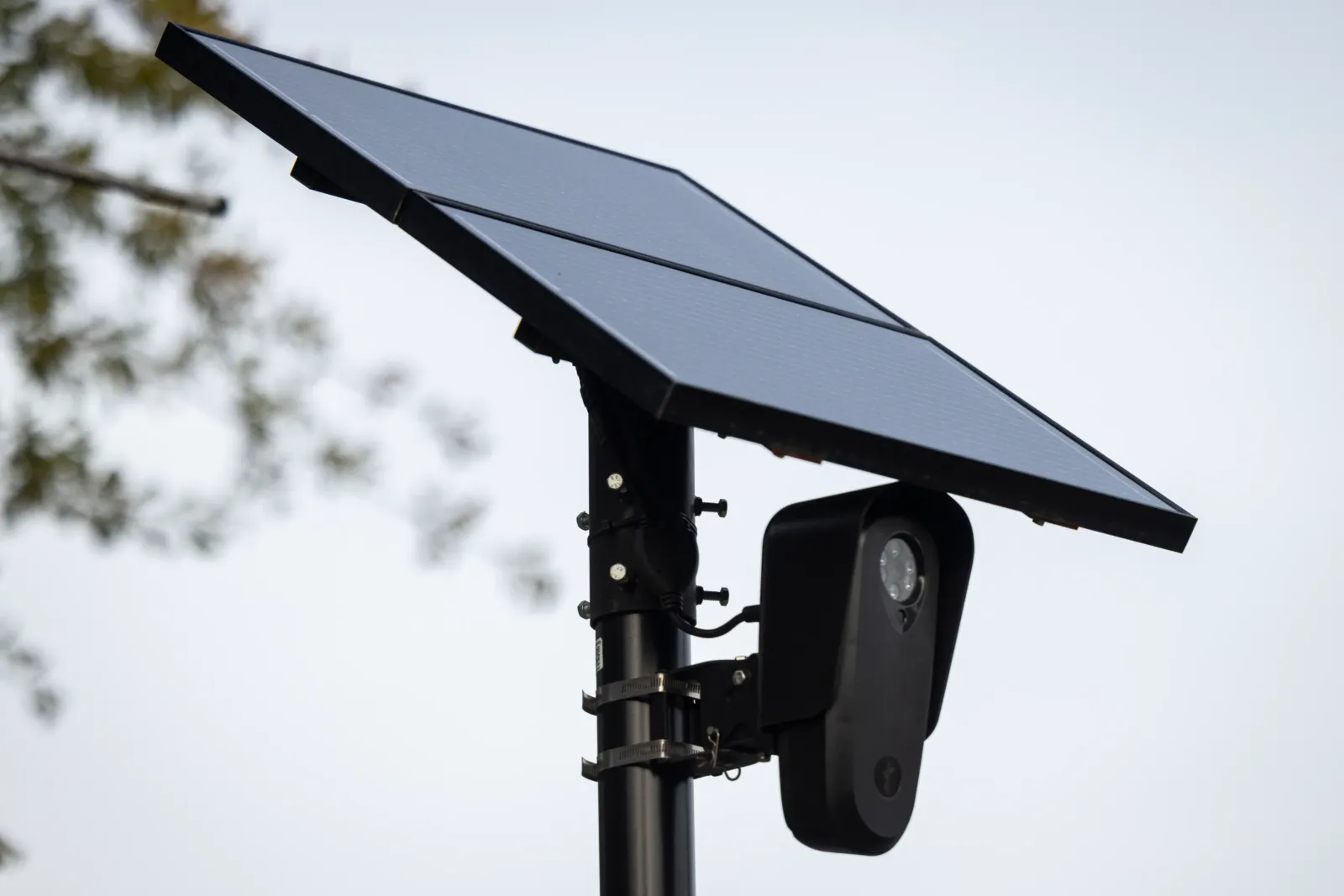
There are now more than 119,000 Flock cameras running across 49 states [1], and there’s a decent chance a handful of them are already photographing your car every time you leave your driveway. Most people find out the way I did: a neighbor mentions it at a block party, or a city council agenda shows up with a line item you’ve never seen before. By the time most residents hear about Flock, the cameras are already up. That’s the actual problem here, not whether the tech works.
What Flock Cameras Actually Do
Flock makes automatic license plate readers, ALPRs for short, that photograph every vehicle passing by and log the plate, timestamp, location, and details like car color and type. That data doesn’t stay local. It feeds into a searchable network that law enforcement agencies can query, and Flock has contracts with roughly 7,000 agencies, about 40% of every police department in the country [2]. Federal agencies including the FBI, ICE, ATF, and CBP have access too.
Think of it less like a single security camera and more like a shared tracking layer stitched across cities and counties. A camera in your subdivision doesn’t just watch your subdivision. It can feed a database another department three states away is searching. That’s a different thing than the doorbell cam on your porch, and it’s worth understanding before you sign off on one.
The growth curve alone tells you how fast this crept in. Flock had around 80,000 cameras in 2024. By mid-2026 that number had climbed past 119,000 [1], and the company won’t publish exact deployment figures, which is part of why independent trackers and crowdsourced maps have become the only real way to know what’s near you.
The Scale Problem Nobody Mentions at the HOA Meeting
Here’s the number that should make you pause: the Electronic Frontier Foundation found more than 12 million searches logged by over 3,900 agencies between December 2024 and October 2025, including searches tied to protests and abortion-related travel [3]. That’s not “we pulled a plate after a hit-and-run.” That’s a system getting queried at dragnet scale, far beyond the missing-person and stolen-vehicle use cases that get pitched to city councils.
Nearly 90% of large sheriff’s offices with 500 or more deputies, and 100% of departments serving populations over 1 million, now use ALPR technology, according to a Congressional Research Service report [4]. This isn’t a niche pilot program anymore. It’s standard infrastructure in big jurisdictions, and it’s spreading into small towns that never had a public debate about it.
I’d also flag the accuracy question, because it rarely comes up until something goes wrong. Reporting has documented a meaningful number of false positives for stolen vehicle alerts [5], the kind of error that turns into an officer approaching a car with guns drawn over a misread plate. If your neighborhood is weighing a Flock contract, “how often is it wrong, and what happens when it is” deserves its own line item.
 From the shopIt Worked Before the UPDATE$18.45Shop →
Is Any of This Actually Legal?
The honest answer: capturing a plate that’s visible from a public street is broadly legal today. Courts have generally treated that as no different from a person standing on a sidewalk writing down plates by hand. But that’s where the simple answer ends and the messy part begins.
Courts and legislatures are actively defining the boundaries right now, not confirming settled ones. In San Jose, nonprofits sued the city over warrantless searches of the Flock database, and the city council later voted to restrict use after public pressure [6]. A Washington state judge ruled that the cities of Sedro-Woolley and Stanwood wrongfully withheld camera images requested under public-records law and failed to preserve records that auto-deleted [7]. In Texas, the state attorney general ordered the city of Conroe to release its Flock contracts, policies, camera locations, and search logs after a resident requested them [8].
The ACLU’s position cuts right to the tension: legal permission doesn’t equal legitimacy [9]. Photographing every car that passes, then feeding that into a searchable, cross-jurisdiction network, builds something closer to a movement-tracking system than a single security tool, even if each individual photo is lawful on its own.
Why Flock Changed Its Own Rules
In August 2026, Flock cut its default data retention from 30 days down to 7, and added a mandatory “Evidence Mode” along with required case numbers for searches [10][11]. This wasn’t a court order. It was a company deciding, under mounting public pressure, that its own defaults were a liability.
CEO Garrett Langley framed the change as proactive, saying the shift to mandatory guardrails rather than optional ones gives cities more control [12]. Flock’s own blog post put it plainly: customers own the data, decide who accesses it, and choose who they share it with [13]. That’s a reasonable-sounding policy. But it’s worth remembering the guardrails only arrived after 12 million logged searches became public knowledge [3], not before.
The retention cut matters practically. Seven days of storage is a real reduction from 30, and it narrows the window where a stray search could resurface old travel patterns. It doesn’t undo the fact that cross-jurisdiction sharing still lets one city’s footage answer another city’s query, which is the part critics say functions like a warrantless movement database [14].
Questions to Ask Before Your Neighborhood Signs On
If your HOA, city council, or homeowners’ group is considering Flock cameras, or already has them, don’t accept a vague “it helps solve crime” pitch. Ask for specifics, in writing. Here’s what I’d bring to that meeting:
- Who can access the footage, and does that include agencies outside our jurisdiction?
- Is a warrant required before data is shared with another department or a federal agency?
- What’s our retention period, and who decided it?
- Is there a public transparency portal or regular reporting on how the system’s actually being used?
- What happens if a plate is misread and someone’s wrongly stopped?
- Can residents request search logs or camera location data through a public-records request?
Cleveland offers a decent model here. The city council approved a short contract extension but barred data sharing without a warrant, required a public transparency portal, and set quarterly reporting with penalties for violations [15]. That’s the kind of specificity that separates a thoughtful local policy from a rubber-stamp vote.
It’s also worth knowing you’re not the only neighborhood asking these questions. At least 30 localities across 23 states have deactivated or canceled Flock contracts since early 2025 [16][3], and plenty more councils are actively reconsidering. Not every place wants this, and pushing back isn’t fringe behavior at this point. It’s a normal part of the conversation.
Weighing the Real Trade-Off
Flock and participating police departments point to genuine wins. The company says its system has supported roughly a million law enforcement investigations and helped locate more than 10,000 missing persons in a single year, though these are company-reported figures rather than independently audited ones. In Costa Mesa, California, police credited Flock with helping recover stolen vehicles, locate missing persons, and solve sexual assault cases over a one-year span [6]. Those are real outcomes for real people, and dismissing them outright would be its own kind of dishonesty.
But other data complicates the “it solves crime” narrative. Flock’s data reportedly supports around 20% of cleared cases among participating agencies [5], and reporting out of Atlanta found that despite tens of thousands of cameras, clearance rates weren’t meaningfully rising. So the technology helps in specific, documented cases. It’s not a blanket crime-reduction machine, and any pitch that frames it that way is overselling.
My honest take: the tech works as advertised for plate capture and search. The real question isn’t whether Flock functions. It’s whether your community wants a warrant requirement, a short retention window, and public reporting locked in before the cameras go up, not negotiated after the fact once 12 million searches have already happened somewhere else.
Frequently Asked Questions
Are Flock cameras legal in my state?
In most states, yes, capturing a publicly visible license plate is legal. But rules around data sharing, retention, and warrant requirements vary by city and are actively being rewritten through lawsuits and local ordinances, so “legal” doesn’t mean “unregulated” or “settled.”
Can I find out if Flock cameras are near my house?
Flock doesn’t publish exact camera counts or locations [1], so your best options are checking your city council or police department’s public records, or using crowdsourced mapping projects that track known deployments.
How long does Flock keep my license plate data?
As of August 2026, Flock’s new default retention is 7 days, down from a previous 30-day default [10]. Individual cities can still set their own retention policies, so ask your local department what they’ve actually configured.
Can my HOA or city cancel a Flock contract once it’s signed?
Yes. At least 30 localities across 23 states have already deactivated or canceled contracts since early 2025 [16][3], so it’s not unprecedented, though the process and any penalties depend on your specific contract terms.
Where to Go From Here
Before your neighborhood votes yes on Flock cameras, get the contract in writing and read the fine print on data sharing and retention. If cameras are already up, file a public-records request for your city’s search logs and policies. Bring the questions above to the next council or HOA meeting. You don’t need to be against the technology to demand the guardrails get decided by your community, not by default.
Sources
- Flock boss admits surveillance firm took too long to act over police … (bbc.com)
- Flock Cameras Can Track Every Car in America. Police … (nytimes.com)
- Get the Flock Outta Here: Backlash Grows Over Video Surveillance Tool (usnews.com)
- Are Rural Law Enforcement Agencies Using Flock Cameras? (goodmenproject.com)
- A large number of false positives for stolen vehicles … (gigazine.net)
- Inside the growing police use and misuse of Flock’s license … (cnn.com)
- Judge rules against cities of Sedro-Woolley, Stanwood in Flock camera case (goskagit.com)
- Texas AG says Conroe must release records it withheld about Flock Safety … (yahoo.com)
- Flock’s Cameras Remain Civil Liberties Threat Despite … (aclu.org)
- Flock camera CEO announces drastic new change to how company … (nypost.com)
- Flock Safety Unveils New Privacy, Audit Controls for ALPR … (officer.com)
- ‘We’re Not Big Brother’: Flock CEO Unveils New Privacy … (bloomberg.com)
- Flock Updates Privacy, Accountability, Security, and … (flocksafety.com)
- Surveillance company Flock moves to increase oversight … (nbcnews.com)
- 3 Ohio Cities Approve Automated License Plate Reader Pacts (govtech.com)
- Flock sees controversial camera contracts canceled in 23 … (washingtonexaminer.com)
Researched from 48 sources.