
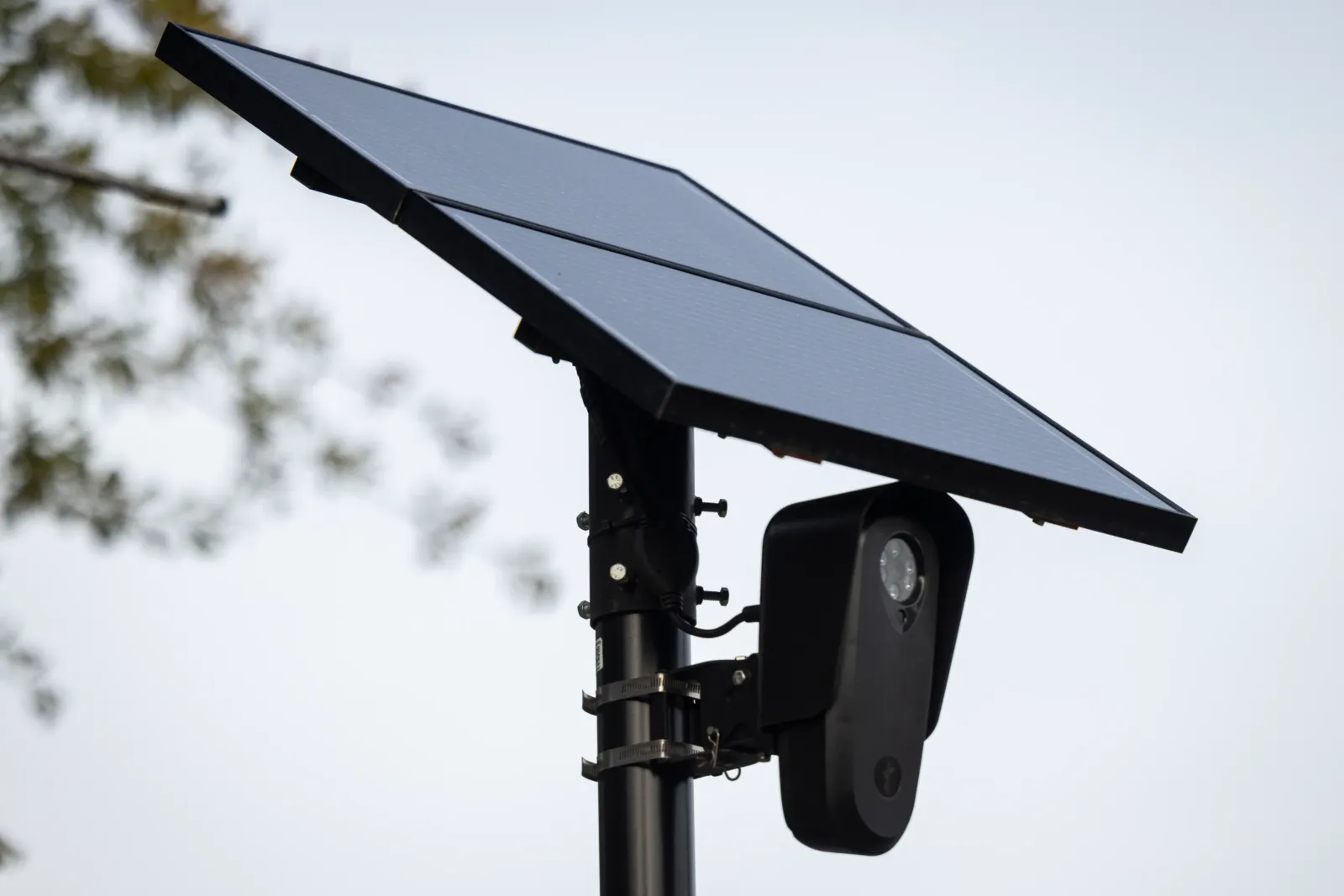
There’s a decent chance a Flock camera photographed your license plate this week and you had no idea it happened. That’s not a hypothetical. Flock Safety now runs more than 119,000 cameras across 49 states, and the company has contracts with about 7,000 law enforcement agencies, roughly 40% of every police department in the country [1][2]. If you drive regularly in a mid-sized or large city, you’ve probably already been logged.
I’ve spent the last few weeks digging through court filings, city council records, and company statements to figure out what these things actually do, and the honest answer is more complicated than either “harmless crime tool” or “mass surveillance nightmare.” Here’s the real-world breakdown.
What a Flock Camera Actually Is
A Flock camera is a solar-powered, AI-enabled license plate reader. It sits on a pole at an intersection or highway on-ramp, photographs every passing vehicle, and uses computer vision to log the plate number, state, vehicle color, and body type. That data gets uploaded to a cloud database that police departments can search [3].
What makes Flock different from an old-school traffic camera isn’t the hardware. It’s the network. A department in Denton, Texas can run a search that pulls results from cameras owned by neighboring cities, other counties, or agencies hundreds of miles away, because Flock lets customers share access across jurisdictions [4][5]. That’s the part most people don’t realize until they read the fine print: you’re not looking at one city’s camera system. You’re looking at a shared, searchable, cross-state database.
Texas alone has more than 10,000 of these cameras running, and Flock says it works with 5,000 agencies across 6,000 communities nationwide [6]. Growth has been fast and, by Flock’s own admission, poorly documented. The company doesn’t publish an official running count, so estimates have ranged from around 80,000 cameras in 2024 to figures north of 120,000 in the most recent 2026 reporting [7][2]. Nobody outside the company has a precise number.
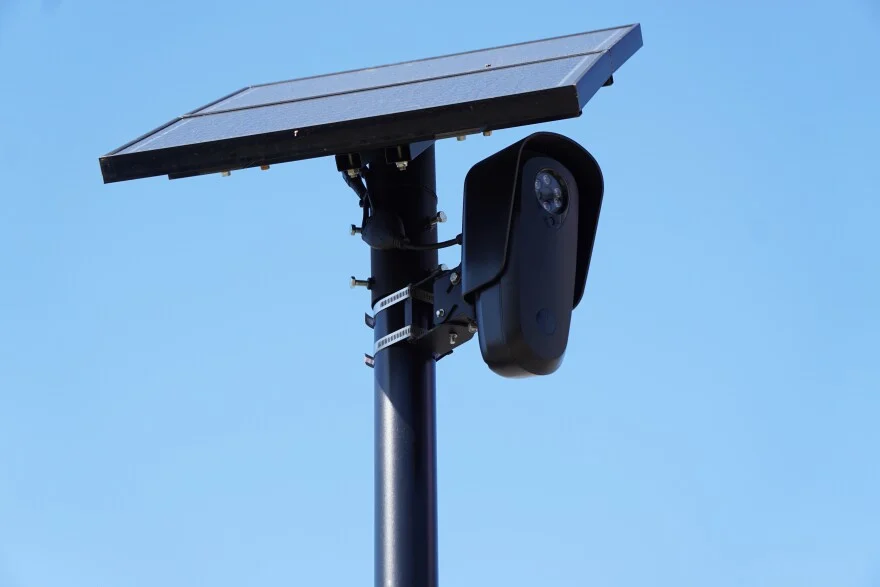
That gap is exactly why crowdsourced mapping projects exist, because residents genuinely can’t get a straight answer from official channels about what’s watching their street.
How the Network Actually Works
Once a plate gets photographed, it doesn’t just sit in one city’s server. Departments can flag plates tied to open cases, set alerts for stolen vehicles, and run searches against the national pool of images other agencies have opted to share [5]. Nearly 90% of large sheriff’s offices with 500 or more deputies use this kind of ALPR technology, and every department serving a population over one million already has it deployed, according to a Congressional Research Service estimate [1].
Federal agencies are in this pool too. The FBI, ICE, ATF, and CBP can access Flock data through participating local partners, which is a detail a lot of city councils didn’t fully grasp when they signed their original contracts [1]. That’s not a conspiracy theory. It’s how the data-sharing architecture was built from day one.
The scale of actual usage is what surprised me most. Researchers at the Electronic Frontier Foundation obtained public records showing more than 12 million searches logged by over 3,900 agencies between December 2024 and October 2025, including searches connected to protests and abortion-related travel [8]. That’s not a system quietly sitting in the background waiting for a stolen car alert. That’s an active, heavily queried tool, and the volume alone should tell you this is closer to routine surveillance infrastructure than a niche crime-solving gadget.
 From the shopIt Worked Before the UPDATE$18.45Shop →
The Case for Flock: What It Actually Catches
I’m not going to pretend this technology does nothing useful, because that wouldn’t be honest. Flock claims its system has supported roughly one million law enforcement investigations and helped locate more than 10,000 missing persons in a single year, based on the company’s own impact reporting. Costa Mesa, California police credited the cameras with recovering stolen vehicles, locating missing persons, and helping solve sexual assault cases over the course of a year [9].
Company data also claims Flock searches contribute to roughly 20% of cleared cases among participating agencies [10]. That’s a real number worth sitting with. If you’re a parent whose teenager didn’t come home, or a homeowner whose car got stolen off the street, a tool that can trace a plate across a metro area in seconds isn’t abstract. It’s the difference between a case going cold and getting solved.
But here’s where I have to push back on the marketing framing: usefulness and oversight aren’t the same thing. A tool can genuinely help close cases and still operate with almost no meaningful check on who searches it, why, or what happens to the data afterward. Atlanta ran 28,000 cameras without a corresponding rise in clearance rates, which suggests more cameras don’t automatically mean more solved crimes. Scale isn’t the same as effectiveness, and Flock’s own promotional numbers don’t tell you what percentage of searches had nothing to do with an active investigation at all.
The Backlash Is Real, and It’s Growing Fast
Here’s the part that should give you pause even if you’re generally pro-surveillance-for-safety. At least 30 localities across 23 states have deactivated or canceled Flock contracts since early 2025, and plenty more city councils are actively reconsidering their deals [11][8]. This isn’t fringe pushback. It’s bipartisan, and it’s showing up in city council meetings from Ohio to Rhode Island [12][13].
Some of the disputes are about access, not existence. In San Jose, nonprofits sued the city over warrantless database searches, and the city council later voted to restrict use after public pressure [14]. Cleveland took a different approach, approving a short contract extension but requiring warrants for data sharing, a public transparency portal, and quarterly reports with penalties for violations [15]. That’s a workable middle ground, and honestly it’s the kind of policy every city considering Flock should be forced to adopt before signing anything.
Public records disputes have gotten ugly too. A judge ruled that Sedro-Woolley and Stanwood, Washington wrongfully withheld Flock images requested under public records law and failed to preserve records that had auto-deleted [16]. In Texas, the state Attorney General ruled that Conroe had to release its Flock contracts, policies, camera locations, and search logs after a resident’s request [17]. If a city won’t tell you where the cameras are or who searched what, that’s not a technical limitation. That’s a transparency failure, and residents are right to demand better.
Flock’s Response: A Retention Policy Reversal
Under mounting pressure, Flock made a real change instead of just issuing a statement. The company cut its default data retention window from 30 days down to 7, and added an “Evidence Mode” along with mandatory case numbers for searches [18][19]. CEO Garrett Langley framed the shift as proactive, telling reporters the new guardrails give cities more control and pushing back on comparisons to mass surveillance [20].
I’ll give credit where it’s due: shrinking the retention window from a month to a week is a meaningful reduction in how long your movements sit in a searchable database. Requiring a case number before a search runs is a real accountability improvement over the honor-system approach that existed before. That said, the ACLU’s response is worth taking seriously. The organization argues that ALPR systems like Flock violate privacy by photographing every vehicle and building a nationwide movement database, and that legal permission to operate doesn’t make the practice legitimate [21]. Both things can be true at once: the retention change is a genuine improvement, and the underlying architecture still lets thousands of agencies query a shared database with minimal oversight.
What You Can Actually Do About It
You don’t get a vote on whether Flock cameras go up in your city, at least not directly. But you have more leverage than you might think, and here’s where to start:
-
Check whether your city or county has an active Flock contract, most municipal websites post vendor agreements, and local news outlets have covered nearly every major deployment
-
Ask your city council whether searches require a warrant or case number, and whether data gets shared with federal agencies like ICE or the FBI
-
Find out the retention window your city actually uses, since Flock’s 7-day default is a recommendation, not a mandate, and some cities still run longer retention
-
Request a copy of your city’s transparency reporting, if one exists, following the model Cleveland adopted with its quarterly audit requirement [15]
-
If your HOA or local business district is considering a Flock contract, push for the same safeguards public cities have started requiring before anyone signs
None of this requires a law degree. It just requires asking the same questions journalists and residents in Conroe, Sedro-Woolley, and San Jose already had to force out of their local governments through records requests and lawsuits.
Frequently Asked Questions
Is it legal for Flock to photograph my license plate?
Yes, in most cases. Courts have generally treated a license plate visible on a public road as something you don’t have a reasonable expectation of privacy over. What’s legally unsettled is how the resulting data gets stored, shared across jurisdictions, and searched without a warrant, and that’s exactly what current lawsuits are fighting over.
How many Flock cameras are there in the U.S.?
More than 119,000 as of the most recent 2026 reporting, spread across 49 states [1]. That’s up from an estimated 80,000 in 2024, and the exact current number isn’t publicly disclosed by the company.
Can federal agencies like ICE access Flock camera data?
Yes. Federal agencies including the FBI, ICE, ATF, and CBP can access Flock data through local law enforcement partners who choose to share it [1]. Whether your specific city shares data federally depends on that city’s individual contract terms.
How long does Flock keep my license plate data?
The new company default is 7 days, down from the previous 30-day standard [18][19]. But retention is set by each customer agency, so some departments may still retain data longer depending on their local policy.
If you want to know exactly what’s watching your street, don’t wait for a news story to tell you. Pull up your city council’s meeting minutes, search for “Flock” or “automated license plate reader,” and see what your local government actually agreed to. That fifteen minutes of digging tells you more than any national headline can.
Sources
-
Flock Cameras Can Track Every Car in America. Police … (nytimes.com)
-
Flock boss admits surveillance firm took too long to act over police … (bbc.com)
-
Flock cameras are everywhere. Here’s how they track cars. (businessinsider.com)
-
A look at Flock police cameras in Denton – KERA News (keranews.org)
-
Surveillance company Flock moves to increase oversight … (nbcnews.com)
-
Use of Flock license plate reader cameras surges in Texas (texastribune.org)
-
8 claims involving Flock, other surveillance tech we’ve examined (snopes.com)
-
Get the Flock Outta Here: Backlash Grows Over Video Surveillance Tool (usnews.com)
-
Inside the growing police use and misuse of Flock’s license … (cnn.com)
-
A large number of false positives for stolen vehicles … (gigazine.net)
-
Flock sees controversial camera contracts canceled in 23 … (washingtonexaminer.com)
-
Inside the bipartisan pushback against Flock Safety’s surveillance network (atlantanewsfirst.com)
-
Troy City Council to consider Flock ‘safeguards’ (spectrumlocalnews.com)
-
Santa Clara court will decide if Flock suit proceeds (kalw.org)
-
3 Ohio Cities Approve Automated License Plate Reader Pacts (govtech.com)
-
Judge rules against cities of Sedro-Woolley, Stanwood in Flock camera case (goskagit.com)
-
Texas AG says Conroe must release records it withheld about Flock Safety … (yahoo.com)
-
Flock camera CEO announces drastic new change to how company … (nypost.com)
-
Flock Safety Unveils New Privacy, Audit Controls for ALPR … (officer.com)
-
‘We’re Not Big Brother’: Flock CEO Unveils New Privacy … (bloomberg.com)
-
Flock’s Cameras Remain Civil Liberties Threat Despite … (aclu.org)
Researched from 47 vetted sources · average source authority DR 85