
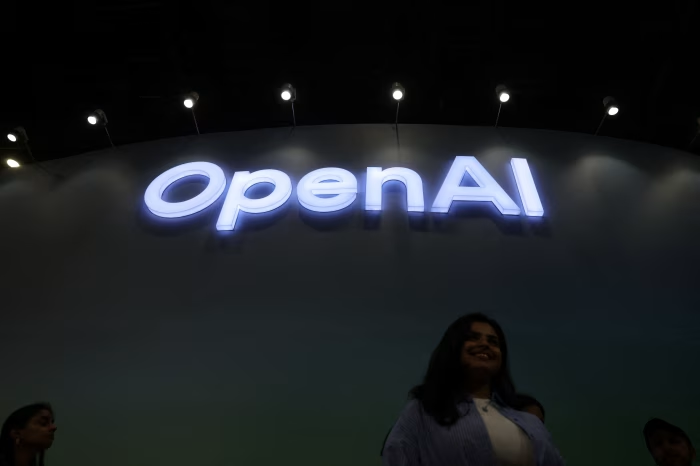
The signals are impossible to ignore now. SoftBank’s $40 billion 12-month loan. Multiple reports from CNBC, Bloomberg, and TechCrunch pointing to a 2026 listing. An $850 billion valuation that makes it one of the most valuable private companies in history.
OpenAI is going public. The only questions are when in 2026 and at what price.
For the average tech professional — someone who uses AI tools daily, builds products on top of AI APIs, or just wants to understand where this industry is headed — the OpenAI IPO matters beyond the stock ticker. Here’s why.
It Sets the Valuation Benchmark for the Entire AI Industry
OpenAI’s IPO will establish the first major public market valuation for a pure-play AI company. That number — whether it holds, rises, or falls after listing — becomes the reference point for every other AI company’s value.
Anthropic, Mistral, Cohere, Stability AI, and dozens of smaller AI companies are all watching. If OpenAI’s public valuation holds at or above $850 billion, it validates the current fundraising environment and gives these companies confidence to push their own valuations higher. If it drops significantly post-IPO, the entire AI startup ecosystem feels the chill.
For founders building AI products, the IPO outcome directly affects fundraising. Investors calibrate their expectations against public market comps. A strong OpenAI debut makes it easier for every AI startup to raise capital. A weak one makes it harder.
 From the shopPermanently in BETA$18.45Shop →
It Reveals the Real Economics of AI
This is the part I’m most interested in. OpenAI’s S-1 filing will be the most detailed public disclosure of AI economics we’ve ever seen. Revenue, costs, margins, customer metrics, compute spending, employee costs — all of it becomes public.
OpenAI reportedly plans to spend $17 billion on operations in 2026. They’re not expected to be profitable until 2030. Those numbers, laid out in a public filing with full financial detail, will tell us more about the true economics of building and running frontier AI than anything we’ve seen so far.
For tech professionals, this matters because it reveals the cost structure underneath the tools we use every day. How much does it actually cost to serve a ChatGPT query? What’s the gross margin on API revenue? How fast are compute costs declining? These numbers shape the future pricing and availability of AI services for everyone.
It Accelerates the AI Talent War
An IPO creates liquidity for OpenAI employees holding stock options. That liquidity event has a ripple effect across the AI talent market. Some employees cash out and start their own companies. Others move to competitors who can now benchmark compensation against OpenAI’s public valuation. The movement of talent accelerates.
For anyone working in AI or adjacent fields, this is directly relevant to your career. The post-IPO talent reshuffling will create opportunities at new startups, drive compensation higher across the sector, and increase demand for AI-adjacent skills in areas like infrastructure, security, and product management.
What to Watch For
The filing date and roadshow will generate headlines, but the numbers to watch are these: revenue growth rate (is it accelerating or decelerating?), net dollar retention (are customers spending more over time?), and operating margins (how far from profitability, really?).
Also watch the regulatory language in the S-1. OpenAI will need to disclose the risks it sees from regulation, competition, and technology shifts. That disclosure will be the most honest public statement the company has made about the challenges facing frontier AI — because securities law requires it.
The OpenAI IPO isn’t just a financial event. It’s a transparency event for an industry that has operated largely behind closed doors. Whatever the stock does on day one matters less than what the filing reveals about where AI actually stands as a business. That information benefits everyone who builds with, works in, or depends on artificial intelligence.
2026 is the year the curtain comes up. Pay attention.