
Some links below are affiliate links. If you buy through one, this site earns a commission at no extra cost to you. It never changes a verdict — here is how that works.
Here’s the thing nobody tells you before you buy your first AirTag: it will absolutely find your lost backpack, and it could just as easily be sewn into someone’s coat without them knowing. I’ve now spent a full year running AirTags on luggage, a bike, and a dog collar, and that split reality is the honest takeaway. The precision is real. So is the risk. Any Apple AirTag review that only covers one side is selling you half the story.
Gear Mentioned in This Post
- Apple AirTagView on Amazon
- AirTagView on Amazon
What a Year of Daily Use Actually Feels Like
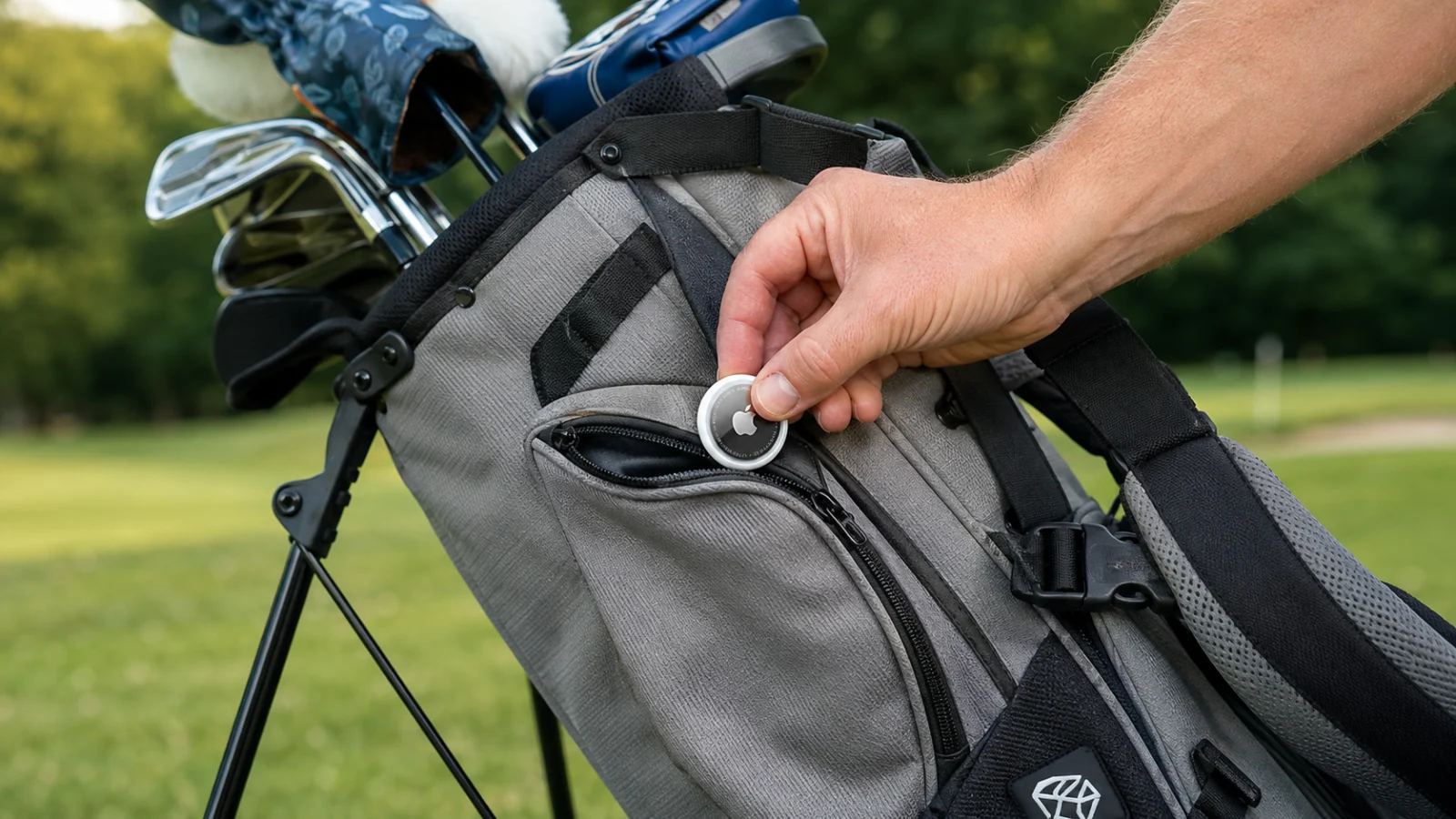
I put an AirTag in my checked bag on every flight this year. I clipped one to my bike. I tried one on my dog’s collar for about two months before switching back to a dedicated pet tracker. Across all three uses, the experience was consistent: fast pairing, accurate location pings inside Apple’s Find My app, and genuinely useful Precision Finding when I got within range of the tag.

That last part is the feature that sells the whole product. Walk into an airport, open Find My, and the AirTag gives you a directional arrow and distance readout that gets you to your bag in seconds, not minutes of wandering around a baggage carousel. It works because Apple’s Find My network is enormous. Every iPhone in range becomes a relay point, which means your AirTag can report its location even when it’s nowhere near you.
That network density is also, without question, why AirTag outperforms nearly everything else on the market for recovery speed. It’s not close. But it’s worth sitting with the fact that the same density is what makes AirTag effective for tracking people, not just objects.
The Real Numbers: Battery, Range, and What Apple Doesn’t Publish
Apple’s AirTag runs on a standard CR2032 coin cell, and in my testing it lasted right around the one-year mark Apple advertises, matching independent measurements elsewhere [1]. That’s a user-replaceable battery, which I appreciate. Pop the back off, swap the cell, done.
Compare that to Tile. Tile’s lineup claims up to three years of battery life depending on the model [1], nearly triple what you get from an AirTag. If you’re tracking something you rarely check on, like a storage unit or a seasonal item, that gap matters.
Range tells a similarly uneven story. Tile publishes real numbers: the Tile Pro claims up to 500 feet, the Tile Mate and Slim around 350 feet, and the Tile Sticker about 250 feet. Apple publishes none of that for AirTag. It relies entirely on the Find My network rather than a fixed Bluetooth range spec, which is a smart design choice for recovery odds but a frustrating one if you’re trying to compare products on paper.
One more gap worth knowing before you buy: the AirTag’s built-in speaker measured around 80 decibels in independent testing, while Tile’s speaker topped 100 decibels. If you’re relying on the “play sound” feature to find something buried in a couch cushion, that difference is noticeable in a loud room.
-
Battery life: AirTag lasts about one year (CR2032, replaceable); Tile claims up to three years
-
Range: Tile Pro up to 500 ft, Tile Mate/Slim ~350 ft, Tile Sticker ~250 ft; AirTag has no published range spec
-
Speaker volume: AirTag measures roughly 80 dB versus Tile’s 100+ dB
-
Network reach: AirTag benefits from Apple’s massive iPhone-based Find My network, which is the real differentiator over raw Bluetooth range
The Part of This Review I Wish I Didn’t Have to Write
I don’t like starting a safety section in a gadget review. But if you’re researching AirTag, you need this before you buy, not after.
Apple has reportedly received more than 40,000 stalking reports connected to AirTag devices between April 2021 and April 2024 [2]. That figure shows up repeatedly across the lawsuits now working through the courts, including a Michigan case that leans on that same number to argue Apple has failed to adequately protect people from being tracked without consent [2].
This isn’t an isolated legal theory. Apple has been named in more than 30 lawsuits alleging that AirTag’s design makes it easy to conceal and misuse for stalking. Court filings describe devices hidden in purses, sewn into clothing, and placed in or on vehicles to track someone’s location in real time without them knowing [3]. More than 20 individual AirTag stalking lawsuits are now pending across at least 17 federal districts, and a petition has been filed asking for those cases to be centralized into a single multidistrict proceeding. Separate reporting puts the pending case count in the Northern District of California alone at 15 to 20, with more filed nationwide [4].
In March, a federal judge dismissed part of the litigation but allowed negligence and strict product-liability claims from three California plaintiffs to move forward [5], a signal that courts see this as more than a public-relations problem.
One case out of Florida, filed in August, alleges a woman’s former partner used an AirTag to secretly monitor her movements for months [6]. It’s the kind of detail that turns a statistic into something you can picture happening to someone you know. That’s not fearmongering. That’s the actual allegation sitting in a court filing right now.
 From the shopPermanently in BETA$18.45Shop →
This Isn’t Just an Apple Problem, and That Context Matters
It would be easy to read the lawsuits and assume AirTag is uniquely dangerous. The wider data doesn’t support that framing, and fairness matters here.
Bluetooth tracker-related stalking cases in the UK rose sharply between 2018 and 2024, and Japanese police have reported a similar climb in tracking-tag stalking consultations over roughly the same window. Both trends point to a global pattern tied to the broader tracker category, not just to one brand’s hardware.
That doesn’t let Apple off the hook. Legal filings claim internal company documents show Apple knew its safeguards would only “deter” rather than “prevent” misuse, and that the company acknowledged it should have consulted domestic abuse organizations before AirTag ever shipped [7]. If true, that’s a design and rollout decision, not an unforeseeable accident. It also means the fix isn’t unique to Apple. Every tracker maker riding this wave of Bluetooth-based location tech is going to face the same reckoning eventually.
Where AirTag Actually Wins in the Market
Here’s a detail that surprised me: even with the lawsuits piling up, AirTag’s accessory ecosystem is thriving. Third-party case and mount makers are doing brisk business fitting AirTags onto everything from pet collars to backpack straps, independent of Apple’s own hardware sales.
Apple’s brand share tells an interesting regional story too. In the US, Apple holds a meaningful slice of the Amazon “4-pack” tracker niche and a similar share in the pet-tracker category, roughly a quarter of each market by recent marketplace analysis. But in the UAE, Apple’s share drops well behind two other brands in a far more fragmented electronics category. That’s a reminder that AirTag’s dominance isn’t universal. It’s strongest where Apple’s broader ecosystem, meaning iPhones in nearly everyone’s pocket, is already dense.
That’s really the honest answer to “is AirTag worth it”: it depends entirely on how many iPhones are around you. Drop an AirTag in a rural area with few iPhone users nearby and the network advantage shrinks fast. Drop it in a city, an airport, or anywhere iPhone density is high, and it’s genuinely the best recovery tool on the market.
My Honest Take After a Year
Would I still use AirTags on my luggage? Yes, without hesitation. Airports are exactly the environment where Find My’s network density pays off, and I’ve recovered a delayed bag faster because of it.
Would I hand one to someone worried about being tracked without their knowledge and tell them not to worry? No. And that’s the real answer any Apple AirTag review owes you in 2026: this is a genuinely excellent object-finding tool built on the same technology that’s now the subject of serious, ongoing litigation over personal safety. Apple has added unwanted tracking alerts and precision-alert features specifically to respond to the misuse problem, and those features are worth turning on and understanding, whether you own an AirTag or you’re worried about someone else’s.
Frequently Asked Questions
How long does an AirTag battery actually last?
About one year under normal use, running on a single replaceable CR2032 coin cell [1]. That’s shorter than Tile’s claimed up to three years, but the tradeoff is Apple’s much larger location network [1].
Can someone track me with an AirTag without my knowledge?
It’s the core allegation behind more than 30 lawsuits against Apple, with court filings describing AirTags hidden in bags, clothing, and vehicles to track people covertly [3]. iPhones now surface unwanted tracking alerts, and Apple offers a separate app for Android users to scan for nearby AirTags, though the safeguards are widely described in litigation as deterrents rather than guarantees [7].
Is AirTag better than Tile or Samsung SmartTag?
For recovery speed in populated areas, AirTag’s Find My network is hard to beat. For raw battery life and published range specs, Tile has the edge, with battery life up to three years versus AirTag’s roughly one year [1].
Are the AirTag stalking lawsuits going anywhere?
A federal judge has already allowed negligence and product-liability claims to proceed in part, and a petition is pending to centralize more than 20 cases across 17 federal districts into one proceeding. This is active, unresolved litigation, not a closed matter.
Where This Leaves You
If you’re buying an AirTag to find your keys, your bike, or your luggage, buy it with confidence. It’s the best tool I’ve tested for that specific job. But take ten minutes to turn on unwanted tracking alerts on your iPhone, and if you know someone with an Android phone, point them to Apple’s tracker-detection app. That’s not paranoia. Given what’s sitting in federal court right now, it’s just due diligence.
Sources
-
Tile vs AirTag Battery Life Compared: Total Cost Over 5 Years | Techwalla (techwalla.com)
-
Michigan lawsuit alleges Apple has failed to “adequately protect” people from being stalked with AirTags (cbsnews.com)
-
Apple Faces Growing Number of AirTag Lawsuits (consumernotice.org)
-
Apple AirTag lawsuit: Did an AirTag put your safety at risk? (topclassactions.com)
-
Apple AirTag Stalking Lawsuit | Get Free Case Evaluation (schmidtandclark.com)
-
Fla. Stalking Victim Sues Apple Over AirTags (law360.com)
-
AirTag nel mirino: nuove cause contro Apple per stalking (telefonino.net)
Researched from 10 vetted sources · average source authority DR 69