
Some links below are affiliate links. If you buy through one, this site earns a commission at no extra cost to you. It never changes a verdict — here is how that works.
OpenAI is reportedly building a $300 to $400 screenless smart speaker shaped like a donut, and it won’t ship until 2027 [1][2]. That’s a strange thing to get excited about today. But here’s the real story: your smart home buying decisions right now, in 2026, are already being shaped by a product that doesn’t exist yet. If you’re staring at a Nest speaker that just got discontinued, or wondering if you should wait on a HomePod, you need a way to judge AI smart home gear that doesn’t depend on hype cycles or release dates.
I’ve spent years testing hubs, speakers, and cameras in a house full of mismatched devices and bad Wi-Fi. Here’s the framework I actually use.
Gear Mentioned in This Post
- Apple TVView on Amazon
Why the Donut Speaker Matters Even Though It’s Two Years Out
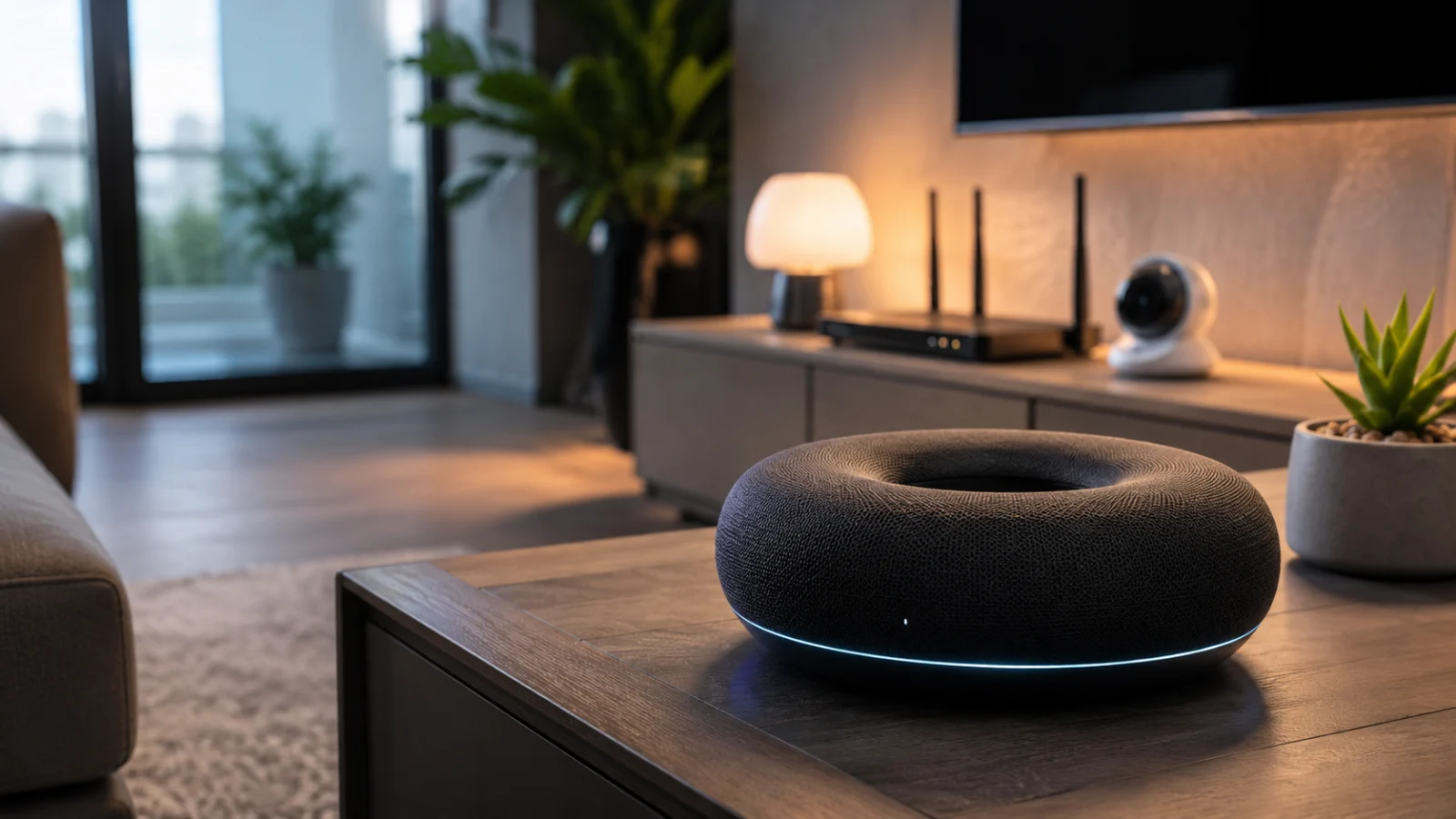
OpenAI’s device is reportedly designed to move, using motorized parts to feel “more alive” rather than sitting there like a static puck [3]. It’s expected to include a camera and other sensors, and it’s being built as a portable, screenless companion rather than a fixed hub [4][5]. Jony Ive’s design team is reportedly behind it, with a 2027 target [6].
None of that changes what you need this month. But it does tell you something important: every major player, OpenAI, Google, and Apple, is racing toward AI-native hardware that listens, watches, and reacts constantly [7][8]. Bloomberg reports Apple is preparing its own Siri AI smart home hub alongside refreshed Apple TV and HomePod mini hardware [7]. Google already shipped its answer, a new Home speaker with Gemini-powered features, its first new speaker since Nest Audio launched back in September 2020 [9][10]. The donut is just the most extreme preview of where this is all headed.
Start With the Question Marketing Won’t Answer: What Does It Actually Do When Things Go Wrong
Every smart home product launch leads with the demo. Perfect Wi-Fi, quiet room, ideal lighting. That’s not your house. Your house has a dead zone in the basement, three generations of devices, and a router that needs a reboot every few weeks.
Before you buy anything AI-powered for your home, ask how it performs under real conditions, not lab conditions. Does the assistant still respond fast when you’ve got 50 devices on the network? Does it break your existing routines, or does it quietly adapt? Android Central’s own hands-on with the new Google Home Speaker noted they kept it around for the sound quality even after mixed feelings on the AI upgrade itself [11]. That’s the kind of honest, split verdict you should be looking for, not a five-star score that ignores tradeoffs.
Here’s what I check first with any new AI home device:
- Response latency on a network with 20+ existing smart devices, not a clean test bench
- Whether existing automations and routines survive the migration or need to be rebuilt from scratch
- How it behaves with intermittent internet, since AI features often lean on cloud processing
- Camera and microphone data handling, especially for anything marketed as “always listening” or “always watching”
- Cross-ecosystem compatibility, meaning Matter support and whether it plays nice with gear you already own
The Nest Discontinuation Is a Preview of What’s Coming
If you own a Nest Audio or Nest Mini, you’re not hypothetically affected by this shift. You’re living it. Google has officially discontinued both devices [12], and the company’s new Home Speaker is the only current path forward for anyone wanting fresh hardware in that ecosystem. The August 2026 software update adds Gemini-powered Interactive Storytime, smarter timers, and expanded camera brand support [1].
That’s a lot of new capability bolted onto an aging install base. And it’s exactly the pattern you should expect to repeat with every ecosystem over the next few years: hardware gets replaced less often than the software running on it gets rewritten around AI.
Apple is in a similar holding pattern. Reports from Bloomberg and MacRumors point to a new Apple TV 4K, refreshed HomePod mini, and a Siri AI smart home hub all arriving close together, timed to Apple Intelligence [7]. Current Apple TV and HomePod inventory has reportedly been running low, which usually signals a launch is close [13]. If you’re a HomeKit power user with dozens of automations already built, the real question isn’t whether to buy now. It’s whether Apple Intelligence will actually fix the reliability issues you’ve already been living with.
 From the shopIt Worked Before the UPDATE$18.45Shop →
A Simple Framework for Reviewing Any AI Smart Home Device
I’ve built this out of years of testing hubs and speakers that all promised the same thing and delivered wildly different results. It works regardless of which company made the product.
1. Test the claim, not the demo
Companies show you the best-case scenario. Your job is to find the worst-case scenario and see what breaks. If a company claims a feature reduces false alerts, like Xiaomi’s Smart Camera 4 Max and its “unusual behavior detection” feature aimed at cutting notification noise [14], the only honest way to evaluate that is weeks of real household use, not a spec sheet.
2. Check what happens to your existing setup
New AI features rarely arrive in isolation. They usually mean a firmware update, a re-authentication, or a routine that quietly stops working. Ask what breaks before you ask what’s new.
3. Separate hardware quality from AI hype
A speaker can sound great and still have a mediocre assistant bolted onto it, or vice versa. Judge them separately. Don’t let one inflate your rating of the other.
4. Weigh privacy architecture, not just privacy policy
A camera-equipped, always-on AI device sitting in your living room or bedroom is a different category of risk than a speaker with a mute button. OpenAI’s rumored device reportedly includes a camera and sensors designed to make it feel more like a companion than a tool [4][5]. That’s worth genuine scrutiny, not just a checkbox in a privacy policy nobody reads.
What to Actually Do With Your Smart Home Right Now
You don’t need to wait for 2027 to make a smart decision today. You need a plan that works no matter which hub eventually wins.
If you’re Alexa-centric, keep an eye on Matter support rather than betting everything on Amazon’s next move. If you’re Google-centric and still on Nest Audio, the new Google Home Speaker is a real, available upgrade path with Gemini features already live [1][9], not a rumor you’re waiting on. If you’re Apple-centric, there’s a real case for holding off on a new HomePod purchase this month, given how close the refreshed lineup reportedly is [13][7].
And if you’re building a Home Assistant or Matter-first setup, you’re honestly in the best position of anyone. You’re not locked into a single company’s roadmap, which means a 2027 product from OpenAI, or whatever Apple ships this fall, can slot in later without forcing you to rebuild everything from zero.
Frequently Asked Questions
Should I wait until 2027 to buy any smart speaker?
No. OpenAI’s device is reportedly two years out and priced at $300 to $400 [1][2], well above typical smart speaker pricing. Waiting that long means missing years of usable upgrades from Google and Apple that are shipping now.
Is the new Google Home Speaker worth buying if I already have a Nest Audio?
Nest Audio and Nest Mini are officially discontinued [12], so if you want new hardware in the Google ecosystem, this is currently your only option. It brings Gemini-powered features like Interactive Storytime that Nest Audio never had [1].
Should I hold off on buying a HomePod or Apple TV right now?
Reports suggest a refreshed Apple TV 4K, HomePod mini, and a new Siri AI smart home hub are close to launch, tied to Apple Intelligence [13][7]. Low current inventory of existing models is another signal a launch is near [13]. If you can wait a few weeks, it’s reasonable to hold off.
What makes OpenAI’s speaker different from Alexa or Google Home?
It’s reportedly screenless, portable, and designed with moving parts meant to make it feel more alive rather than static [4][3]. It’s also expected to ship with a camera and additional sensors [5], a meaningfully different hardware approach than a fixed speaker on a shelf.
Where to Go From Here
The right move isn’t chasing every AI smart home headline as it breaks. It’s building a testing habit you can apply to whatever ships next, whether that’s Apple’s hub this fall or OpenAI’s donut in 2027. Start by auditing what you already own: what’s discontinued, what’s aging, and what actually needs replacing versus what just needs a software update. That audit will tell you more about your next purchase than any press release will.
Sources
- OpenAI’s new AI smart speaker will reportedly sell for … (techcrunch.com)
- OpenAI’s first device may be a $300 donut-shaped speaker … (tech.yahoo.com)
- OpenAI’s expensive smart speaker will use moving parts to seem ‘more alive’ (arstechnica.com)
- OpenAI’s first hardware device is reportedly a screenless speaker … (techcrunch.com)
- OpenAI’s first device will be a portable speaker with a … – 9to5Mac (9to5mac.com)
- Jony Ive’s First OpenAI Device Will Be Smart Speaker With Camera … (macrumors.com)
- Apple Set to Make Big Smart Home Push With Siri AI at Center (bloomberg.com)
- OpenAI developing AI devices including smart speaker … – Reuters (reuters.com)
- Google is upgrading almost every Nest security device – and there’s a new Home speaker, too (zdnet.com)
- The Google Home Speaker is a slap in the face to Nest … (androidauthority.com)
- I upgraded to the new Google Home Speaker for the AI, but I’m keeping it for the sound (androidcentral.com)
- New Apple TV and HomePod Mini Are ‘Nearly Ready’ to Launch, New Siri … (forums.macrumors.com)
- Report: New Apple TV, HomePod mini set to launch this fall – 9to5Mac (9to5mac.com)
- Xiaomi introduces smart camera capable of detecting unusual behavior (tech.news.am)
Researched from 36 sources.
Independently verified
The statistics above were independently corroborated against these sources: