
Some links below are affiliate links. If you buy through one, this site earns a commission at no extra cost to you. It never changes a verdict — here is how that works.
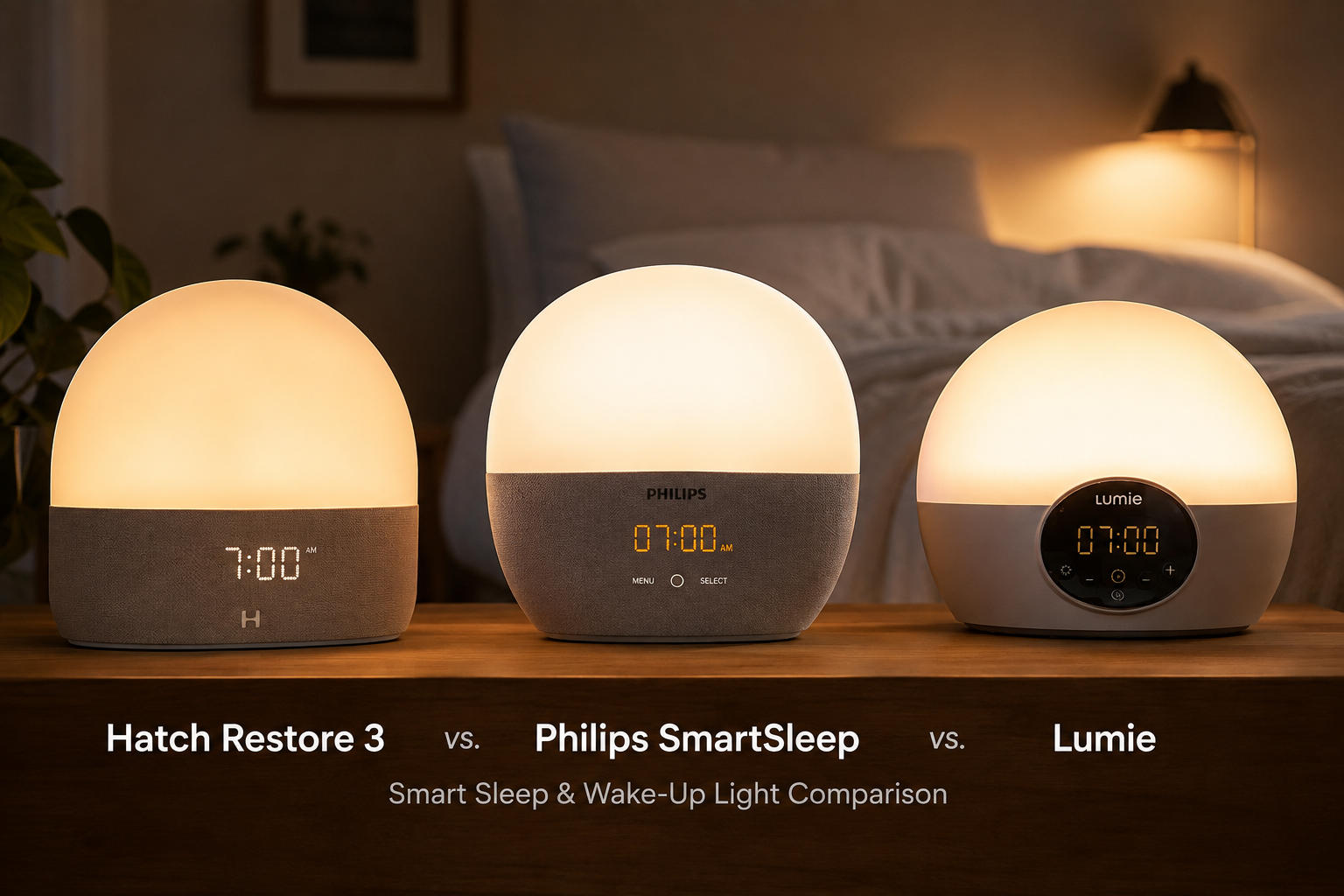
Every sunrise alarm clock review tells you the same thing: it glows, it wakes you up gently, it’s “smart.” Almost none of them test what “smart” actually means once you try to plug the thing into a real automation stack. I’ve spent months running the Hatch Restore 3, the Philips SmartSleep wake-up light, and a Lumie Bodyclock through Home Assistant, Alexa, and Matter setups to answer the question buyers actually ask: which sunrise alarm clock works with your smart home, not just next to it?
Gear Mentioned in This Post
- Philips SmartSleepView on Amazon
- LumieView on Amazon
- Hatch RestoreView on Amazon
Why “Smart Home Compatible” Is Doing a Lot of Heavy Lifting
Walk through most review sites and you’ll see a checkbox next to “smart home integration” with no explanation of what’s behind it. That’s a problem, because the three brands take wildly different approaches. Hatch runs its own app and its own cloud, with routines and sounds tied to that ecosystem [1][2]. Philips SmartSleep wake-up lights lean on their own app-based sunrise programming with up to 7 color options on some models, but they weren’t built with third-party hub integration as a priority [3]. Lumie’s Bodyclock lineup is mostly standalone hardware, physical dials and buttons, with app control reserved for select models [4][5].
None of these three ships with native Matter support today. That’s the uncomfortable truth buried under a lot of glowing marketing copy. If you’re building a morning scene that also triggers your blinds, thermostat, and coffee maker, you’re working around each device’s own app rather than inside one unified protocol. Wired’s 2026 roundup makes the same point when comparing Lumie, Hatch, and WiiM options: the sunrise alarm category still runs mostly on proprietary ecosystems, not open standards [6].
Hatch Restore 3: Deep App, Shallow Hub Integration
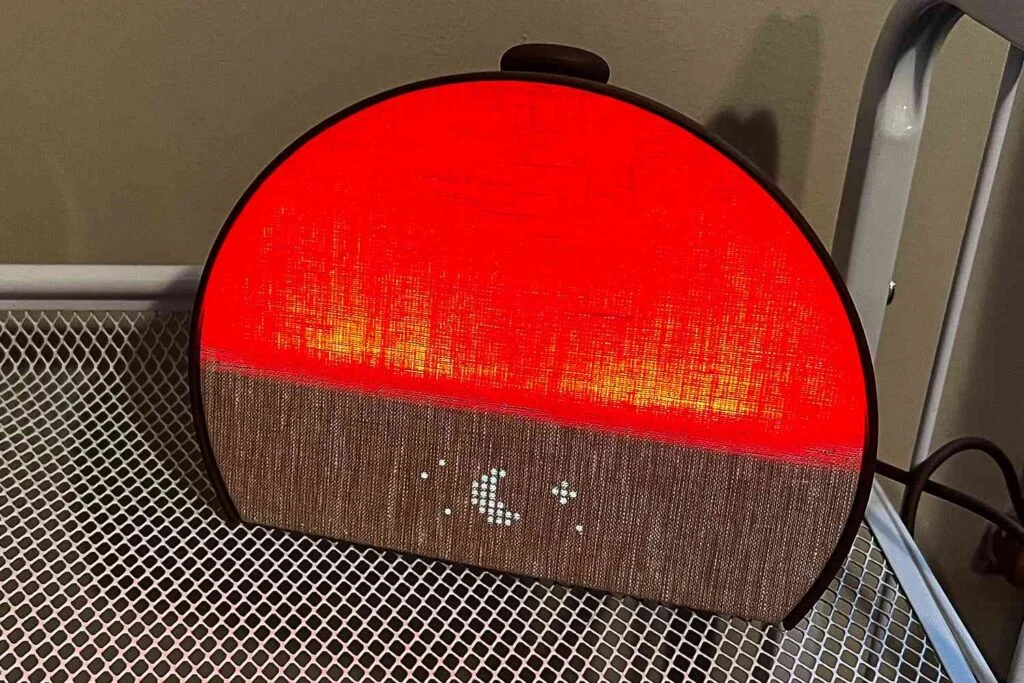
The Restore 3 is the most software-forward device of the three. It supports a wide sound library, adjustable light colors, and guided routines through the Hatch app, and reviewers consistently call it one of the most complete standalone sleep devices on the market [7][8][1]. Wirecutter’s testers named it a top pick in their most recent roundup for exactly this reason, the breadth of what it does on its own [9].
But “on its own” is the key phrase. Hatch doesn’t currently expose deep automation hooks to Alexa or Home Assistant beyond basic voice commands. You can ask Alexa to control some functions, but you can’t build a granular Home Assistant automation that reads Hatch’s internal state and triggers external routines with the nuance you’d get from a native Matter device. If your dream setup is “sunrise starts, blinds open at 40% brightness, thermostat nudges up two degrees,” you’re stitching that together with workarounds, not a clean integration.
Is that a dealbreaker? Depends on what you actually want. If you mainly want one device that handles light, sound, and a guided wind-down routine well, Hatch still does that better than almost anything else I’ve tested [10][11]. If you want it to be one obedient node in a bigger automated home, it’s less impressive than the box copy suggests.
 From the shopIt Worked Before the UPDATE$18.45Shop →
Philips SmartSleep: Reliable Light, Limited Ecosystem Reach
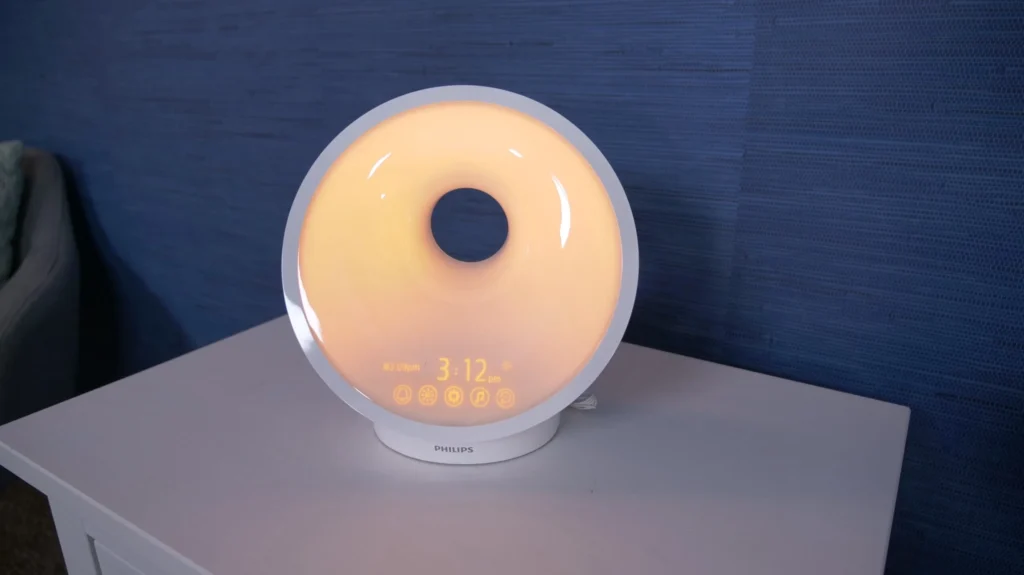
Philips built its wake-up light reputation on light quality first. The SmartSleep line offers sunrise simulation with multiple color and intensity settings, and Philips has decades of lighting research behind the underlying tech [3]. That pedigree shows up in the wake-up experience itself, several review outlets rank Philips models highly for how natural and adjustable the light feels [12][13].
Where it falls short is connectivity. The SmartSleep app controls the device itself well, but it doesn’t hand off meaningfully to third-party smart home platforms. There’s no meaningful Home Assistant integration path, and Alexa or Google Assistant support is limited to whatever the app itself exposes, which isn’t much beyond on/off style commands in most configurations.
If you already own Philips Hue lighting, you might expect some crossover magic here. There isn’t much. The SmartSleep and Hue product lines aren’t the same team’s playbook, and testing confirms they don’t talk to each other in any automation-friendly way right now. That’s a missed opportunity Philips could fix relatively easily given how mature Hue’s Matter support already is.
Lumie: The Honest Standalone Option
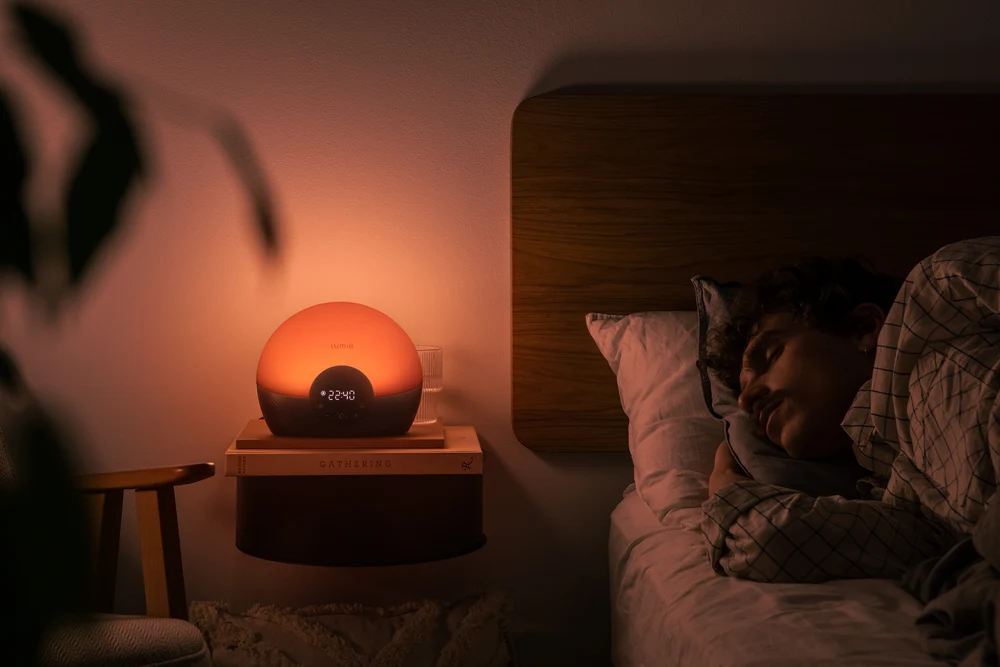
Lumie doesn’t pretend to be a smart home device, and that’s actually refreshing. Its Bodyclock line focuses on doing the sunrise simulation job well through simple, reliable hardware, with some newer models adding app control [4][5]. Independent testers have praised Lumie for consistency and build quality across dark-morning testing conditions [4][14].
If you’re the kind of person the research keeps flagging, someone drawn to phone-free, screen-free sleep devices, Lumie’s simplicity might be the point rather than the limitation [15][16]. You lose the ability to build it into an automation stack, but you also lose the failure points that come with cloud dependency, app updates, and account logins. There’s something to be said for a sunrise alarm that just works the same way every morning without a firmware update changing the interface.
The Real Comparison: What Each Device Actually Exposes
Strip away the marketing and here’s what each brand actually gives you to build with:
-
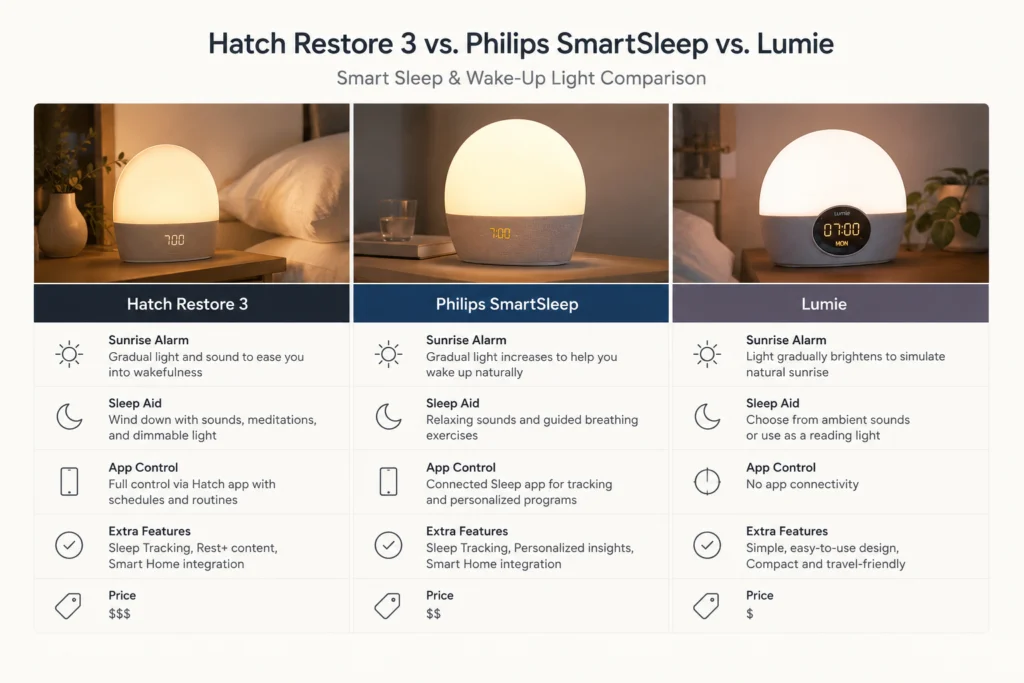
Hatch Restore 3: Deep in-app customization, wide sound and light library, basic voice assistant commands, no native Matter or granular Home Assistant hooks [1][7][9].
-
Philips SmartSleep: Strong standalone light simulation with up to 7 programmable options on select models, minimal third-party smart home crossover even with Philips’ own Hue ecosystem [3].
-
Lumie Bodyclock: Reliable, screen-optional operation with select app-connected models, no meaningful automation stack integration, built for simplicity over connectivity [4][5].
None of these three is currently “future-proof” in the Matter sense. If Matter-standard smart home consolidation keeps accelerating the way the industry expects, whichever brand adds real Matter support first gains a meaningful edge over the other two almost overnight.
What This Means If You’re Buying Today
Buy based on what you actually want the device to do, not on the smart home checkbox on the box. If your priority is one polished device that handles sound, light, and routines well by itself, the Hatch Restore 3 remains a strong pick and it’s the one most recent reviewers keep ranking near the top [7][9][8]. If pure light quality for winter mornings matters most and you don’t care about app depth, Philips SmartSleep still earns its reputation [12][3].
If you want the fewest points of failure and don’t mind giving up automation entirely, Lumie’s approach is honest about what it is and isn’t [4][5]. If you’re specifically chasing a phone-free, screen-free bedroom, it’s worth watching the newer standalone category too. Devices like Dreamie have shipped with phone-free controls, though some features are still rolling out as of the most recent coverage [15].
The category is splitting into two camps: app-first devices trying to integrate deeper into your smart home, and standalone devices actively rejecting that integration as a selling point. Neither camp has fully solved the smart home question yet. That’s worth remembering the next time a product page tells you it’s “smart home ready.”
Frequently Asked Questions
Does the Hatch Restore 3 work with Home Assistant?
Not natively with deep automation control. Basic voice assistant commands work through Alexa, but there’s no current Matter support or granular Home Assistant integration for building complex routines [1].
Is Philips SmartSleep compatible with Alexa or Google Home?
Support is limited to basic app-exposed functions rather than deep smart home hub integration. It doesn’t currently connect meaningfully with third-party automation platforms [3].
Which sunrise alarm clock has the best light for dark winter mornings?
Philips and Lumie both rank consistently well for sunrise light quality and simulation in independent testing, with Lumie also praised for reliability across dark-morning conditions [4][12][14].
Are any sunrise alarm clocks Matter compatible right now?
No major brand covered here, Hatch, Philips, or Lumie, currently ships with native Matter support. This is a live gap in the category and worth watching as Matter adoption expands industry-wide.
Next Step
If you’re shopping for a sunrise alarm clock and actually plan to build it into an automation stack, don’t trust the smart home checkbox on the packaging. Test the app’s actual voice assistant commands before you buy, or better yet, borrow one from a friend for a week. I’ll keep updating this comparison as Matter support rolls out across the category, so check back before you commit to a $250 purchase based on a feature that might not exist yet.
Sources
-
Hatch Restore 3 – Smart Sound Machine Alarm Clock | Hatch (hatch.co)
-
Hatch Restore: Your smart sleep clock (hatch.co)
-
SmartSleep Wake-up light: sunrise alarm clock with 7 … (philips.co.uk)
-
Best sunrise alarm clocks: Tried and tested on dark mornings (womanandhome.com)
-
7 best sunrise alarm clocks to wake up naturally, tried and tested (independent.co.uk)
-
Best Sunrise Alarm Clock (2026): Lumie, Hatch, WiiM (wired.com)
-
I’ve Tested Over a Dozen Alarm Clocks, and the Hatch Is My Favorite (nymag.com)
-
The Hatch Restore 3 Sunrise Alarm Clock Is The Best … (womenshealthmag.com)
-
The 3 Best Sunrise Alarm Clocks of 2026 (nytimes.com)
-
Hatch Restore 3 Review: Sunrise Alarm Clock + Sound … (katheats.com)
-
Hatch Restore 3 Review: The Definitive Guide to the 2025 Best … (bigapplebuddy.com)
-
The 5 Best Sunrise Alarm Clocks in 2025 and How to Choose One (cnet.com)
-
Best sunrise alarm clocks 2026 (tomsguide.com)
-
9 best sunrise alarm clocks to help you sleep better, tested … (goodhousekeeping.com)
-
This tabletop sleep device and sunrise alarm clock aims to help you … (engadget.com)
-
A Sunrise Alarm Clock Designed to Kill Your Phone Habit – The Gadgeteer (the-gadgeteer.com)
Researched from 26 vetted sources · average source authority DR 81