
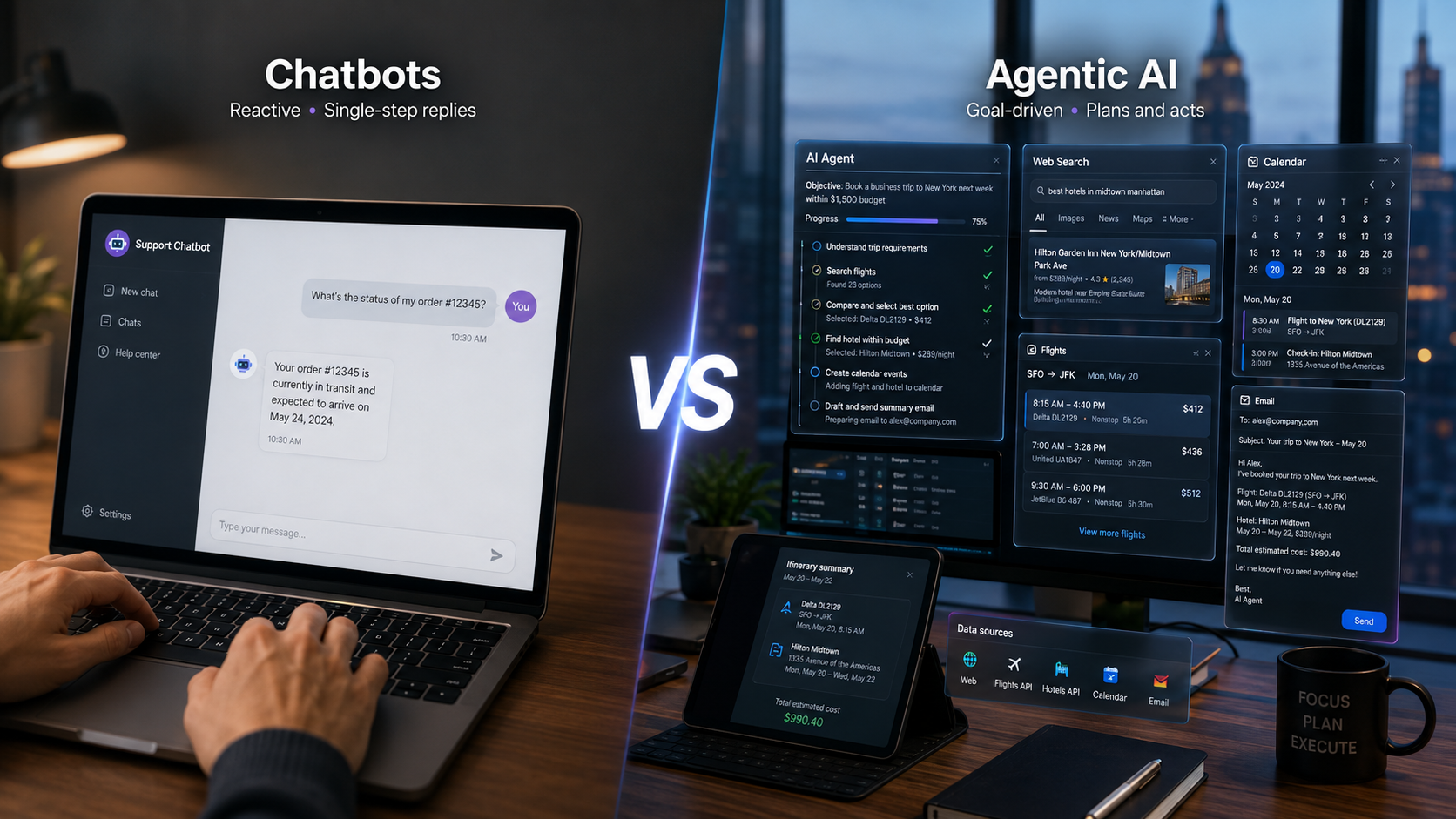
Here’s something that should catch your attention: the AI skill everyone spent two years learning, writing a good prompt, is already losing value. What’s replacing it? The ability to design, supervise, and fix AI systems that act on their own. I’ve spent the last several months running agentic AI tools through my smart home, my content pipeline, and my daily workflow. What I found changed how I think about which tech skills are actually worth building in 2026.
What “Agentic AI” Actually Means (And Why It’s Different)
A chatbot answers questions. You type something, it types something back, and the conversation ends when you close the tab. That’s it. It doesn’t do anything unless you ask it to, and it definitely doesn’t remember your goals from one session to the next.
Agentic AI works differently. It plans a sequence of steps, executes them, and adjusts based on what happens along the way, often with little or no human checking in [1]. Think about the difference between asking a chatbot “what’s the best way to secure my house before a trip” and telling an agent “I’m leaving for a week” and having it lock the doors, adjust the thermostat, reroute your security camera alerts, and dim your lights on a randomized schedule, all without you touching another app.
That second scenario isn’t hypothetical. It’s the exact kind of task agentic systems are being built to handle right now, and it’s why Deloitte frames this shift as preparation for what it calls a “silicon-based workforce” of software agents working alongside humans [2]. That phrase sounds dramatic. After testing this stuff hands-on, I don’t think it’s an exaggeration.
Why This Shift Is Happening Now
Smart home tech is a good lens for watching this play out in real time. For years, automation meant “if this, then that.” Motion sensor triggers light. Thermostat drops at 10pm. Useful, but rigid. You had to think through every scenario yourself and wire it up manually.
Agentic systems flip that. Instead of programming a fixed rule, you state an intent and the system figures out the steps. That requires the AI to reason about context, sequence actions, and course-correct when something doesn’t go as planned, which is a fundamentally different kind of software than what powered smart homes even two years ago.
The same shift is happening in office work. People are moving past asking a chatbot to draft an email and are instead handing agents entire workflows: scheduling, follow-ups, first-pass research, content calendars. The appeal is obvious. The risk is that these systems are still fragile in ways a simple chatbot never was, because a chatbot that gives a bad answer just gives you a bad answer. An agent that takes a wrong action has already done something in the real world.
 From the shopPermanently in BETA$18.45Shop →
The New Skill Nobody’s Talking About Enough
Prompt engineering had its moment. It’s still useful, but it’s becoming table stakes rather than a differentiator. The more valuable skill now is knowing how to build, supervise, and debug an autonomous system that’s making decisions without you standing over its shoulder.
Job postings are already reflecting this. Titles and required skills increasingly reference AI agent building, AI workflow design, and AI operations, not just “knows how to use ChatGPT” [3][4]. Employers aren’t just looking for people who can talk to a model well. They want people who understand how these systems fail, and how to design guardrails before something goes wrong.
That’s a meaningfully different skill set. Here’s what it actually involves:
- Observability: knowing what an agent is doing at every step, not just seeing the final output
- Permissioning: deciding exactly which actions an agent can take without approval, and which need a human to sign off
- Rollback design: building a way to undo an action fast when the agent gets something wrong
- Failure-mode thinking: anticipating how a multi-step plan can go sideways before it actually does
None of that is “prompting.” It’s closer to systems engineering than chatting with software. And it maps almost exactly onto what I’ve been doing, without fully realizing it, every time I’ve tested an automation hub in my own house.
What I Learned Handing Real Control to an AI Agent
I’ve run agentic tools against my smart home setup and against my content production schedule, and the lessons overlapped more than I expected. In both cases, the agent was genuinely good at multi-step planning. It could take a loose instruction and turn it into a sequence of actions that mostly made sense.
Where it struggled was judgment calls at the edges. Should the agent unlock a smart lock because it inferred I was arriving home? Should it reschedule a meeting because it decided my calendar looked “too full”? Those are the moments where autonomy without oversight gets uncomfortable fast.
My rule after testing this for months: some device classes and some decisions are fine to fully automate, and others aren’t. Lighting, thermostats, and routine scheduling are low-risk. Locks, garage doors, cameras, and anything involving sending a message on your behalf as another human deserve a human checkpoint, at least for now.
This isn’t caution for caution’s sake. It’s the same operational thinking that companies are now paying for when they hire someone who understands AI workflow design. If you’ve ever debugged why an automation triggered at the wrong time, or built in a manual override for a device you didn’t fully trust, you’ve already been practicing the skill that’s showing up in job descriptions.
How to Build This Skill Without an Engineering Degree
You don’t need a computer science background to start developing agent-supervision skills. You need repetition, curiosity, and a willingness to let something break in a low-stakes environment.
Start small. Give an agent a real but bounded task: manage your smart plugs on a schedule, or draft your weekly newsletter outline based on a folder of notes. Watch what it does, not just what it produces. When it makes a mistake, don’t just fix the output. Ask why the agent chose that path, and figure out what guardrail would have caught it earlier.
Over time, you build an instinct for where these systems are strong (executing clear, well-scoped plans) and where they’re weak (ambiguous judgment calls, edge cases, anything involving real-world consequences). That instinct is exactly what MIT Sloan researchers point to when describing agentic AI’s core promise and its core risk: systems that can act with real autonomy also need real accountability structures around them [1].
Where This Is Headed for Your Career
I don’t think prompting disappears as a skill. But it stops being the ceiling. The professionals who’ll have leverage over the next few years are the ones who can look at an agentic system and immediately ask the right questions: What can this act on without approval? What happens if step three fails? Who gets notified when it does something unexpected?
Those aren’t AI questions, really. They’re operations questions applied to a new kind of software. If you’re already the person in your house or your office who thinks through failure modes before flipping a switch, you’re closer to job-ready for this shift than you might realize.
Companies are hiring for AI operations and agentic workflow design because they’ve discovered these tools are powerful and unreliable in equal measure [3][4][2]. Somebody has to sit between the raw capability and the actual business risk. That’s not a role you land by getting better at prompts. It’s a role you build by getting hands-on with real systems, watching them fail, and learning what stops the failure from spreading.
Frequently Asked Questions
Is agentic AI just a rebranding of chatbots?
No. A chatbot responds to input in a single exchange. An agentic system plans a sequence of steps, executes them, and adjusts along the way with minimal human involvement [1]. The difference is action versus conversation.
Do I need to learn to code to work with agentic AI?
Not necessarily. Many of the most in-demand skills right now are around workflow design, permissioning, and oversight rather than pure coding [3][4]. Understanding how to structure and supervise a system matters as much as building one from scratch.
Which smart home tasks are safe to hand to an AI agent right now?
Based on hands-on testing, routine and low-risk actions like lighting schedules and thermostat adjustments are generally safe to automate fully. Locks, garage doors, and cameras are worth keeping a manual confirmation step around, at least until you’ve watched the system handle edge cases reliably.
What’s the single most valuable skill for the agentic AI job market?
Knowing when to pull the plug. Employers increasingly want people who can build guardrails, spot failure modes early, and design rollback options, not just people who can write a clever prompt [3][4][2].
Your Next Step
If you want to actually build this skill instead of just reading about it, pick one small, bounded task in your own home or workflow and hand it to an agent this week. Watch it closely. Note where it surprises you, good or bad. That’s the same muscle companies are hiring for, and there’s no faster way to build it than testing it yourself.
Sources
- Agentic AI, explained (mitsloan.mit.edu)
- The agentic reality check: Preparing for a silicon-based workforce (deloitte.com)
- Agentic AI Skills Gap: How to Become an AI Agent Builder in 2026 (cloudxlab.com)
- How to Become an AI Agent Engineer in 2026 (Skills, Salary & Roadmap) (skillscouter.com)
Researched from 4 vetted sources · average source authority DR 71