
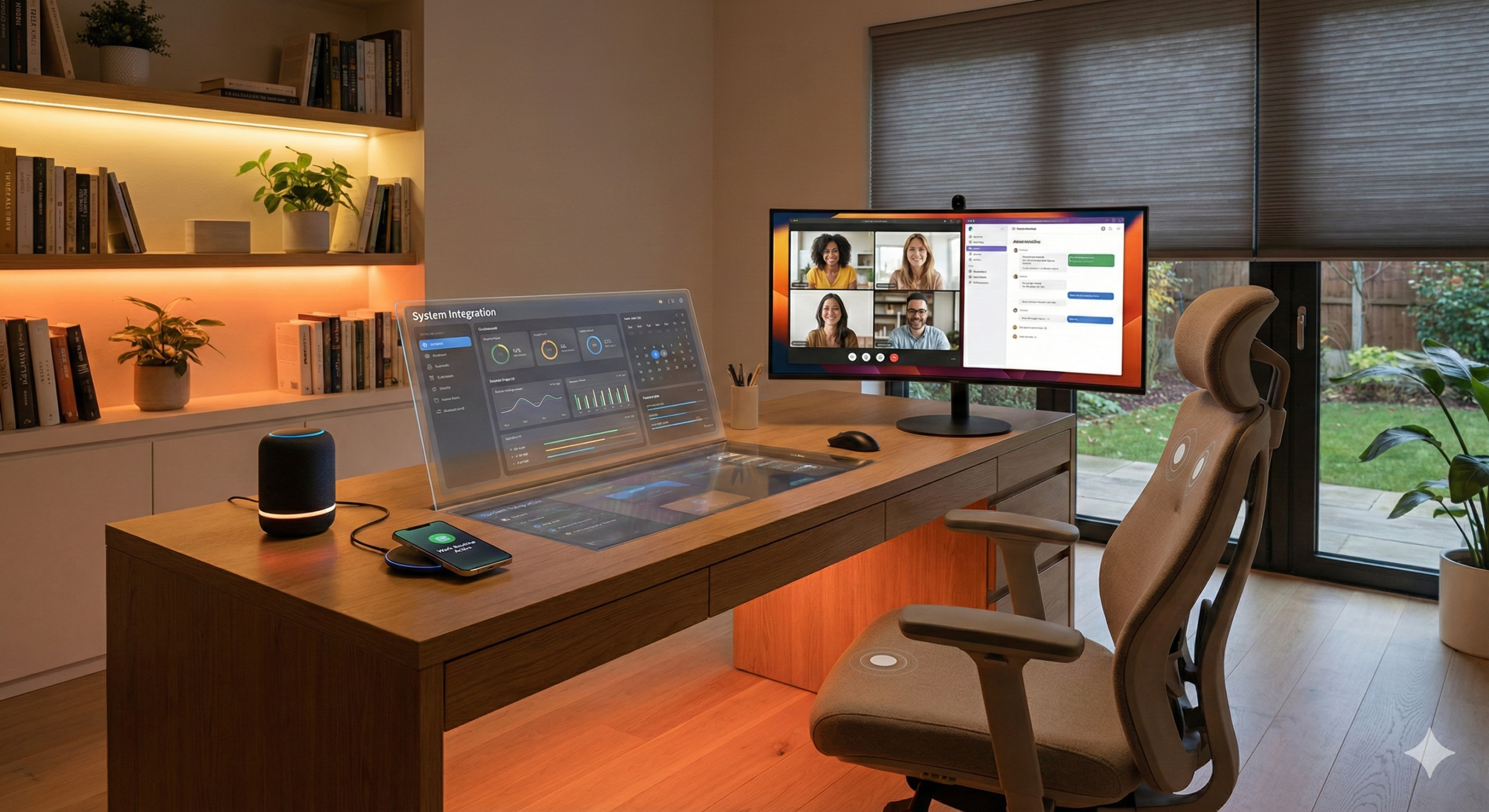
In 2026, the concept of a “home office” has shifted from a static room with a desk to a dynamic, responsive ecosystem. We are no longer just “using” devices; we are orchestrating them. The keyword for this year is System Integration. It is the difference between having five different apps to control your office and having a single, unified environment that anticipates your needs before you even sit down.
The “Automated Office” isn’t about gadgets; it’s about removing the friction of administrative and environmental tasks so you can focus on high-value work. This guide explores the “Pillar” of the modern workspace: a fully integrated, smart home office designed for peak efficiency.
The Foundation: Understanding System Integration in 2026
Before buying a single bulb or sensor, you must understand the “glue” that holds a smart office together. In 2026, Matterand Thread have become the gold standards for interoperability.
The Connectivity Hierarchy
| Protocol | Role in the Office | Why It Matters |
| Matter 2.0 | The Universal Language | Ensures your Apple, Google, and Amazon devices talk to each other locally. |
| Thread | The Mesh Backbone | Low-latency, low-power mesh networking that doesn’t clog your Wi-Fi. |
| Wi-Fi 7 | The Data Highway | Crucial for high-bandwidth tasks like 8K video conferencing and cloud rendering. |
| Local AI | The Brain | Systems like Josh.ai or Samsung EdgeAware process commands locally for privacy. |
Export to Sheets
Pro Tip: Always prioritize “Matter-over-Thread” devices. They offer the fastest response times and don’t rely on the cloud, meaning your office stays “smart” even if your internet goes down.
The Core: The Smart Desk Ecosystem
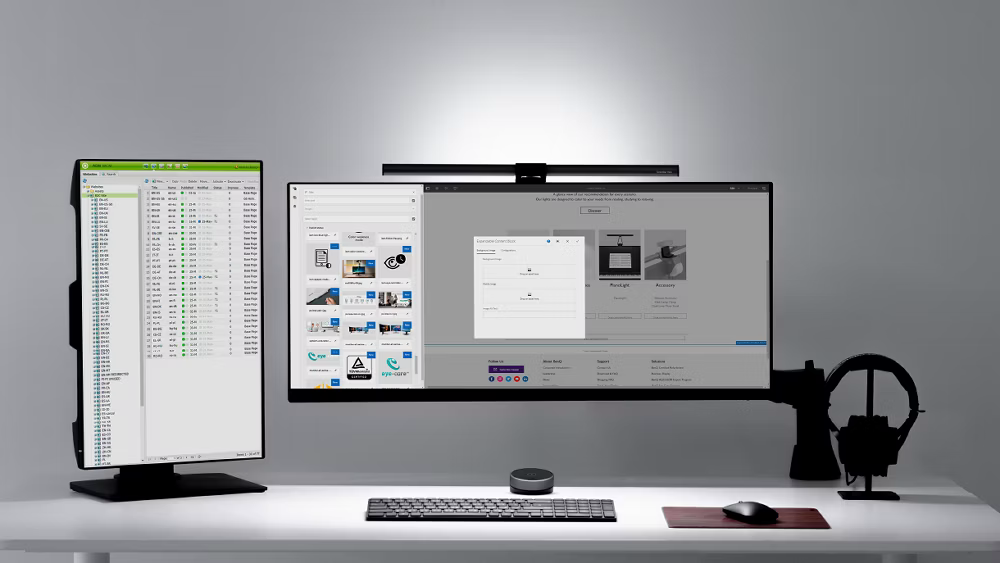
The desk is the cockpit of your professional life. In 2026, it is no longer just a piece of wood with legs; it is a sensor-laden hub for system integration.
1. The Uplift V3 Standing Desk
The Uplift V3 Standing Desk remains the gold standard. In 2026, the integration with smart health apps has deepened. It doesn’t just move up and down; it coordinates with your Apple Watch or Oura Ring to suggest height changes based on your actual fatigue levels.
2. BenQ ScreenBar Halo
Lighting is often overlooked, but the BenQ ScreenBar Halo integrates with ambient sensors to automatically adjust color temperature based on the time of day. This supports your circadian rhythm, keeping you alert during the “9-to-5” and helping you wind down if you’re working late on a project.
Environmental Automation: Lighting, Climate, and Air
True system integration means your office environment reacts to your calendar. Imagine this: Five minutes before a scheduled Zoom call, your smart shades lower to prevent glare, your HVAC kicks on to cool the room by two degrees (knowing your PC will run hot), and your “Busy” light outside the door turns red.
Smart Lighting & Shading
- Lutron Caséta Wireless: The Lutron Caséta Smart Start Kit is essential for integrating traditional overhead lighting into your smart ecosystem.
- Nanoleaf Elements: For aesthetic and functional backlighting that mimics natural wood textures, use Nanoleaf Elements. They can be programmed to flash a specific color when you receive a high-priority email or a Slack message.
Air Quality & Climate
High CO2 levels lead to brain fog. Integrating a smart air purifier like the Dyson Purifier Cool TP07 allows your office to “breathe” for you. By 2026, these devices use AI to predict “pollution events” based on your local weather and your schedule (e.g., more people in the room for a meeting).
The Professional AI Edge: Audio & Video Integration
With “Physical AI” now a reality, your camera and microphone are more than just peripherals; they are intelligent agents.
The “Deep Focus” Setup
- Logitech MX Brio 705: The Logitech MX Brio uses AI-driven framing and light correction that integrates directly with macOS and Windows at a system level.
- Shure MV7+: For audio, the Shure MV7+ provides real-time noise suppression. In a 2026 automated setup, this can be linked to your smart home’s “Meeting Mode” to automatically mute external sirens or lawnmowers via software triggers.
Tutorial: How to Set Up Your First “Work Mode” Automation
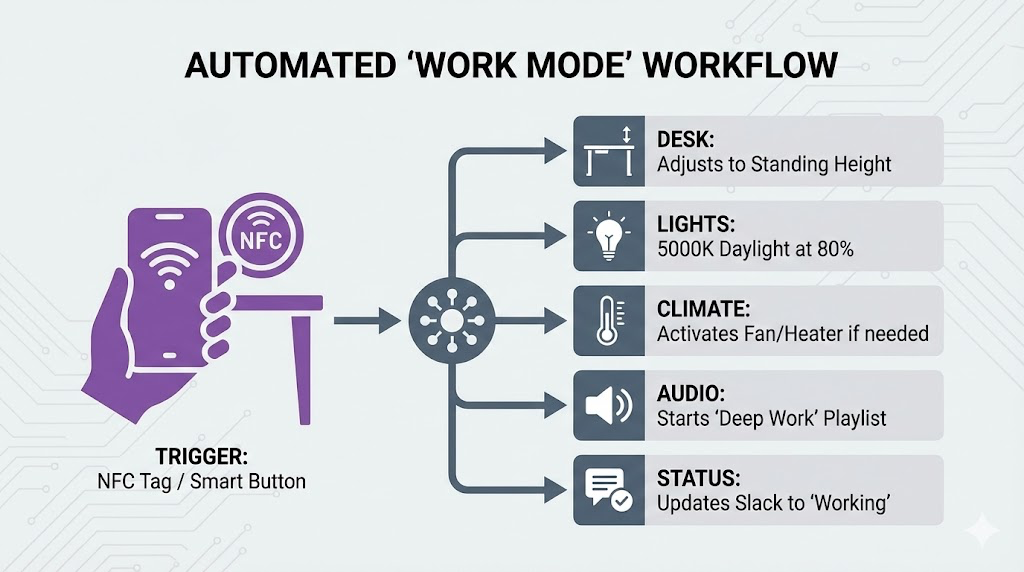
The goal of system integration is to create “Scenes.” Here is a step-by-step guide to creating a “Start Work” automation using a Hub (like Home Assistant or Apple Home).
Step 1: Define the Trigger
The best trigger is an NFC tag hidden under your desk or a smart button like the Flic 2 Buttons.
Step 2: The Action Sequence
When you tap your phone to the NFC tag:
- Desk: Moves to your preferred “Morning Standing” height.
- Lighting: Office lights turn to 5000K (Daylight) at 80% brightness.
- Climate: Smart plug for a space heater or fan activates if the temperature is outside a specific range.
- Audio: Your “Deep Work” Spotify playlist starts on your Sonos Era 100.
- Status: Your Slack status is automatically updated to “Working.”
Power & Cable Management: The Invisible Backbone
You cannot have a smart office if you are tripping over dumb wires. System integration extends to how you power your devices.
Smart Power Management
The Kasa Smart Power Strip is a must-have. By integrating this into your hub, you can:
- Monitor Energy Usage: See exactly how much power your dual-monitor setup is pulling.
- Phantom Power Kill: Automatically cut power to peripherals (printers, extra monitors) after 7 PM to save energy.
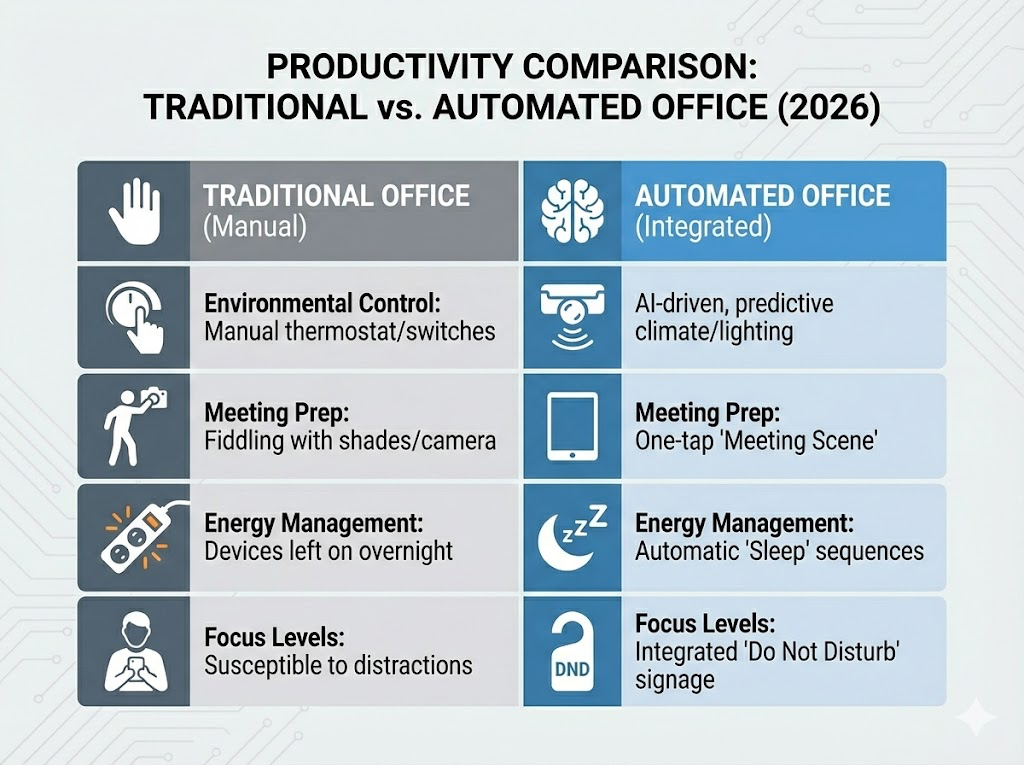
Productivity Comparison: Traditional vs. Automated Office
| Feature | Traditional Office | 2026 Automated Office |
| Environmental Control | Manual thermostat/switches | AI-driven, predictive climate/lighting |
| Meeting Prep | Fiddling with shades/camera | One-tap “Meeting Scene” |
| Energy Management | Devices left on overnight | Automatic “Sleep” sequences |
| Focus Levels | Susceptible to distractions | Integrated “Do Not Disturb” signage |
| Ergonomics | Set it and forget it | Dynamic reminders based on biometrics |
Export to Sheets
Frequently Asked Questions (FAQ)
What is the best smart home ecosystem for a home office in 2026?
While Apple Home is the most secure, Home Assistant is currently the leader for power users who want deep system integration. However, for most users, Amazon Alexa offers the widest device compatibility and the most robust “Routines” for office tasks.
Is Matter really necessary for my office?
Yes. Matter ensures that if you switch from an iPhone to an Android (or vice versa), your expensive smart shades and lights will still work perfectly. It future-proofs your investment.
How do I automate my office on a budget?
Start with a Smart Plug and a single Motion Sensor. Program the light to turn on when you enter the room and off after 10 minutes of no movement. This simple automation pays for itself in energy savings.
Does a smart office improve productivity?
According to 2025 studies, users in integrated smart environments reported a 15% increase in “Deep Work” hours due to the reduction in environmental distractions and manual task management.
Conclusion: Building for the Long Game
The ultimate 2026 smart home office is a reflection of your workflow. By focusing on system integration, you aren’t just buying toys; you are building a professional toolset. Whether it’s the Uplift V3 desk moving to keep you healthy or Lutron lighting keeping you focused, every piece of tech should serve a single purpose: making your best work easier to achieve.
Start small, focus on the protocols (Matter/Thread), and slowly build an environment that works as hard as you do.
Disclaimer: This article contains affiliate links. If you purchase a product through one of these links, I may earn a small commission at no extra cost to you.
