
Some links below are affiliate links. If you buy through one, this site earns a commission at no extra cost to you. It never changes a verdict — here is how that works.
Picture a buyer standing in front of a $4,300 strength machine, credit card in hand, about to sign up for a workout system that promises to change how they train. Nobody in that moment is thinking about what happens if the company goes under, changes its pricing, or decides your hardware isn’t worth supporting anymore. But that’s exactly the question you need to answer before you buy a smart home gym. I’ve spent years auditing smart home hubs for this same failure mode: expensive hardware, a required subscription, and a company that can quietly change the deal whenever it wants. Smart gyms run the exact same playbook, and almost nobody is asking the right questions before they buy.
Gear Mentioned in This Post
- WhoopView on Amazon
Why Smart Gyms Are Just Smart Home Hubs With Weights
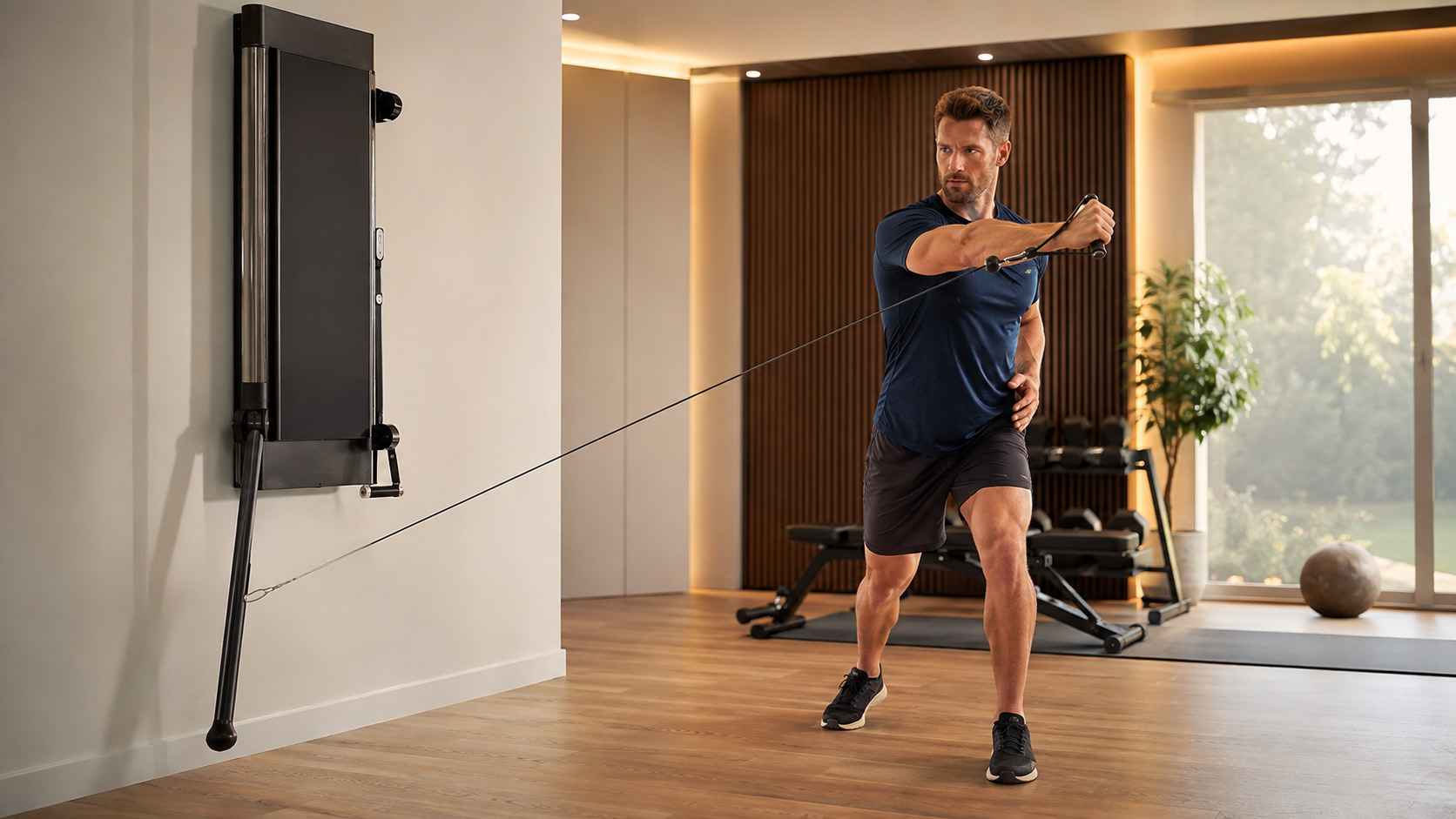
Strip away the sweat and the marketing, and a connected gym is a hub. It’s a piece of hardware that talks to a server you don’t control, running software you don’t own, gated by a subscription you’re required to keep paying. Tonal charges $4,295 for hardware and requires a mandatory $59.95 monthly membership with a 12-month minimum commitment, and the company itself says the AI coaching simply doesn’t work without it. That’s not a bonus feature behind a paywall. That’s the entire product held hostage.
Peloton runs the same structure. Its bikes and treads have only limited functionality without the $49.99 monthly All-Access Membership, and the company’s own annual report confirms that full content access requires a paid subscription tier [1][2]. You’re not buying a bike. You’re buying a permanently metered relationship with a media company that happens to sell exercise equipment.
The Real Cost Nobody Puts on the Price Tag
Sticker prices are the least honest number in this category. A Tonal buyer looking at $4,295 in hardware is actually signing up for roughly $5,804 in year-one costs once you add the mandatory membership on top. A Peloton Bike listed at $1,445 turns into an estimated $3,245 over three years once you factor in the required $49.99 monthly fee, and that’s before tax, accessories, or delivery.
Here’s what makes this worse: the subscription band across the entire category has basically standardized, which tells you it’s not competitive pressure keeping prices in check. Hydrow runs $50 a month. Echelon Premier runs $39.99. Tempo runs $39 after the first year. iFIT Pro sits at $39. When five different companies selling five different machines all land in the same $39-to-$60 monthly range, that’s not coincidence. That’s an industry that has agreed, implicitly, on how much recurring revenue it can extract before people push back.
And the market is pushing back. Reviewers covering the category note that the subscription model is the single biggest complaint from smart gym owners, and it’s specifically why subscription-free machines like the AEKE K1 are gaining traction [3]. Three companies now, AEKE, MAXPRO, and SQUATZ, offer lifetime free access with no monthly fee at all [3]. That matters more than it sounds. It proves lock-in isn’t a technical requirement of connected fitness hardware. It’s a business decision, and you should treat every mandatory subscription as a choice the company made, not a rule of physics.
 From the shopIt Worked Before the UPDATE$18.45Shop →
What Happens When the Company Changes Its Mind
Ask any smart home hub owner what happens when a manufacturer pivots, and they’ll tell you a war story. Smart gyms have their own version, and it’s already happened.
Mirror, the workout mirror acquired by Lululemon, shut its hardware business down entirely and pivoted to a software-only Studio service [4]. Owners who’d paid full price for a physical mirror were left with a company that no longer wanted to be in the hardware business. Reviews from before the shutdown had already flagged the platform’s content depth and value as inconsistent compared to competitors [5], which in hindsight looks like an early signal that the underlying business wasn’t stable.
This isn’t a hypothetical scare tactic. It’s the single clearest case study of what smart gym buyers are actually exposed to: a company can decide, at any point, that supporting your hardware no longer fits its strategy. Under Armour did something similar years earlier, disabling premium features on its connected fitness gear after acquiring and then abandoning a fitness app business [6], a pattern that should sound familiar if you’ve followed smart home hub discontinuations. The equipment doesn’t get worse. The company just stops caring whether it still works.
Tonal’s own recent moves are worth watching too. Under a new CEO, the company launched a rental program, $279 a month for the newer Tonal 2 unit, $219 a month for a refurbished original, both bundling in the membership [7][8]. That’s not a company backing away from subscription dependency. That’s a company doubling down on recurring revenue as the core of its model, which tells you where its incentives point if it ever has to choose between hardware buyers and monthly billing.
The Data Portability Question Nobody Will Answer
Here’s the part of this audit that should worry you most, and it’s the part almost nobody talks about. When you ask a smart home hub company how to export your automation data if you switch platforms, you at least get a shrug and a half-answer. Ask a smart gym company the same question about your workout history, your strength progression, your heart rate data over three years, and you’ll mostly get silence.
There’s a real legal standard for this. GDPR’s data portability rules give people the right to receive their personal data in a structured, commonly used, machine-readable format that can be moved to another service where technically feasible. That’s the bar. It’s not a radical ask. It’s the same standard enterprise software buyers apply when evaluating any vendor: who owns the data, how it comes out, and what happens if you leave. The advice for enterprise buyers is blunt: test the exit before you buy, ask for a live export in the demo, and don’t accept “standard format” as an answer unless the contract actually names the file type.
Apply that test to Tonal, Peloton, or Hydrow, and you’ll come up empty. None of them publish a documented export process or an open API for your training data. That absence isn’t neutral. It’s the strongest piece of evidence in this entire audit, because it means the years of workout history you build up are, functionally, hostage to whatever that company decides to do with its platform next.
What Happens When You Stop Paying
The clearest way to understand lock-in is to look at what happens the moment you cancel. Whoop’s wearable becomes immediately unusable after a subscription cancellation, even when there’s still paid time left on the plan. That’s not a gradual feature reduction. That’s a hard kill switch, and it tells you exactly how the company views your relationship with the hardware you paid for.
NordicTrack and iFIT owners have responded to similar restrictions by building their own workarounds: hidden hardware resets, DNS blocking, bypass PINs, all published in enthusiast communities as a way to keep treadmills functional without an active subscription. That’s a grassroots repair culture forming around fitness hardware, the same pattern smart home hub owners have used for years to keep discontinued devices alive. It’s clever. It’s also a sign that the manufacturer’s default behavior is to make the hardware worthless the second you stop paying, and customers had to build their own fix for it.
There’s a regulatory counterforce building, at least on the repair side. The EU’s Right to Repair Directive bars manufacturers from using contractual, hardware, or software tricks to block repairs, with member states required to adopt it by July 31, 2026. That’s meaningful progress, but it’s narrow. It covers physical repair, not data export or subscription-gated software. You can win the right to fix your Tonal cable machine and still lose every rep you ever logged on it.
Running Your Own Smart Home Gym Audit
Before you buy, run the same checklist I use for smart home hubs. It takes ten minutes and it’ll tell you more than any spec sheet.
- Calculate the true 3-to-5-year cost: hardware plus the mandatory monthly fee, not just the sticker price
- Ask directly whether the company offers a documented data export option for your workout history
- Check what functionality survives if you cancel the subscription, not what the marketing page implies
- Look at the company’s financial position and recent leadership changes, since restructuring often precedes feature cuts
- Compare against at least one subscription-free alternative in the same category, even if you don’t end up buying it
None of this means smart gyms are a bad buy. Some of them are genuinely worth it if you use them consistently and go in with clear eyes about what you’re signing up for. But “worth it” only holds up if you’ve actually run the math and know what you’re exposed to. Right now, most buyers don’t, and the industry has no real incentive to help them figure it out.
Frequently Asked Questions
Do smart home gyms stop working if you cancel the subscription?
Mostly yes, in some form. Tonal’s coaching software doesn’t function without the membership [3], and Peloton hardware is explicitly limited without All-Access [1][2]. Whoop’s wearable goes fully unusable on cancellation, even with paid time remaining. Expect the core experience to be gated, not just bonus content.
Is there a smart gym with no required monthly subscription?
Yes. AEKE, MAXPRO, and SQUATZ all offer lifetime free access with no mandatory monthly fee [3]. They’re less established than Tonal or Peloton, so weigh that tradeoff, but they prove subscription lock-in is a business choice, not a technical necessity.
Can you export your workout data if you switch smart gym platforms?
There’s essentially no public documentation of a formal export process or open API from major smart gym makers. GDPR’s data portability rules set a legal standard for structured, machine-readable exports, but no fitness hardware company in this space appears to have built a comparable process for you to use.
What happened to Mirror, and what does it mean for smart gym buyers?
Mirror, acquired by Lululemon, shut down its hardware business entirely and moved to a software-only Studio service [4]. Owners with a physical mirror were left holding hardware the company no longer supported as a standalone product. It’s the clearest real-world example of what a corporate pivot can do to your investment, and it’s exactly the scenario every smart home gym buyer should plan for before they buy.
If you’re weighing a smart home gym purchase, don’t start with the machine. Start with the audit: run the true cost math, ask about data export before you hand over a card, and check what survives if you ever cancel. That’s the same process that’s kept me from getting burned on smart home hubs, and it applies here just as directly.
Sources
- Peloton details growth risks and strategy | PTON Annual Report (10-K) (stocktitan.net)
- Innovative exercise equipment and personalized workout … (onepeloton.com)
- Daily Burn vs. Tonal: Which Is Better in 2026? (dailyburn.com)
- lululemon Studio, formerly MIRROR | 10,000+ Workout Classes (mirror.co)
- Lululemon Mirror review: a reflection of at-home fitness | The Verge (theverge.com)
- You Don’t Own What You’ve Bought: Under Armour Smart Hardware Gets Lobotomized | Techdirt (techdirt.com)
- Tonal Launches Rental Program in First Major Move Under New CEO (athletechnews.com)
- Tonal 2 Features All-Black Design, New Strength Training Tech – Athletech News (athletechnews.com)
Researched from 14 sources.
Independently verified
The statistics above were independently corroborated against these sources: