
Some links below are affiliate links. If you buy through one, this site earns a commission at no extra cost to you. It never changes a verdict — here is how that works.
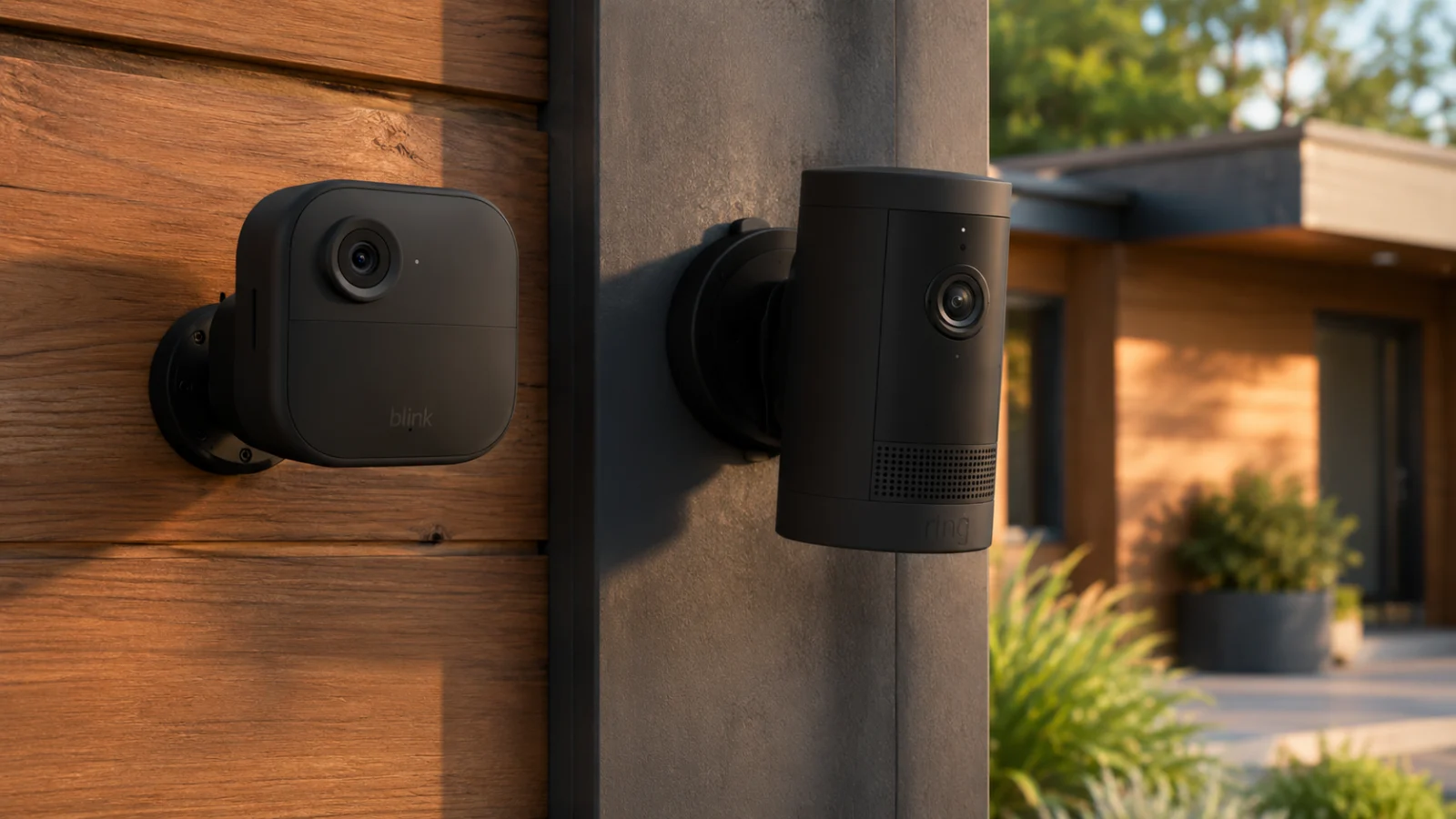
Here’s a number that surprised me: one tester ran a Blink Outdoor 4 at a high-traffic gate, tripping the motion sensor about 20 times a day, and after 90 days the battery indicator still read 100%. That’s not a marketing claim. That’s someone actually using the thing. And it’s the kind of detail that matters more than any spec sheet when you’re trying to figure out whether Blink Outdoor 4 vs. Ring Outdoor Cam even matters for your setup, or whether one of them just quietly loses by default.
I’ve spent enough time with battery cameras to know the marketing numbers and the real numbers rarely match. In this case, they’re closer than usual, but the gap between these two systems isn’t really about battery life at all. It’s about what you’re willing to pay for, and when.
Gear Mentioned in This Post
- Blink OutdoorView on Amazon
The Battery Life Gap Is Real, Not Just a Spec
Blink Outdoor 4 claims up to two years of battery life on two AA lithium batteries. That’s not a rounding-up number from a press release, it’s been independently corroborated by testers running the camera in real conditions. Ring, by comparison, lands somewhere between 6 to 8 weeks and 3 to 6 months depending on which testing source you trust [1], with usage patterns and temperature swings doing a lot of the explaining for that wide range.
I want to be fair to Ring here. Battery life on any wire-free camera depends heavily on how often it triggers, how cold it gets outside, and whether you’ve got Wi-Fi signal strength issues forcing the radio to work harder. But even accounting for all that variability, the gap between “up to two years” and “6 to 8 weeks” isn’t something you argue your way around. If you hate charging batteries or climbing a ladder every other month, Blink wins this round outright.
Where it gets interesting is what that battery life is actually protecting you from. Longer battery life means fewer maintenance trips, sure. But it also means Blink can afford to be less chatty with the cloud, which plays into the bigger subscription story below.

What You’re Actually Paying For Upfront
Hardware pricing tells its own story. A Blink Outdoor 4 single-camera kit runs around $79.99, and it’s not uncommon to see multi-camera bundles discounted well below that during sales events, with three-camera bundles occasionally dropping into some of their best prices of the year [2] and two-camera bundles showing up for even less on flash-sale sites [3]. Ring’s hardware, meanwhile, tends to sit in a higher range per camera, particularly once you start looking at hardwired or solar-equipped versions [4].
The price gap isn’t small. And for a single-camera household, that upfront difference can outweigh almost everything else on this list.
But upfront price is only half the financial picture, and it’s the half that’s easiest to market around. The real number you need is what the camera costs you every year after you bring it home. That’s where things flip.
 From the shopIt Worked Before the UPDATE$18.45Shop →
The Subscription Trap Nobody Puts on the Box
Here’s the part that should bother you more than it probably does. Without a paid subscription, Ring cameras won’t record clips at all. You still get a phone alert that motion happened, but the alert can’t tell you what triggered it, and there’s no saved footage to check later [1]. That’s not a limited free tier. That’s a hardware purchase that does almost nothing useful until you start paying monthly.
Blink handles this differently, and it’s the detail that actually separates these two products. Out of the box, Blink gives you live view, motion alerts, and two-way audio with no subscription required. If you want cloud-saved clips, Blink’s plans start at $3.99 a month for a single camera, compared to Ring’s $4.99 per device. Want to skip the cloud fee entirely? Blink’s Sync Module 2 paired with your own USB flash drive gives you local storage for a one-time cost of roughly $35, with no real equivalent on the Ring side.
I like that Blink gives you a real subscription-free path, but I don’t want to oversell it. A Reddit thread from Blink’s own user community pointed out that without a subscription, the system can’t tell a person from a passing car or a raccoon, that kind of filtering runs in the cloud and requires a paid plan either way. So “subscription-free” gets you basic alerts and manual review, not smart detection. It’s an honest trade-off, not a loophole.
That subscription-fatigue reality is bigger than these two cameras. Streaming subscribers who say they haven’t hit subscription fatigue dropped from 37% in 2023 down to 24% as of the most recent data available. People are tired of recurring fees stacking up across every device they own, and that frustration is clearly shaping how buyers think about security cameras too.

When Ring Actually Wins on Math
This is the part most comparison articles skip, and it’s the part that actually matters if you’re building out a full-house system instead of buying one camera for the back porch.
For a single camera, Blink’s basic plan runs about $39.99 a year against Ring’s Solo plan at roughly $49.99 a year. Blink wins, no contest. But once a household scales up to four or more cameras, Ring’s unlimited plan becomes about $20 a year cheaper than Blink’s equivalent tier. One family-cost analysis put it bluntly: the brand everyone recommends as the budget option becomes the more expensive one to run the moment you stop being a one-camera household.
That’s the crossover point you need to know before you buy, not after you’ve committed to a brand.
So the real question isn’t “which camera is better.” It’s “how many cameras will I actually own in two years.” Here’s roughly how the math shakes out:
-
One camera: Blink wins on both hardware price and annual subscription cost
-
Two to three cameras: Blink still holds a cost edge, though it narrows
-
Four or more cameras: Ring’s unlimited plan becomes cheaper per year, even though Blink’s hardware may still cost less upfront
Video Quality and Smart Features, the Honest Version
Ring genuinely does more once you’re paying for it. It integrates more deeply with Alexa, offers color night vision, and has more advanced motion zone controls than Blink’s baseline feature set. If you’re already living inside Amazon’s smart home ecosystem and you want your camera to talk to your other devices without friction, Ring is the more capable platform, full stop.
Field of view is close between the two, Blink Outdoor 4 covers 143° diagonally, Ring covers roughly 140° horizontal and 85° vertical, so neither has a meaningful edge in coverage area.
Ring’s storage window, once you’re paying, gives you 180 days of saved video, more generous than most competitors in that price range [1]. That’s a real advantage if you need to go back and review something from weeks ago, not just yesterday’s package delivery.
But “more capable once you’re paying” is the catch. Ring’s better features exist behind a paywall by design. Blink’s better features are mostly available for free, with the paywall reserved for cloud storage and smart filtering. Neither approach is dishonest, but only one of them tells you upfront what you’re actually getting for nothing.
Which One Actually Fits Your Setup
If you’re a renter or a single-house owner putting one camera on the front porch, Blink Outdoor 4 is the more honest deal. You get real battery life, a lower entry price, and a working camera even if you never pay a subscription fee. That’s worth a lot if you’re the type who resents recurring charges on principle, and the Reolink survey data backs that instinct up, 38.10% of respondents said they’d rather pay more upfront than deal with ongoing fees, and 62.07% specifically prioritized local storage over cloud convenience. Blink is built for that mindset.
If you’re running a four-camera-plus setup around a full property, already live inside the Alexa ecosystem, and you want richer video features without hunting for a USB drive and a sync module, Ring’s economics actually catch up to Blink and its feature set pulls ahead. That’s not the answer the “budget pick” marketing suggests, but it’s the one the actual math supports.
Frequently Asked Questions
Does Blink Outdoor 4 work without a subscription?
Yes. You get live view, motion alerts, and two-way audio for free. You lose cloud-saved clips and smart person-detection filtering unless you subscribe or add a Sync Module 2 with your own USB drive for local storage.
Does Ring Outdoor Cam work without a subscription?
Barely. You’ll get a motion alert on your phone, but the camera won’t record or save any footage, and you can’t tell what triggered the alert without paying for a plan [1].
How much cheaper is Blink for a single camera?
Blink’s basic annual plan runs about $39.99 a year versus roughly $49.99 a year for Ring’s Solo plan. Hardware pricing favors Blink too, with single-camera kits around $79.99 compared to Ring’s typically higher per-camera cost [4].
At what point does Ring become the cheaper option?
Once a household owns four or more cameras, Ring’s unlimited subscription plan runs about $20 a year less than Blink’s equivalent tier, even though Blink’s individual hardware units often cost less to buy.
Your Next Step
Don’t buy based on which brand shows up first in search results. Count how many cameras you actually plan to run in two years, price out both subscription tiers at that number, and then decide. If you land on Blink and want to skip the monthly fee entirely, budget the extra $35 for a Sync Module 2 and a USB drive on day one, it’ll save you the 30-day trial scramble later. That’s the real decision, and it’s one worth making with your own numbers instead of a marketing headline.
Sources
-
The 5 Best Outdoor Security Cameras of 2026 (nytimes.com)
-
Blink Outdoor 4 three-camera bundle back at one of its best … (pcguide.com)
-
Blink Outdoor 4 (2 cam system) – $42.99 – Free shipping for Prime members (electronics.woot.com)
-
Ring Outdoor Cam Plus Hardwired Power over Ethernet … (homedepot.com)
Researched from 16 vetted sources · average source authority DR 82