
Some links below are affiliate links. If you buy through one, this site earns a commission at no extra cost to you. It never changes a verdict — here is how that works.
Here’s the number that started this whole investigation: 610 lux. That’s what one independent test recorded from a Hatch Restore 3 held one foot away, compared to 730 lux from a Lumie Bodyclock Shine 300 and 840 lux from a Philips Hue Twilight at the same distance.[1] Sunrise alarm clocks are having a real moment, with brands promising they’ll gently wake you up and reset your body clock at the same time. But almost nobody asks the basic question a tech reviewer should ask first: is the light actually bright enough to do anything to your biology, or are you just buying a nicer-looking lamp?
Gear Mentioned in This Post
- Hatch RestoreView on Amazon
- LumieView on Amazon
Why Lux Numbers Matter More Than Marketing Photos
Every sunrise alarm clock ad shows the same thing: a bedroom bathed in warm orange light, a person stretching happily awake. What those ads don’t show you is a lux meter. Lux measures how much light actually hits a surface, and it’s the closest thing we have to an objective test of whether a “sunrise” is doing biological work or just setting a mood.
For context, actual outdoor daylight can hit 10,000 lux or more on an overcast day, and bright indoor lighting used in light-therapy boxes for seasonal mood support typically runs in the 2,500 to 10,000 lux range at close distance. Against that backdrop, a device topping out around 600 to 840 lux at one foot is nowhere close to daylight. That doesn’t mean it’s useless. It means the honest question isn’t “does this work like sunlight,” it’s “does this do enough to matter, and for what.”
This is exactly the kind of spec-versus-reality gap that gets buried in most reviews. Outlets will tell you a device has a “sunrise simulation feature” and call it a day. They rarely put a meter in front of it, and when they do, it’s usually a single test from one source rather than something verified across multiple devices and distances [1].
What the Existing Data Actually Shows
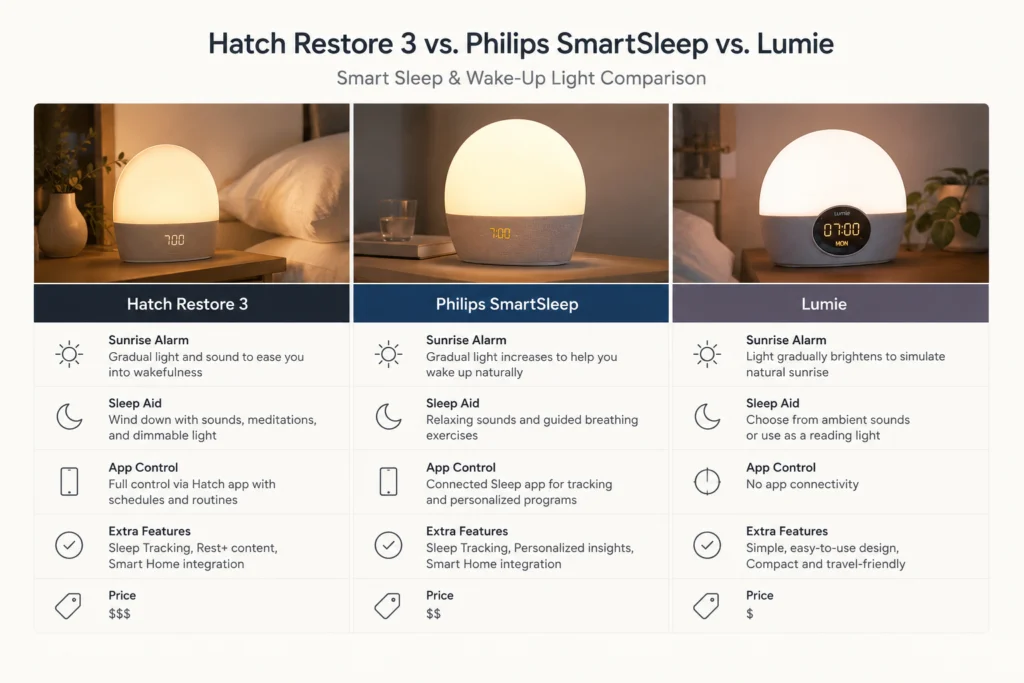
Based on the numbers available so far, sunrise alarm clocks land in a wide range depending on brand and price. The Hatch Restore 3, one of the most popular models on the market, measured at 610 lux at one foot. The Lumie Bodyclock Shine 300 came in higher at 730 lux, and the Philips Hue Twilight topped the group at 840 lux at the same distance [1].
That’s a meaningful spread. If you’re comparing two devices purely on “does it have a sunrise feature,” you’d assume they’re roughly equivalent. The lux numbers say otherwise. A nearly 40 percent difference in brightness output between the dimmest and brightest device in that comparison is not a rounding error, it’s a real difference in how much light is reaching your eyes at wake time.
Sunrise ramp times add another variable. Depending on the model, the gradual light-up period can run anywhere from 15 to 90 minutes before your alarm goes off [1]. A device with a dimmer max brightness but a longer ramp might expose you to more cumulative light than a brighter device with a short ramp. Nobody in the mainstream coverage is doing that math. They’re listing “sunrise simulation: yes” in a spec table and moving on.
 From the shopIt Worked Before the UPDATE$18.45Shop →
The Gap Between “Feels Nice” and “Does Something”
I want to be direct about something here: feeling like you woke up better isn’t the same as measuring that you woke up better. Even outlets that genuinely like these devices are careful about their claims. One review of the Hatch Restore 3 specifically called it “not a cure-all,” noting it helps more with winding down at night than with the actual wake-up push in the morning. That’s a notably honest admission buried in otherwise glowing coverage, and it’s the kind of nuance that gets lost in “best of” roundups that just rank products by star rating.
There’s also real skepticism worth taking seriously. Threads on Reddit have openly questioned whether devices like the Hatch actually help people wake up at all, with some users calling the whole category oversold. That pushback deserves airtime instead of getting buried under affiliate links, because it points at a real question: if the light output is objectively lower than daylight or a proper light-therapy box, what exactly is the mechanism that’s supposed to help you?
The honest answer is probably layered. Some of the benefit is likely genuine light exposure, some is the sound design (rain, white noise, birdsong), and some is simply the psychological effect of not being jolted awake by a harsh beep. None of that is fake. But it’s a different claim than “this resets your circadian rhythm,” and reviewers should be clearer about which one they’re actually promising.
What a Proper Test Would Actually Measure
If you’re going to test these devices instead of just reviewing them, here’s what actually needs measuring:
-
Lux output at multiple distances (1 foot, 2 feet, and typical nightstand-to-pillow distance), not just one arbitrary spot
-
Full ramp duration and whether brightness increases linearly or in steps
-
Color temperature shift during the ramp, since warmer light early and cooler light later can matter for alertness
-
Actual wake-time behavior tracked with a wearable over weeks, not one groggy morning
-
Comparison against a control period using a standard alarm with no light component
Almost none of the existing coverage does more than the first item, and even that’s usually a single data point from a single source rather than something cross-checked across models and testers [1]. That’s the gap. Multi-month, instrumented testing that tracks real sleep data against real light output simply doesn’t exist yet in this category, and it’s the difference between a review and a genuine investigation.
Price Doesn’t Track With Light Output
Here’s something that should bother anyone shopping by price alone: the category spans roughly $20 to over $250, and lux output doesn’t scale cleanly with cost. A budget dupe running around $59 has drawn real interest as a potential Hatch alternative, and comparisons between the two suggest the gap in actual functionality is smaller than the price gap suggests. If the expensive option isn’t meaningfully brighter or better-timed than the cheap one, you’re paying for app polish, sound library size, and industrial design, not biology.
That’s not a knock on paying for those things if they matter to you. A nicer-sounding, better-designed device might genuinely improve your bedtime routine and your mood about getting up. Just don’t confuse that with a stronger circadian signal, because right now the data doesn’t support that connection at the price tiers we’ve seen.
So Does It Actually Affect Your Biology?
The honest, unglamorous answer: probably a little, for some people, under some conditions, and largely because of ramp duration and consistency rather than raw brightness. None of the sunrise alarm clocks on the market currently approach the lux levels used in clinical light therapy, and the evidence base for their specific circadian claims is limited [1]. That doesn’t mean skip the category entirely. It means treat the “resets your body clock” language the same way you’d treat any other marketing claim: skeptically, until someone actually measures it.
What we can say with more confidence is that a gradual, predictable wake-up routine, paired with sound design you like, tends to feel better than a jarring alarm. Whether that’s biology or habit formation is a separate question, and it’s one worth testing properly instead of assuming.
Frequently Asked Questions
Are sunrise alarm clocks bright enough to replace a light therapy lamp?
No. Light therapy boxes for conditions like seasonal affective disorder typically operate at much higher lux levels than sunrise alarm clocks, which have measured in the 610 to 840 lux range at close distance [1]. Treat them as a wake-up aid, not a therapeutic device.
Does a higher lux number mean a better sunrise alarm clock?
Not necessarily. Ramp duration, color temperature changes, and sound design all factor into whether a device actually helps you wake up gradually. A dimmer device with a longer, smoother ramp might work better for you than a brighter one with a short burst of light [1].
Is a cheap sunrise alarm clock dupe worth it compared to a premium model?
Early comparisons between budget options and premium devices like the Hatch Restore suggest the core light and wake features aren’t dramatically different, with the price gap mostly reflecting app features, sound libraries, and build quality [2]. If you just want the wake-up mechanic, a budget option may be enough.
Why do some people say sunrise alarm clocks don’t work?
Some of that skepticism is fair. Even brands’ own strongest advocates acknowledge these devices help more with sleep wind-down than with the actual wake-up push, and public skepticism about their real-world effectiveness is common and worth taking seriously rather than dismissing.
Where This Goes Next
This is the first pass at a question that deserves ongoing, measured testing rather than a one-time verdict. If you’re shopping for a sunrise alarm clock, don’t buy based on the glow in the marketing photo. Ask for the lux number, ask about ramp time, and treat any circadian claim with a healthy dose of “show me the data.” We’ll keep pulling lux meters out on new models as they launch, and if you’ve got a device you want tested against real numbers, that’s exactly the kind of comparison worth running next.
Sources
-
Best Sunrise Alarm Clock (2026): Lumie, Hatch, WiiM (wired.com)
-
I’m testing this $59 Hatch dupe and it might just be my new favorite sunrise alarm clock (tomsguide.com)
Researched from 24 vetted sources · average source authority DR 84