
Some links below are affiliate links. If you buy through one, this site earns a commission at no extra cost to you. It never changes a verdict — here is how that works.
Last updated: April 15, 2026
This is a follow-up to my Hume Band Review. If you haven’t read that yet, start there — this review builds on it.
Gear Mentioned in This Post
- OuraView on Amazon
- WhoopView on Amazon
- GarminView on Amazon
TL;DR — Hume Pod Review
- Best for: people who want detailed body composition tracking at home without paying for DEXA appointments or gym-based scans
- What it nails: segmental body analysis via 8-electrode handlebar design, 45+ metrics, strong trend tracking for fat loss and muscle gain, excellent integration with the Hume Band
- What to expect: Bluetooth-only connectivity (no Wi-Fi), occasional sync hiccups that will test your patience, body fat readings that fluctuate based on hydration — treat it as a trend tracker, not a medical device
- Buy it if: you are serious about body recomposition and want to see beyond the scale number — especially powerful when paired with the Hume Band
- Skip it if: you need clinical-grade precision on a single reading, you want Wi-Fi auto-sync, or you just want a basic bathroom scale
Deal Alert: You can get 20% OFF the Hume Pod using the code “ROBBSUTTON” at checkout.
- Official Website: HumeHealth.com — Hume Pod
Table of Contents
- Why I’m Reviewing This
- Hume Pod Specifications
- Pricing & Value Proposition
- Unboxing and First Impressions
- Why an 8-Electrode Scale Matters
- Design and Build Quality
- How to Get the Best Readings
- Tracking Performance
- The Ecosystem Effect: Band + Pod Together
- Using the Pod Without the Band
- Using the Band Without the Pod
- The App: What Works and What Frustrates Me
- What I’d Change (Dear Hume)
- The Accuracy Question
- Competitor Comparison
- Hume Pod vs. Withings Body Scan
- Hume Pod vs. InBody Dial H30
- Hume Pod vs. Renpho Smart Scale
- Hume Pod vs. Withings Body Smart
- Pros and Cons
- FAQ
- Who Is the Hume Pod For?
- Closing Thoughts
Why I’m Reviewing This (and Why It Matters)
Back in February, I published my deep-dive review of the Hume Band — the subscription-free wearable that tracks sleep, HRV, and recovery through Hume’s proprietary Metabolic Capacity and Metabolic Momentum scores. That review has performed well in search, and for good reason: people are tired of paying subscription rent on their own health data.
But the Band was only ever designed to be half the picture.
In my Band review, I mentioned the Hume Health ecosystem — specifically, how the app constructs a “Bio-Digital Twin” that improves as you feed it more data. At the time, I was only feeding it wrist-based data: heart rate, HRV, sleep stages, and activity strain. I could see my recovery trends, but the app was essentially blind to what was happening with my body composition. It knew how I was recovering, but it had no idea what I was recovering from — or what my body was actually made of.
Enter the Hume Pod.
I’ve been using the Hume Pod alongside the Hume Band for several weeks now — stepping on this thing every single morning right after I wake up, barefoot on my bathroom tile, before coffee, before food, before anything. And I’ll be honest: the first few days were frustrating enough that I almost shelved it. But once I dialed in my routine and the trend data started painting a picture, something clicked. The Hume app with both devices feeding it data is a fundamentally more useful product than either device running solo.
But as always, there are caveats. A lot of them, actually. Let’s get into it.
Hume Pod: The Specifications
Before we get into real-world performance, here’s what’s under the glass.
- Form Factor: Smart scale with retractable handlebars (8-electrode system)
- Sensors: 8-point tactile electrode array, multi-frequency BIA (bioelectrical impedance analysis), heart rate sensor
- Frequencies: 8 frequencies ranging from 20kHz to 100kHz
- Measurement Time: Under 60 seconds per full body scan
- Scans Per Session: 64 individual bioelectrical scans per measurement
- Body Segments Measured: 5 (left arm, right arm, torso, left leg, right leg)
- Metrics Tracked: 45+ (body fat %, muscle mass, visceral fat, metabolic age, bone mineral content, hydration, segmental fat/muscle distribution, intracellular/extracellular water, and more)
- Weight Capacity: 9 lbs – 400 lbs (5 – 200 kg)
- Weight Precision: 50g (0.1 lb)
- Display: 2.8″ LED color display
- Connectivity: Bluetooth (no Wi-Fi)
- Battery: Rechargeable Li-ion (up to 1 year per charge on standby, ~30 min fast charge)
- Platform Dimensions: 12.7 x 12.7 x 1.1 inches (315 x 315 x 25.6 mm)
- Multi-User Support: Up to 24 individual profiles
- Compatibility: iOS and Android via Hume Health app
- HSA/FSA Eligible: Yes (U.S. customers — verify with your plan administrator)
Pricing & Value Proposition
- MSRP: $352
- Typical Sale Price: $229 (frequently on promotion)
- Subscription: Optional. The app is free and the scale is fully functional without Premium. Hume Plus ($9.99/month) adds coaching, weekly health reports, and nutrition tracking.
- Warranty: 1-year standard (10-year extended warranty available at checkout for $46)
- Return Policy: 45-day no-questions-asked trial
Deal Alert: You can get 20% OFF the Hume Pod using the code “ROBBSUTTON” at checkout.
- Official Website: HumeHealth.com — Hume Pod
Unboxing and First Impressions: It’s Not Plug-and-Play
I want to talk about the setup experience because most reviews skip this, and it’s the part that will make or break your first impression.
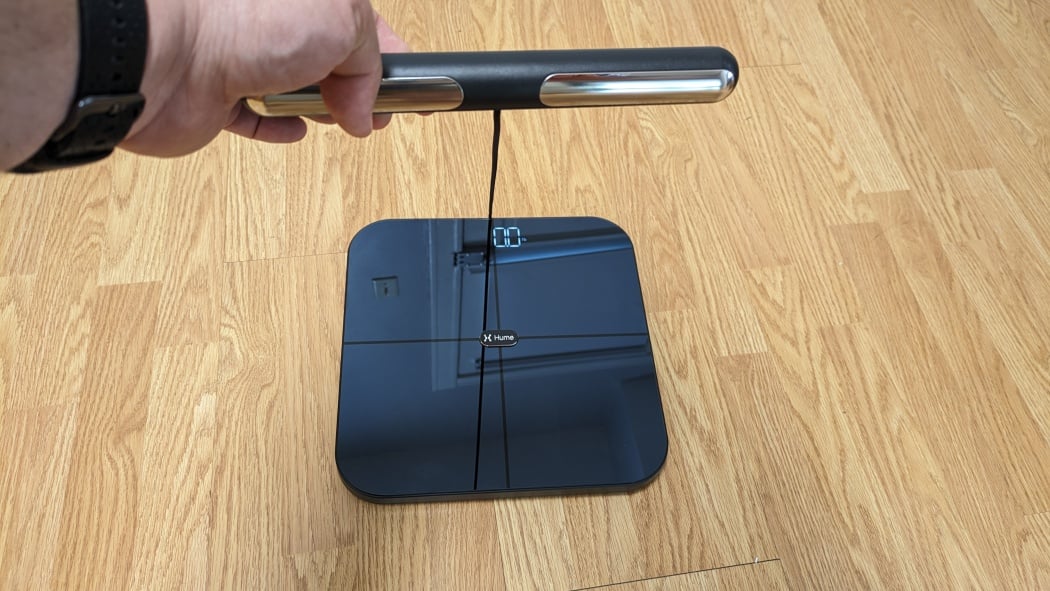
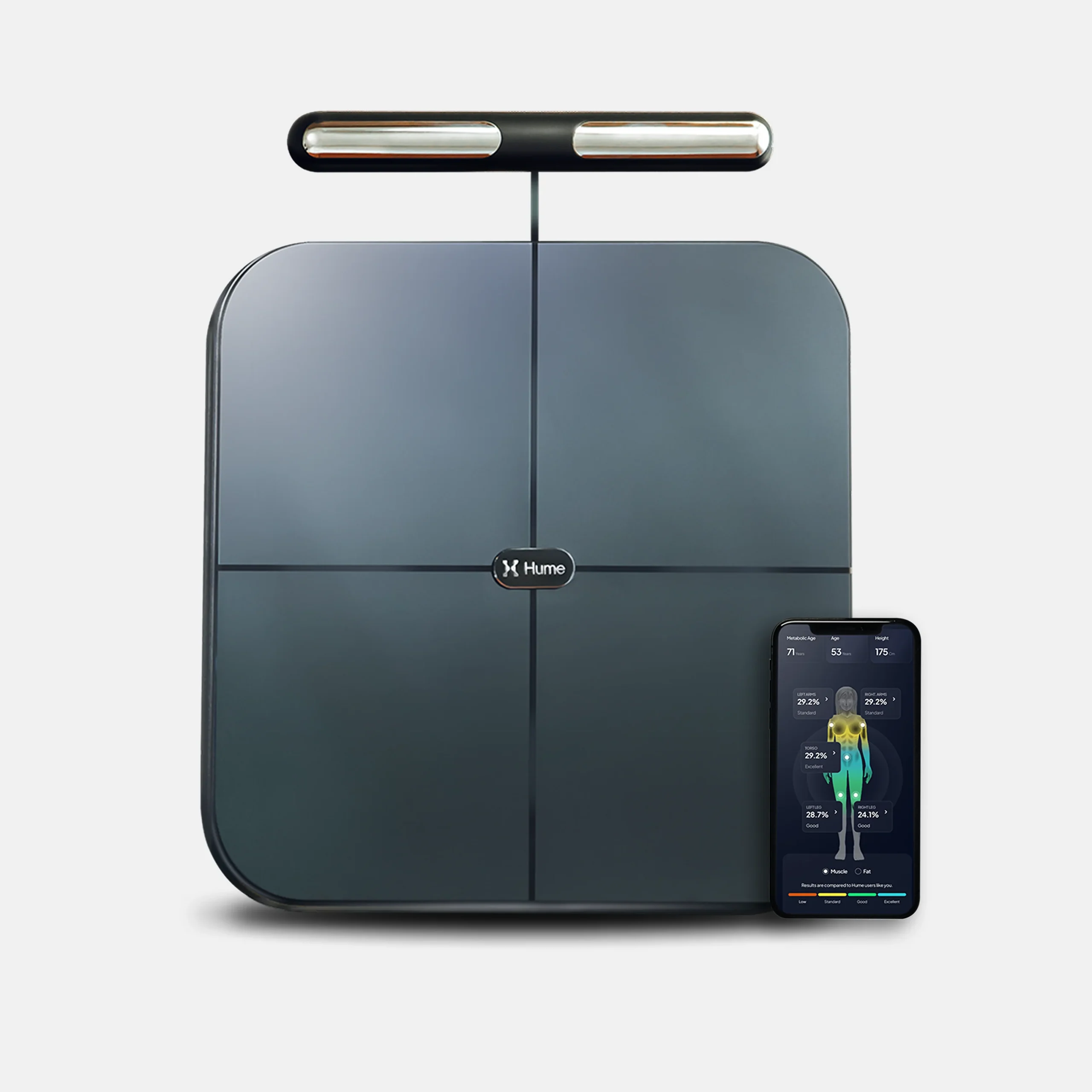
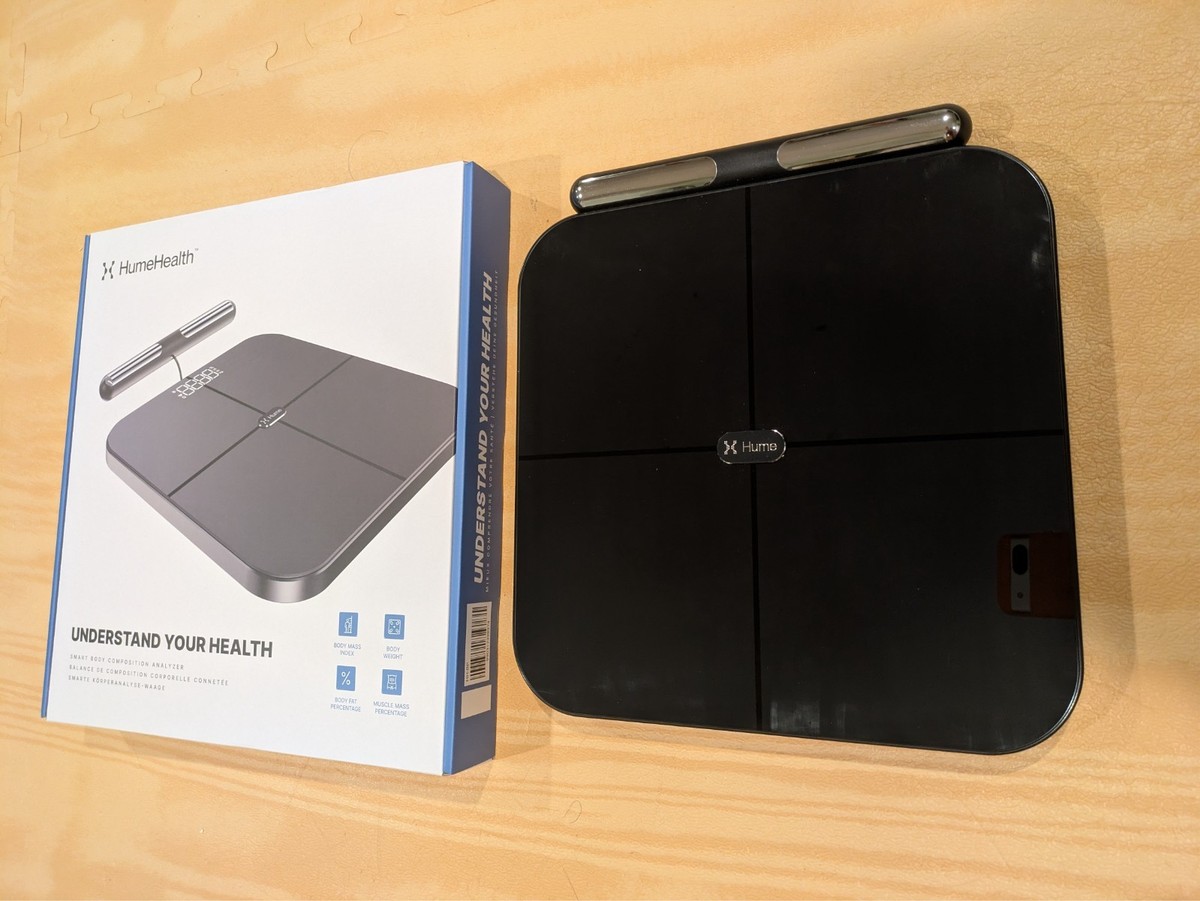
The Pod arrives well-packaged — sturdy box, minimal waste. The scale itself looks premium. Tempered glass, a clean 2.8″ LED display, and the retractable handlebars that differentiate it from every other bathroom scale. First impression: this looks like a $200+ device. Good start.
Then I tried to connect it to the Hume Health app.
Look, I’ve reviewed enough tech products to know that Bluetooth pairing is rarely seamless. But the Hume Pod pushed my patience. My first three attempts to pair the scale failed. The app would find the device, show a loading spinner, and then… nothing. I force-closed the app, toggled Bluetooth off and on, reopened, and tried again. Fourth attempt worked. Total setup time: about 12 minutes, when it should have been 2.
I want to be fair here — once the initial pairing was done, subsequent connections have been more reliable. Not perfect (more on that later), but the first-time setup was the roughest part. If you buy this scale and the first pairing fails, don’t panic. Close everything, restart your phone’s Bluetooth, and try again. It’s annoying, but it does work.
The Big Idea: Why an 8-Electrode Scale Matters
Most smart scales you see on Amazon — the $30 to $80 ones from Renpho, Eufy, Wyze, and others — are foot-pad-only designs. They send a small electrical signal up one leg and down the other, and then estimate your entire body composition based on what happened in your lower half. Your arms, torso, and visceral cavity? Pure algorithmic guesswork.
The Hume Pod is architecturally different. It uses a retractable handlebar system that adds four additional contact points at your hands, giving it eight total electrodes. This means the electrical signals travel through your arms, across your torso, and down through your legs — covering all five body segments (left arm, right arm, trunk, left leg, right leg) independently.
This is the same general approach used by clinical-grade devices like InBody analyzers that you find in hospitals, sports facilities, and research labs. The difference is that those machines cost $5,000 to $25,000. The Hume Pod brings that segmental architecture home for under $250.
Does that mean it’s as accurate as a DEXA scan? No. But according to Hume’s third-party testing (conducted by Socotech), the Pod correlates within approximately 2-3% of DEXA for fat-free mass and body fat percentage. Independent reviewers have generally confirmed that the readings align reasonably well with DEXA scans, though accuracy can vary based on hydration levels, time of day, and individual body type.
The real value isn’t in any single reading. It’s in the trend. And I cannot stress that enough. If you buy this scale expecting to step on it once and get a perfect body fat number, you will be disappointed — just like you’d be disappointed by every other consumer BIA device on the planet. The value comes from stepping on it every day, under the same conditions, and watching the trendlines over weeks.
Deal Alert: You can get 20% OFF the Hume Pod using the code “ROBBSUTTON” at checkout.
- Official Website: HumeHealth.com — Hume Pod
Design and Build Quality
The Hume Pod is a good-looking scale. The tempered glass platform is sturdy, the LED display is bright and readable, and the retractable handlebars feel solid. It doesn’t feel cheap.
In terms of footprint, it’s about the size of a standard bathroom scale — 12.7 inches square. The handlebars pull up and lock into place for each scan, then fold back down for storage. It’s not something you’ll want to travel with, but it tucks easily against a bathroom wall.
One thing I didn’t expect: the handlebars add a slight learning curve to the weigh-in process. You step on, pull the handlebars up, grip them at waist height, and stand still for about 60 seconds while it runs the scan. It’s not complicated, but it’s more involved than just stepping on a Withings or Renpho and stepping off. Some mornings when I’m half-awake, I’ll be honest, it feels like a minor chore. You get used to it, but if you’re the kind of person who wants to step-on-and-go, the handlebar design adds friction to your morning routine.
The rechargeable battery is a nice touch. Hume claims up to a year of standby battery life, and in my testing, I haven’t had to charge it yet after several weeks of daily weigh-ins. A 30-minute charge gets you back to full.
One design note: The scale must be placed on a hard, flat surface. Carpet will throw off the readings. Tile or hardwood floor, every time.
How to Get the Best Readings (Lessons Learned the Hard Way)
Before I get into tracking accuracy, this needs to be said clearly: your measurement protocol matters more than the device.
I learned this the hard way during my first week. I weighed in one morning right after waking up — barefoot, empty stomach, the works. Body fat reading: reasonable. The next morning, I weighed in after drinking 20oz of water and having coffee. Body fat “jumped” by almost 3 percentage points. I nearly wrote the scale off as inaccurate right there.
It wasn’t inaccurate. I was just measuring under wildly different conditions. Every BIA scale — whether it’s a $30 Renpho or a $25,000 clinical InBody — is affected by hydration, food intake, and time of day. The electrical signals travel through water in your body, so the amount of water in your system directly affects the readings. That’s not a device problem — that’s physics.
Here’s the protocol I’ve settled on for the most consistent results:
1. Same time every day. First thing in the morning, before anything else.
2. After your first bathroom visit. This matters more than you think.
3. Barefoot, minimal clothing. Socks are a hard no — they block the foot electrodes.
4. Bare hands on the handlebars. Grip firmly at waist height. Don’t death-grip them, but make full contact.
5. Stand still and upright. Don’t lean forward or shift your weight.
6. Open the Hume app first, then step on the scale. This reduces the Bluetooth connection failures significantly.
Once I locked in this routine, the day-to-day noise dropped dramatically and the trend data started telling a coherent story. If your first week of readings looks erratic, fix your protocol before blaming the hardware.
Tracking Performance: What the Pod Actually Shows You
Body Composition Breakdown
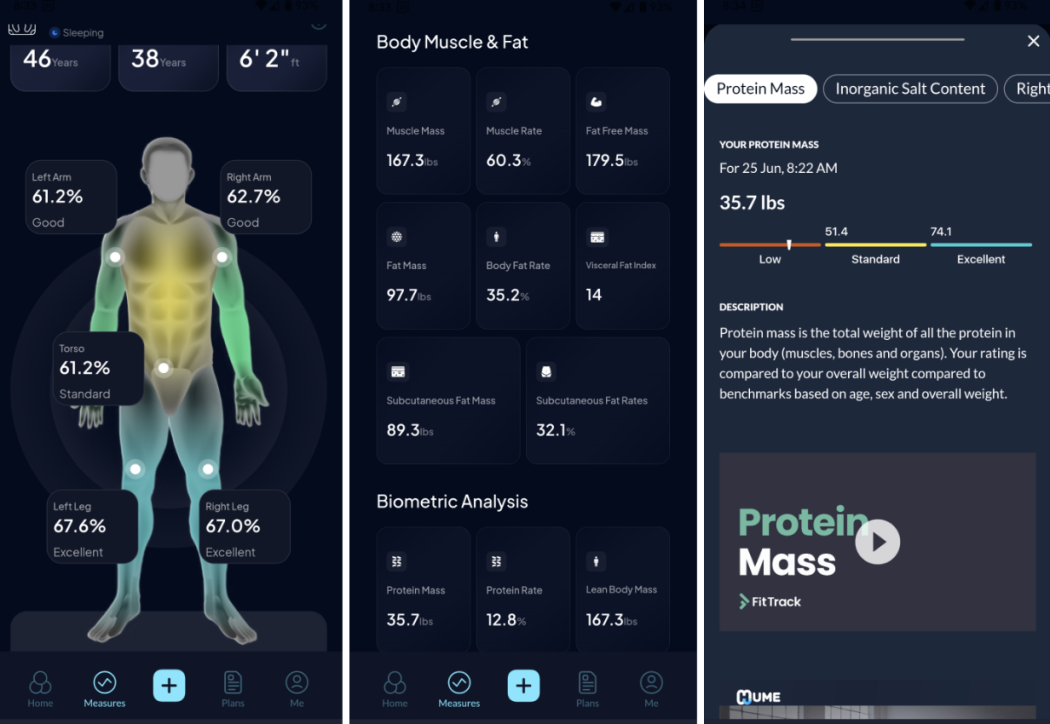
The headline feature is the full body composition readout. After each 60-second scan, the Hume app breaks down your body into its constituent parts: fat mass, muscle mass, bone mineral content, body water (total, intracellular, extracellular), protein levels, and visceral fat.
In my testing, the weight readings have been dead-on accurate — consistently matching the dumb analog scale I keep as a sanity check. The body fat percentage readings have been consistent day-to-day (under the same conditions) and have tracked logically with my dietary and training changes. When I tightened up my nutrition for a week — cut the late-night snacking, hit my protein targets — fat mass dropped and muscle mass held steady. When I had a weekend where I ate like a teenager at a food court, the water weight spike appeared exactly where you’d expect it — in the extracellular compartment. The Pod saw it. It was almost uncomfortably honest about it.
Segmental Analysis
This is where the handlebar design earns its price premium. The app shows you fat and muscle distribution across five body segments: both arms, torso, and both legs, independently.
For me, the most useful insight was identifying that my left arm carries slightly more fat and slightly less lean mass than my right arm. It’s a minor asymmetry — the kind of thing that would never show up on a regular scale — but it makes sense given that I’m right-handed and my right arm does more work in the gym. Whether you’d actually change your training based on that data is debatable, but it’s the kind of granularity that makes the Pod feel like a different category of device than a foot-pad-only scale.
Visceral Fat
This is the metric that regular scales simply cannot provide. Visceral fat — the fat packed around your internal organs — is one of the strongest independent predictors of metabolic disease and cardiovascular risk. You can look lean on the outside and still be carrying dangerous visceral fat levels internally. If you’re someone who is interested in longevity and metabolic health (and if you’re reading a review on RobbSutton.com, you probably are), this is a metric worth watching.
The Hume Pod reports visceral fat as a numerical rating. Is it as precise as an MRI or CT scan? Absolutely not. But for trend-tracking — “Am I trending up or down?” — it’s a data point that most consumer devices cannot offer at all, and the trendline has been consistent with my dietary choices in testing.
Metabolic Age
The Pod calculates your metabolic age based primarily on your lean tissue mass and resting metabolic rate. This is essentially a gamified way of asking: “Based on your body composition, does your body function like someone younger or older than your chronological age?”
I’ll be honest — I find this metric somewhat gimmicky in isolation. It’s a calculated estimate, not a lab result. But when you track it over weeks and months, a downward trend means your body composition is improving. It’s motivational, and I’ve found myself checking it more than I expected. Take the specific number with a grain of salt, but respect the trend direction.
Deal Alert: You can get 20% OFF the Hume Pod using the code “ROBBSUTTON” at checkout.
- Official Website: HumeHealth.com — Hume Pod
The Ecosystem Effect: Band + Pod Together
This is the section that matters most — and the reason this review exists.
If you read my Hume Band review, you know that the Band tracks your internal recovery signals — HRV, sleep stages, resting heart rate, strain, and Hume’s proprietary Metabolic Capacity and Metabolic Momentum scores. It tells you how your body is responding to stress.
The Pod adds the what. It shows you what your body is actually made of — how much muscle you’re carrying, where your fat is distributed, whether you’re adequately hydrated, and how your composition is changing week over week.
I had both devices feeding the same app for several weeks, and here’s the thing nobody else is really talking about in their reviews: the app with two data streams is a fundamentally different product than the app with one.
Here’s what actually changes when both devices are connected:
1. The Health Score Stops Being Abstract
With the Band alone, the Health Score (0-100) is calculated from cardiovascular and sleep data. It’s useful, but it always felt a little detached — like being told “you recovered well” without knowing what you recovered into. Add the Pod, and the Health Score now integrates body composition data — fat trends, muscle trends, hydration — alongside recovery metrics. It becomes a composite picture of your health, not just your recovery.
The first time I saw my Health Score account for a body composition shift, it clicked. It wasn’t just telling me I slept well. It was telling me I slept well and my body comp was trending in the right direction and my hydration was solid. That context makes the score actionable in a way it wasn’t before.
2. The Bio-Digital Twin Actually Earns Its Name
In my Band review, I described the “Bio-Digital Twin” as a concept that felt largely like a fancy visualization for trends. I stand by that assessment for the Band-only experience.
With both devices? Different story. The Digital Twin now has body composition data layered on top of cardiovascular and sleep data. It can correlate your sleep quality with your body composition changes. It can flag when a stretch of poor recovery (detected by the Band) coincides with a stall in fat loss or a dip in muscle mass (tracked by the Pod). It starts making connections that would take you a spreadsheet and a lot of patience to piece together on your own.
The predictive features become more interesting, too. The app starts suggesting how maintaining your current consistency might affect your visceral fat or metabolic age over the next 30 days. Is it always right? No idea — I haven’t been using it long enough to validate the predictions. But it’s the first time the “Digital Twin” has felt like more than a marketing concept.
3. You Stop Guessing Why Your Recovery Score Changed
This is the subtlest but most important benefit. With the Band alone, you might get a recovery score that says “take a rest day.” But you don’t know why. Is it because your sleep was bad? Is it because you’re undereating and your body composition is shifting in the wrong direction? Is it inflammation from overtraining?
With both devices, the app can cross-reference. If your Metabolic Capacity dips and your body fat is trending up while muscle mass is flat, the insight is different than if your Capacity dips but your body comp is improving. Context changes the recommendation. And that context only exists when both data streams are live.
The bottom line: the Hume Band is a good standalone device. The Hume Pod is a good standalone scale. But together, they produce a health tracking experience that is genuinely greater than the sum of its parts. This is the strongest argument for the Hume ecosystem over competitors — neither Withings, InBody, nor Oura can offer a wearable and a scale feeding the same unified platform.
What About Using the Pod Without the Band?
This is a fair question. Not everyone wants to wear a wrist tracker 24/7.
The Pod works perfectly fine as a standalone body composition scale. You get all 45+ metrics, trend tracking, weekly health reports, and the AI-driven insights. The app experience is clean and informative.
What you lose is the cardiovascular and recovery layer. Without the Band, the app doesn’t know how you slept, what your HRV looks like, or how strained your body was from yesterday’s workout. The Health Score becomes composition-heavy and misses the lifestyle/recovery dimension.
User sentiment online backs this up. People who own just the Pod generally find it valuable for body composition tracking and weight management — I noticed particularly positive feedback from users on GLP-1 medications (semaglutide, tirzepatide) who need to monitor whether they’re preserving lean mass during weight loss. The Pod’s segmental muscle tracking gives you real data on that question instead of just hoping for the best. But users who have both devices consistently report a more complete and more motivating experience.
If you can only buy one, here’s my honest recommendation: If you care more about sleep and recovery, get the Band first. If you care more about body composition and fat loss, get the Pod first. If you’re serious about long-term health optimization, get both.
What About Using the Band Without the Pod?
Also a fair question, and one I can answer from direct experience — I used the Band alone for several weeks before the Pod arrived.
The Band is a solid sleep and recovery tracker on its own. The Metabolic Capacity and Metabolic Momentum scores are genuinely useful daily signals, and the subscription-free model is still a massive win over competitors like Whoop. I covered all of this in detail in my Hume Band review.
What the Band lacks without the Pod is any insight into body composition. It knows you’re recovering well (or poorly), but it has no idea if you’re gaining muscle, losing fat, or just dehydrated. For athletes focused purely on performance and recovery, this might be enough. For anyone focused on body recomposition, longevity, or weight management, the Band alone leaves a significant blind spot.
The App: What Works and What Still Frustrates Me
The Hume Health app is noticeably improved from when I first reviewed the Band. The dashboard is cleaner, the data visualization is better organized, and the weekly health reports (especially with both devices) are genuinely informative.
But I need to be honest about the things that still bother me.
What Works
- Trend graphs for every metric. You can view daily, weekly, monthly, and yearly trends for everything from body fat to intracellular water.
- Weekly health reports that synthesize your data into actionable takeaways.
- Multi-user support — up to 24 profiles on one Pod. Good for families.
- Integration with Apple Health and Google Health Connect for importing workouts, steps, and sleep data.
What Still Frustrates Me
- Bluetooth-only connectivity. This is the Pod’s most significant hardware limitation and I’m going to harp on it. The Pod doesn’t have Wi-Fi. You have to open the Hume app and stand on the scale within Bluetooth range for the data to sync. With a Withings scale, I could step on it in the bathroom and the data would be synced to my phone via Wi-Fi before I even finished brushing my teeth. With the Hume Pod, I’m standing there holding handlebars, watching my phone to confirm the data came through. It works — but it’s 2026, and a $230 scale should have Wi-Fi.
- Sync quirks are still a thing. I flagged this in my Band review, and it persists with the Pod. Most mornings, the sync works fine. But maybe one out of every eight or nine weigh-ins, the app doesn’t recognize the scale on the first try. I force-close the app, reopen it, and it connects. It takes 15 seconds to fix, but it’s 15 seconds of friction that shouldn’t exist. User reviews on Amazon and Trustpilot confirm that Bluetooth connectivity is the most common complaint about this product — so it’s not just me.
- 45+ metrics can overwhelm new users. For experienced fitness enthusiasts, the data depth is great. For someone who just bought this to “lose some weight,” opening the app to 45 metrics, segmental analyses, and intracellular water percentages is going to feel like drinking from a firehose. The app does a reasonable job of surfacing the most important numbers on the home screen, but Hume could do better with an “essentials” mode for beginners.
- Premium paywall muddies the messaging. The core features work without a subscription, and that’s genuinely better than what Whoop offers. But some of the deeper coaching and detailed reports are locked behind Hume Plus at $9.99/month. This creates an awkward situation where the marketing says “no subscription required” but the app keeps nudging you toward Premium features you can’t access. It’s not a dealbreaker, but it’s worth knowing going in.
What I’d Change (Dear Hume)
If I could send Hume one feature request, it would be Wi-Fi connectivity. The handlebar design is the right engineering decision for measurement accuracy — having electrodes at both the hands and feet is what separates the Pod from every foot-pad-only scale on the market. But pairing that thoughtful hardware choice with Bluetooth-only sync in 2026 feels like a product decision made to hit a price point. A “Pod Pro” with Wi-Fi at $299 would be an instant buy for me, and I suspect for a lot of the people reading this review.
Beyond that, the app needs a beginner mode. Something that surfaces 5-6 key metrics on the home screen and tucks the other 40 behind a “deep dive” tab. Right now, the experience is optimized for data enthusiasts and it intimidates newcomers. Hume clearly has the data depth — they just need a better front door for people who are stepping on a smart scale for the first time.
Finally, the multi-user Bluetooth handoff needs work. If my wife and I want to weigh in back-to-back, one of us has to fully close the app so the other can connect. With Wi-Fi and automatic user recognition (which InBody already does), this would be seamless. As it stands, it’s a minor daily annoyance that adds up.
Deal Alert: You can get 20% OFF the Hume Pod using the code “ROBBSUTTON” at checkout.
- Official Website: HumeHealth.com — Hume Pod
The Accuracy Question: My Honest Assessment
Let me be direct about this, because I’ve seen reviews on both extremes — glowing endorsements claiming “98% DEXA accuracy” and scathing takedowns calling the device useless. The truth depends entirely on what you’re asking the device to do.
For weight: The Hume Pod is accurate. It consistently matches my other scales to within a tenth of a pound. This is table stakes for any modern digital scale.
For body composition trends: This is where the Pod earns its value. Once I locked in my measurement protocol (same time, same conditions, every day), the trends have been reliable and logically consistent with my real-world behavior. When I cleaned up my diet, fat mass trended down. When I had a high-sodium day, extracellular water spiked and came back down the next day. The trend is trustworthy — and after several weeks of data, I trust the direction of the trendlines even if I take any single data point with healthy skepticism.
For absolute body fat percentage on a single reading: This is where all consumer BIA devices — including the Hume Pod — have limitations. Hydration, food timing, and even ambient temperature can swing a single reading by several percentage points. Some reviewers and independent testing sites have noted that the Pod can show larger fluctuations for women and very lean individuals. This isn’t unique to Hume — it’s a physics limitation of bioelectrical impedance analysis. DEXA scans exist for a reason.
My take: If you’re comparing a single Hume Pod reading to a DEXA scan and expecting them to match within 1%, you will be disappointed — and that’s true of every BIA device on the market, including InBody and Withings. If you’re using the Pod as a daily trend tracker with consistent measurement habits, it’s a genuinely useful tool that gives you data you simply cannot get from a traditional scale. I plan to get a DEXA scan in the next month or two specifically to compare against my Pod trendlines, and I’ll update this review with those results when I do.
Competitor Comparison: Hume Pod vs. The Field
Here’s how the Hume Pod stacks up against four competing smart scales across price, electrode technology, connectivity, ecosystem integration, and subscription requirements. The detailed breakdowns follow the chart.
| Feature | Hume Pod | Withings Body Scan | InBody Dial H30 | Withings Body Smart | Renpho Smart Scale |
|---|---|---|---|---|---|
| Street Price | ~$229 | ~$400 | ~$350 | ~$100 | ~$30 |
| Electrode System | 8-point (feet + handlebars) | 8-point (feet + handle) | 8-point (feet + handlebars) | 4-point (feet only) | 4-point (feet only) |
| BIA Frequencies | 8 (multi-frequency) | Multi-frequency | 3 frequencies | Single frequency | Single frequency |
| Segmental Analysis | ✓ 5 segments | ✓ 5 segments | ✓ 5 segments | ✗ | ✗ |
| Total Metrics | 45+ | ~20 | ~15 | ~10 | ~13 |
| Visceral Fat | ✓ | ✓ | ✓ | ✓ | ✗ |
| Heart Rate | ✓ | ✓ | ✗ | ✓ | ✗ |
| ECG | ✗ | ✓ 6-lead | ✗ | ✗ | ✗ |
| Wi-Fi Sync | ✗ Bluetooth only | ✓ Wi-Fi + BT | ✓ Wi-Fi + BT | ✓ Wi-Fi + BT | ✗ Bluetooth only |
| Paired Wearable Ecosystem | ✓ Hume Band | ✗ | ✗ | ✗ | ✗ |
| Subscription Required | ✗ Optional ($9.99/mo) | Partial (Withings+ for some features) | ✗ Free app | Partial (Withings+ for some features) | ✗ Free app |
| Multi-User Profiles | Up to 24 | Up to 8 | Unlimited (auto-detect) | Up to 8 | Unlimited |
| Battery | Rechargeable (~1 year) | Rechargeable (~12 months) | AA batteries (~12 months) | AAA batteries (~18 months) | AAA batteries (~6 months) |
| HSA/FSA Eligible | ✓ | ✓ | ✓ | ✗ | ✗ |
| Best For | Ecosystem + body recomp | Premium health monitoring | Clinical-grade consistency | Best value all-rounder | Budget weight tracking |
Hume Pod vs. Withings Body Scan (~$400)
The Withings Body Scan is the premium king. It offers Wi-Fi + Bluetooth connectivity, a 6-lead ECG, nerve health assessment, vascular age, and segmental body composition — all wrapped in what is arguably the best health app in the consumer space.
Where Withings wins: Wi-Fi auto-sync (no phone needed during weigh-in), ECG and cardiovascular features, mature and polished app experience, broader health ecosystem integration.
Where Hume Pod wins: More total metrics tracked (45+ vs. ~20), lower price point ($229 vs. $400), deeper integration with the Hume Band for a unified wearable + scale ecosystem, higher multi-user capacity (24 vs. 8).
Verdict: If you want the best standalone smart scale experience with cardiovascular monitoring and don’t care about pairing with a wearable, the Withings Body Scan is the best on the market — but it costs nearly twice as much. If you want a body composition scale that integrates with a paired wearable for a unified health picture, the Hume ecosystem (Pod + Band) offers something Withings can’t match.
Hume Pod vs. InBody Dial H30 (~$350)
InBody is the gold standard in clinical BIA. Their professional analyzers are in hospitals and research labs worldwide. The H30 brings that technology home with professional-grade DSM-BIA, Wi-Fi + Bluetooth, and automatic user recognition.
Where InBody wins: Day-to-day reading consistency (widely regarded as the most repeatable consumer BIA device), Wi-Fi auto-sync, clinical-brand credibility, free app with AI-driven diet and exercise recommendations.
Where Hume Pod wins: Price ($229 vs. ~$350), deeper metric library, paired wearable ecosystem with the Hume Band, more modern/consumer-friendly app interface.
Verdict: The InBody H30 is the choice for athletes and data purists who need maximum consistency in individual readings. The Hume Pod is the choice for people who want a broader health ecosystem that combines body composition with wearable-based recovery tracking at a lower price.
Hume Pod vs. Renpho Smart Scale (~$25-$50)
Renpho is the budget champion. Best-selling smart scales on Amazon, cheap, functional, decent app.
Where Renpho wins: Price. That’s about it.
Where Hume Pod wins: Everything else. Renpho uses foot-pad-only BIA with a single frequency. It estimates your upper body from your lower body readings. The Hume Pod directly measures all five body segments with eight electrodes at eight frequencies. The data quality isn’t in the same universe. If you’ve been using a Renpho and wondering whether the body fat number is real — it’s an estimate of an estimate. The Pod is at least measuring what it claims to measure.
Hume Pod vs. Withings Body Smart (~$100)
The Withings Body Smart is arguably the best value smart scale on the market for most people. Visceral fat, body composition, hydration tracking, Wi-Fi sync, excellent app — all for under $100.
Where Withings Body Smart wins: Price-to-value ratio, Wi-Fi auto-sync, proven app ecosystem, no handlebar required (simpler daily use).
Where Hume Pod wins: Segmental measurement (the Body Smart is foot-pad only), total metric depth, wearable ecosystem integration.
Verdict: The Withings Body Smart is the recommendation for casual health trackers who want solid data without a $200+ investment. The Hume Pod is for serious body recomposition trackers who need segmental analysis and want the Hume ecosystem. If I didn’t own the Hume Band already, the Body Smart would be a hard value argument to beat.
Pros and Cons
Pros:
- 8-Electrode Segmental Analysis gives you real upper-body and torso data, not estimates from your feet.
- 45+ Metrics including visceral fat, segmental muscle/fat distribution, metabolic age, and intracellular/extracellular water balance.
- No Mandatory Subscription — core features work without Hume Plus.
- Ecosystem Integration with the Hume Band transforms the app into a genuinely unified health platform. This is the Pod’s single biggest differentiator.
- HSA/FSA Eligible for U.S. customers.
- Rechargeable Battery with outstanding standby life.
- Multi-User Support for up to 24 profiles — great for families.
- 45-Day Return Policy — low-risk trial period.
Cons:
- No Wi-Fi. Bluetooth only. You must have the app open during every weigh-in. This is the single biggest hardware limitation and a real step behind Withings and InBody in daily usability.
- Bluetooth Sync Issues — occasional connection failures require force-closing and reopening the app. Not every day, but often enough to be frustrating. This is the most common complaint across Amazon, Trustpilot, and user forums.
- Single-Reading Accuracy Limitations — like all BIA devices, individual readings fluctuate based on hydration, food timing, and body type. Lean individuals and women may see wider swings. Use trends, not snapshots.
- Premium Paywall — some deeper insights and coaching features require Hume Plus at $9.99/month, which softens the “no subscription” value proposition.
- App Still Maturing — while improved, the app still feels younger and less polished than Withings Health Mate or Garmin Connect. Occasional UI quirks and the data firehose can overwhelm new users.
- Customer Support Concerns — some users online report slow response times from Hume’s support team, particularly around returns and refunds. I haven’t needed support personally, but the pattern in reviews is worth noting.
- First-Time Setup — initial Bluetooth pairing can be rough. Budget a few extra minutes and some patience.
FAQ
Q: Do I need the Hume Band to use the Hume Pod?
A: No. The Pod works as a fully standalone body composition scale. But the experience is significantly better with both devices — the combined data gives you a more complete and more actionable health picture. I’d go as far as saying the ecosystem is the main reason to choose Hume over Withings or InBody.
Q: Is it accurate compared to a DEXA scan?
A: Hume claims a 98% correlation with DEXA for fat-free mass. Independent reviewers have generally found readings within 1-3% of DEXA for body fat. However, individual readings can vary based on hydration and other factors. The real value is in consistent trend tracking, not single-point accuracy. I plan to validate against a DEXA scan and will update this review with those results.
Q: Can multiple family members use the same Pod?
A: Yes, up to 24 individual user profiles. Each person needs their own Hume Health app account. Note: only one phone can be connected via Bluetooth at a time, so other family members may need to close their app while you weigh in. This is a real annoyance if two people want to weigh in back-to-back.
Q: Does it work on carpet?
A: No. Hard, flat surface only — tile, hardwood, or concrete. I keep mine on bathroom tile. Carpet will produce inaccurate readings because the scale can’t sit level.
Q: Does it sync with Apple Health or Google Fit?
A: Yes, both. It also syncs with Fitbit and Garmin through the Hume Health app.
Q: Is the subscription required?
A: No. Core features — all body composition metrics, weight tracking, and trend graphs — are free. Hume Plus ($9.99/month) adds coaching, nutrition tracking, and detailed weekly reports. Unlike Whoop, the device doesn’t become a brick if you don’t subscribe.
Q: Does it measure heart rate?
A: Yes. The Pod includes a heart rate sensor in the scale platform.
Q: Is it safe with a pacemaker?
A: Hume states that their BIA technology is safe for customers with pacemakers or ICDs implanted after 1992. However, always consult your doctor before using any BIA device with an implanted cardiac device.
Q: What’s the return policy?
A: 45-day no-questions-asked trial. Contact support@myhumehealth.com to initiate a return. Device must be in original packaging.
Q: Does the scale have Wi-Fi?
A: No. Bluetooth only. You need the Hume Health app open and nearby for data to sync. This is my biggest hardware complaint — see the full review above for why.
Who Is the Hume Pod For?
Who Should Buy It
- The Body Recomposition Tracker: You’re lifting weights, managing your diet, and the number on a regular scale doesn’t tell you what you need to know. You need to see whether you’re losing fat, gaining muscle, or both — and where it’s happening on your body.
- The Hume Band Owner: If you already own the Band and love the ecosystem, the Pod is the missing piece. The combined data turns the Hume app from a good recovery tracker into a comprehensive health platform. This is the Pod’s killer use case.
- The GLP-1 User: If you’re on semaglutide or a similar medication, monitoring lean mass preservation during weight loss is critical. Published research shows 25-39% of weight lost on GLP-1s can be lean mass. The Pod’s segmental muscle tracking gives you real data to catch that early.
- The Data-Driven Family: With 24-user support, the Pod can serve an entire household. Everyone gets their own profile, their own trends, and their own insights.
- The “I Hate Subscriptions” Buyer: Like the Band, the Pod’s core features work without a subscription. You buy it once and own your data.
Who Should Skip It
- The Casual Weigher: If you just want to know your weight and maybe a rough body fat estimate, a $30-$100 smart scale will do the job. The Pod is overkill for checking a number.
- The Wi-Fi Purist: If seamless auto-sync without touching your phone is a deal-breaker, the Withings Body Scan or InBody H30 are better options. Period.
- The Clinical Accuracy Seeker: If you need single-reading accuracy that matches a DEXA scan, no consumer BIA device will satisfy you — including this one. Get periodic DEXA scans instead and use the Pod for trend tracking between appointments.
- The Minimalist: If 45+ metrics sounds like a nightmare, and you prefer simple dashboards with three numbers, the Hume experience will overwhelm you. Consider the Withings Body Smart instead.
Closing Thoughts: More Data, Better Decisions
The Hume Pod is not a perfect device. The Bluetooth-only connectivity is a real limitation in 2026. The app still has sync quirks that need to be ironed out. The first-time setup tested my patience. And the “no subscription needed” message gets muddied by the Premium paywall on some features.
But here’s what the Hume Pod gets right — and what its competitors largely don’t: it’s designed to be part of a system.
Most smart scales exist in isolation. You step on, get your numbers, and then… what? You’re left to cross-reference your scale data with your sleep tracker data with your workout app data, hoping to stitch together some coherent picture of your health. The Hume Pod, when paired with the Hume Band, eliminates that stitching. One app, one dashboard, one Health Score that integrates body composition with cardiovascular recovery with sleep quality.
The more data you feed the ecosystem, the smarter it gets. That’s not just a marketing line — it’s the lived experience. My first week with just the Band produced useful but limited insights. Adding the Pod didn’t just add more data points; it fundamentally changed the quality of the insights the app could produce. The app went from telling me “you recovered well” to telling me “you recovered well, your body composition is trending in the right direction, and here’s what to focus on next.”
Is it the most accurate smart scale on the market reading-by-reading? Probably not — the InBody H30 likely holds that crown. Is it the most feature-rich standalone scale? The Withings Body Scan has it beat on cardiovascular monitoring. But neither InBody nor Withings offers a paired wearable that feeds into the same unified health platform. That’s Hume’s lane, and right now, they own it.
If you’re already in the Hume ecosystem with the Band, the Pod is the obvious next step. If you’re starting from scratch and want a comprehensive, subscription-optional health tracking system, the Band + Pod combination is one of the most compelling value propositions in the consumer health tech space right now.
I’ll continue updating this review as I accumulate more data — including a DEXA comparison when I get one scheduled. If you have specific questions about the Pod or the Band+Pod experience, drop them in the comments and I’ll answer from my testing.
Get 20% Off Hume Pod: Code “ROBBSUTTON”
Link: HumeHealth.com — Hume Pod
Disclaimer: This review is based on real-world usage and research. Using the affiliate links and codes above supports the content creation on RobbSutton.com. Always consult with a medical professional regarding health metrics; this device is for informational purposes only.