
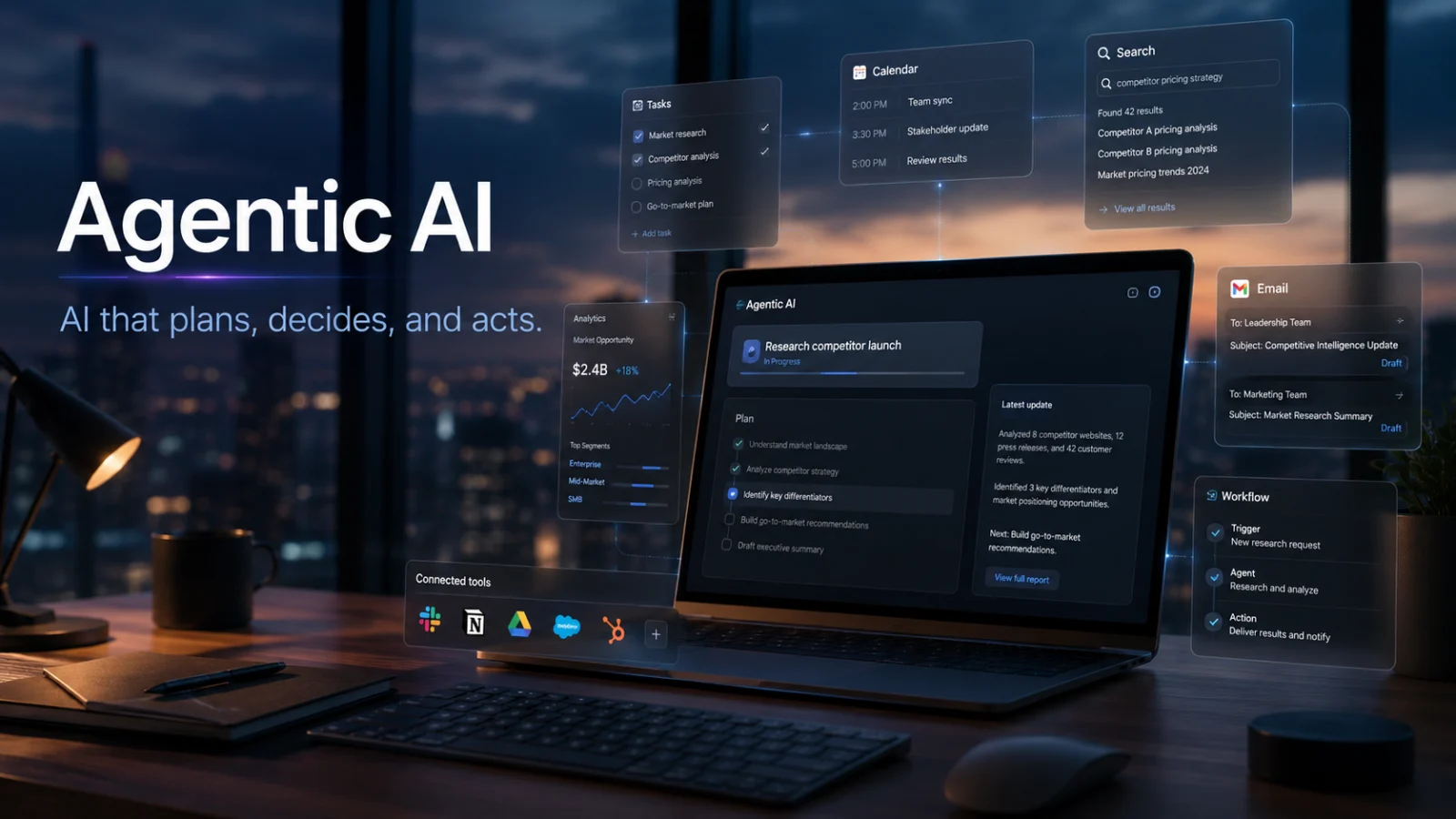
My smart home has locks, cameras, and a thermostat that all now take orders from software that plans and acts on its own. That’s not a chatbot answering a question. That’s an agent making a decision. It’s exactly why the agentic AI skills gap is becoming the career story of the next few years, not just a smart home story. The people who know how to design, supervise, and debug these systems are about to be worth a lot more than the people who just know how to write a good prompt [1].
What Agentic AI Actually Means (And Why It’s Different)
A chatbot waits for you to ask something, then answers. An agent doesn’t wait. It takes a goal, breaks it into steps, and carries out those steps with little or no supervision [1]. That’s the shift MIT Sloan researchers point to when they describe agentic AI as systems built to plan and act, not just converse [1].
I’ve felt this shift in my own house. Tell an old-school smart home routine “turn off the lights at 10pm” and it does exactly that, every night, no matter what’s happening. Tell an agentic system “I’m going on vacation” and it reasons through what that actually means: lock the doors, adjust the thermostat, vary the lighting pattern, keep the cameras active. That’s planning. That’s execution. It’s happening with less human hand-holding every month.
Deloitte’s research on what it calls the “silicon-based workforce” frames this as a real strategic shift for companies, not a gadget trend [2]. Businesses are starting to hand off entire workflows to agents the same way I’ve handed off parts of my house. The catch is the same in both cases: the system is only as good as the person who set it up and who keeps watching it.
Why the Skills Gap Is Real, Not Hype
Here’s the uncomfortable part. Knowing how to prompt an AI well was the hot skill for the last two years. It’s not the hot skill anymore. Building and supervising agentic systems calls for a different kind of thinking, closer to systems engineering than copywriting [3][4].
The gap shows up as a mismatch between what companies need and what most job candidates can actually do. Research on agentic AI adoption describes a widening split between organizations racing to deploy autonomous agents and a workforce that mostly still thinks in terms of single prompts and single answers [4]. That mismatch is the gap. It’s not going away on its own, and it’s not something a weekend course fixes.
What makes this different from past tech skill gaps is the stakes. A bad prompt gives you a bad paragraph. A bad agent configuration can lock you out of your own house, send fifty emails you didn’t mean to send, or double-book your entire week. The cost of getting agentic AI wrong is a lot higher than the cost of getting a chatbot answer wrong, which is exactly why the people who can supervise these systems safely are becoming valuable.
 From the shopPermanently in BETA$18.45Shop →
The Blueprint: Skills That Actually Matter
I’ve spent months running agentic tools against real hardware in my own home, and the pattern that keeps showing up is this: the technical skill isn’t “using AI.” It’s designing the guardrails around it. Roadmaps for becoming an AI agent engineer consistently point to a specific cluster of abilities that go well beyond prompting [3][4].
- Workflow design – breaking a goal into steps an agent can actually execute in order, with clear stopping points
- Permissioning and access control – deciding exactly what an agent is allowed to touch, and what it’s never allowed to touch alone
- Observability – building in logs and checkpoints so you can see what the agent did and why, after the fact
- Failure-mode thinking – planning for what happens when the agent gets it wrong, not just when it gets it right
- Rollback capability – the ability to undo an agent’s action fast, before a small mistake becomes a big one
None of these are exotic. They’re the same discipline operations engineers have used for years to keep complex systems from falling over. The difference now is that this discipline is showing up in job postings for roles that didn’t exist three years ago [3].
Where Home Automation Becomes a Career Advantage
Every smart home enthusiast who’s built a real automation setup already has a head start here, whether they realize it or not. Think about what it actually takes to get a Home Assistant setup running well: you’re mapping out triggers and conditions, deciding which devices can act without asking you first, and figuring out what happens when a sensor gives you bad data. That’s workflow design. That’s permissioning. That’s failure-mode thinking. You just called it “my smart home setup” instead of “AI operations.”
I’d argue the person who’s spent a year debugging why their agent keeps unlocking the wrong door at the wrong time understands agentic AI failure modes better than someone who’s only read about them. Hands-on experience with real hardware, real edge cases, and real consequences teaches lessons that no course module can fully replicate. That’s not a small thing. It’s the entire reason hands-on testers tend to spot problems that feature-list reviewers miss.
The honest caveat: home automation experience alone won’t get you hired as an AI operations engineer. But it gives you a framework for learning the professional version faster, because you already understand the core tension every agentic system creates: how much autonomy do you actually hand over, and to what?
The Autonomy Question Every Skilled Operator Must Answer
Should an AI agent be able to open your garage door on its own? That question sounds like a smart home debate, but it’s really a professional skill in disguise. Every organization deploying agentic AI right now is asking some version of the same thing about its own systems: which decisions can the agent make alone, and which ones need a human to sign off first?
I sort devices and workflows into three tiers when I test agentic setups, and I think the same tiering applies to any professional agent deployment:
- Fully autonomous, low risk – lighting, thermostat adjustments, routine scheduling. Mistakes here are annoying, not dangerous.
- Autonomous with logging – content pipelines, calendar management, non-critical notifications. The agent acts, but you can see and undo what it did.
- Confirmation required, always – locks, security cameras, financial actions, anything sent externally to another person. No exceptions, no matter how good the agent’s track record is.
Getting this tiering right, for a house or for a company workflow, is a skill you build through repetition and failure, not through a single training. That’s the real blueprint for closing the skills gap: build small, watch closely, and expand autonomy only after the system earns it.
How to Start Closing the Gap Yourself
You don’t need a computer science degree to start. What you need is a project where the stakes are real enough to teach you something, but small enough that a mistake won’t cost you your job. That’s actually the argument for starting at home rather than at work.
Pick one workflow you already run manually and try automating it with an agent instead of a static rule. Not “turn the lights off at 10pm,” but something with actual decision-making involved, like managing your notifications based on your calendar and your location. Watch where it breaks. Write down why. That log of failures is worth more than a certificate, because it forces you to think through permissioning and rollback before anyone hands you a system with real consequences attached.
From there, look at how companies frame this skill set in job postings. Titles referencing “AI workflow design” and “AI operations” are becoming more common as employers look for people who can integrate agents into real processes rather than just knowing how to use one [3][4]. Reading a dozen of these postings will tell you more about what to learn next than any generic course outline.
Frequently Asked Questions
What’s the difference between a chatbot and an agentic AI system?
A chatbot answers questions when you ask them. An agentic system takes a goal, plans the steps needed to reach it, and carries out those steps with minimal ongoing input from you [1].
Do I need to learn to code to work with agentic AI?
Not necessarily. Many of the highest-value skills, like workflow design, permissioning, and failure-mode planning, are conceptual and can be learned through hands-on projects, though technical roles like AI agent engineer do call for stronger coding ability [3][4].
Is it safe to let AI agents control smart home devices like locks or cameras?
Treat high-risk devices, locks, cameras, garage doors, as always requiring human confirmation. Lower-risk devices like lighting and thermostats are reasonable to hand over to full automation once you’ve tested the system.
How fast is the agentic AI skills gap actually growing?
Fast enough that industry roadmaps now treat “AI agent builder” as a distinct, in-demand role separate from traditional data science or prompt engineering positions [3][4]. Deloitte’s research frames this as an organizational shift already underway, not a future prediction [2].
Your Next Step
The agentic AI skills gap isn’t going to close by reading about it. Pick one small, low-stakes workflow in your own home or your own workday and try handing it to an agent this week. Watch what it does well, write down what it gets wrong, and use that log to figure out where your permissioning and rollback plans need work. That’s the actual blueprint. Everything else is just theory until you’ve broken something and figured out why.
Sources
- Agentic AI, explained (mitsloan.mit.edu)
- The agentic reality check: Preparing for a silicon-based workforce (deloitte.com)
- How to Become an AI Agent Engineer in 2026 (Skills, Salary & Roadmap) (skillscouter.com)
- Agentic AI Skills Gap: How to Become an AI Agent Builder in 2026 (cloudxlab.com)
Researched from 7 vetted sources · average source authority DR 77