TL;DR — Hume Band Review
- Best for: people who want 24/7 sleep + recovery tracking without a required subscription
- What it nails: super comfortable strap, strong trend-based coaching (Metabolic Capacity/Momentum), easy sleep tracking (no screen)
- What to expect: battery is ~4–5 days, occasional app sync quirks, lifting HR can lag/under-read peaks (normal for wrist optical)
- Buy it if: you want a “buy once, track long-term” Whoop alternative
- Skip it if: you need built-in GPS, a smartwatch, or the most athlete-optimized recovery platform
Deal: Save 20% with code ROBBSUTTON at checkout.
In the world of fitness wearables, we are currently suffering from what I call “Subscription Fatigue.” You buy a $300 ring or band, and then you’re held hostage for another $30 a month just to see your own sleep data. It’s a rental model for your own biology, and frankly, it’s exhausting.
Enter the Hume Health Band.
You might know Hume from their smart scales (the Body Pod), but their entry into the wearable space is making waves for one very specific reason: It claims to be the subscription-free alternative to Whoop.
I’ve been testing the Hume Band extensively. I’ve worn it through heavy compound lifts in the garage gym, during sleep, and while sitting at my desk analyzing the data. Is it a true “Whoop Killer,” or is it just a glorified pedometer with a fabric strap?
This is the comprehensive, deep-dive review of the Hume Band.
Get 20% Off Hume Band: Code “ROBBSUTTON” Link: HumeHealth.com/pages/hume-band
Hume Band Review: The Specifications
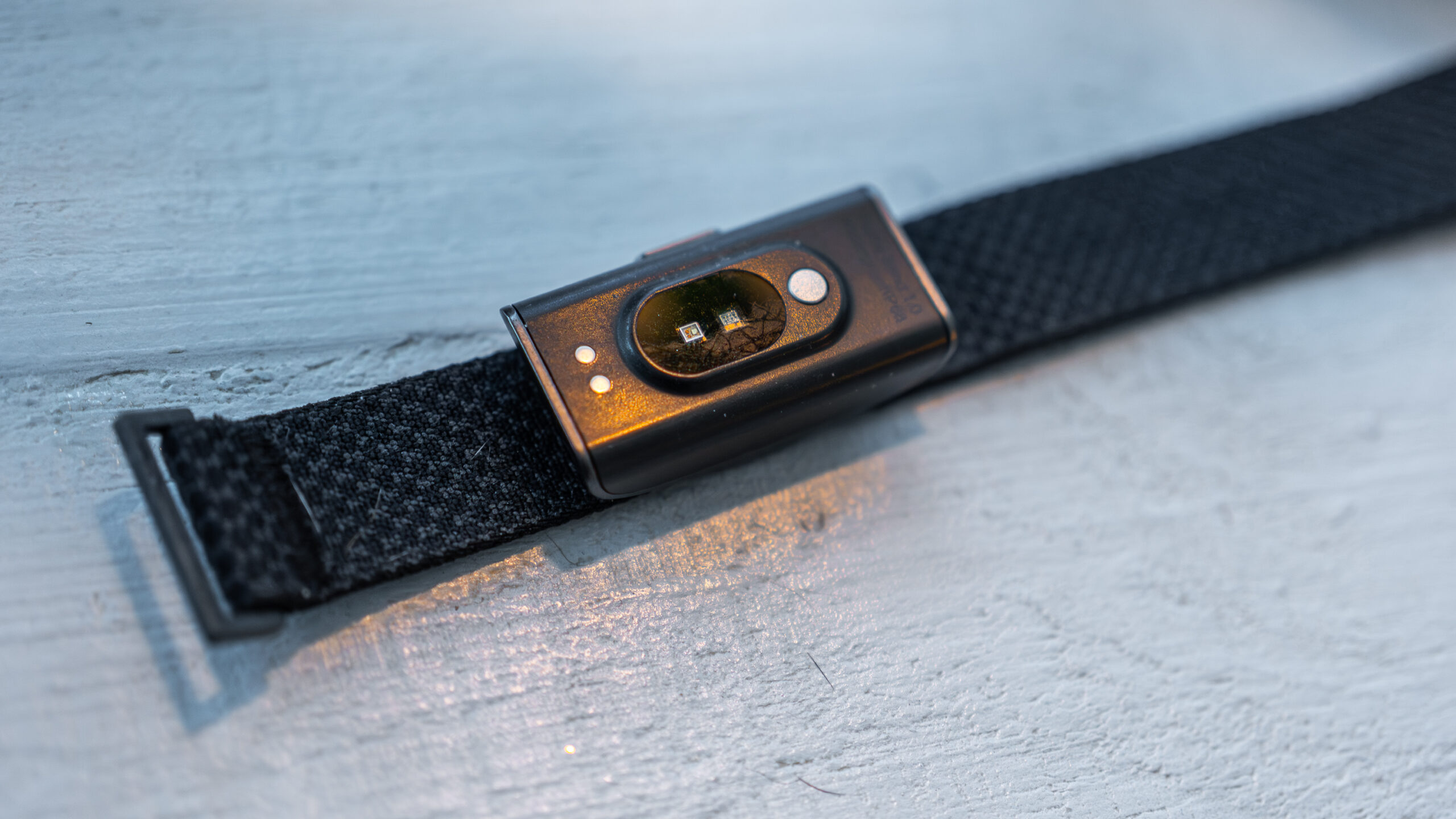
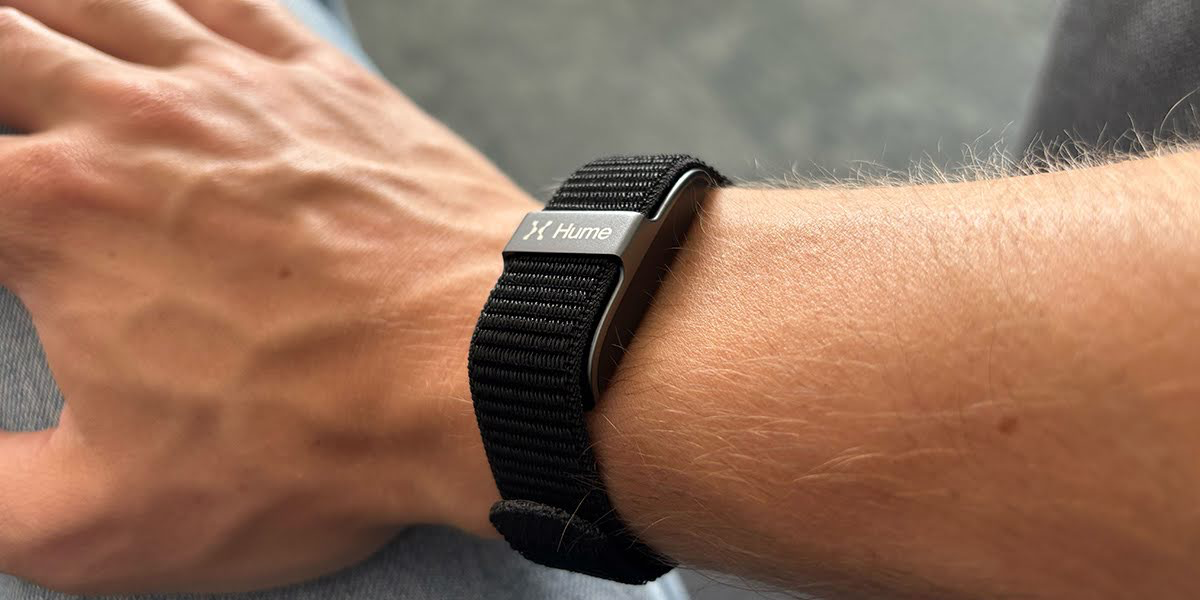
Before we get into the real-world performance, let’s look at what is actually under the hood. The Hume Band is a screenless, fabric-strap tracker designed for 24/7 wear.
- Form Factor: Screenless wristband with “SuperKnit” fabric strap.
- Sensors: 5 LEDs and 4 Photodiodes (Optical Heart Rate, SpO2, Skin Temperature).
- Battery Life: Up to ~4–5 days (Real-world usage varies, see below).
- Water Resistance: IP68 (Hume states water-resistant up to 1m for up to 2 hours — safe for showers and swimming).
- Connectivity: Bluetooth Low Energy (BLE).
- Compatibility: iOS and Android.
- Charging: Proprietary USB-C magnetic charging dock.
- Key Metrics: Heart Rate, HRV (Heart Rate Variability), SpO2, Sleep Stages, Metabolic Capacity, Metabolic Momentum, Health Score.
Current Pricing & Value Proposition
This is the headline feature. Unlike its main competitor, Whoop, which requires an ongoing membership, the Hume Band is a one-time purchase with an optional Premium layer for extra coaching.
- MSRP: Typically priced around $299.
- Promotional Pricing: Frequently seen between $199 – $249.
- Subscription Model: Optional. The app is free and the band remains functional without Premium. Premium adds deeper coaching/AI features (and other membership benefits depending on the current offer).
Deal Alert: You can currently get 20% OFF the Hume Band by using the code “ROBBSUTTON” at checkout.
- Official Website: HumeHealth.com/pages/hume-band
Design and Comfort: The “Invisible” Wearable
If you are like me, you probably already wear a traditional watch or a smartwatch (like an Apple Watch or Garmin). The beauty of the Hume Band, much like the Whoop, is that it doesn’t try to compete for wrist real estate. It has no screen. It doesn’t buzz you with text messages. It is strictly a data collector.
The Strap
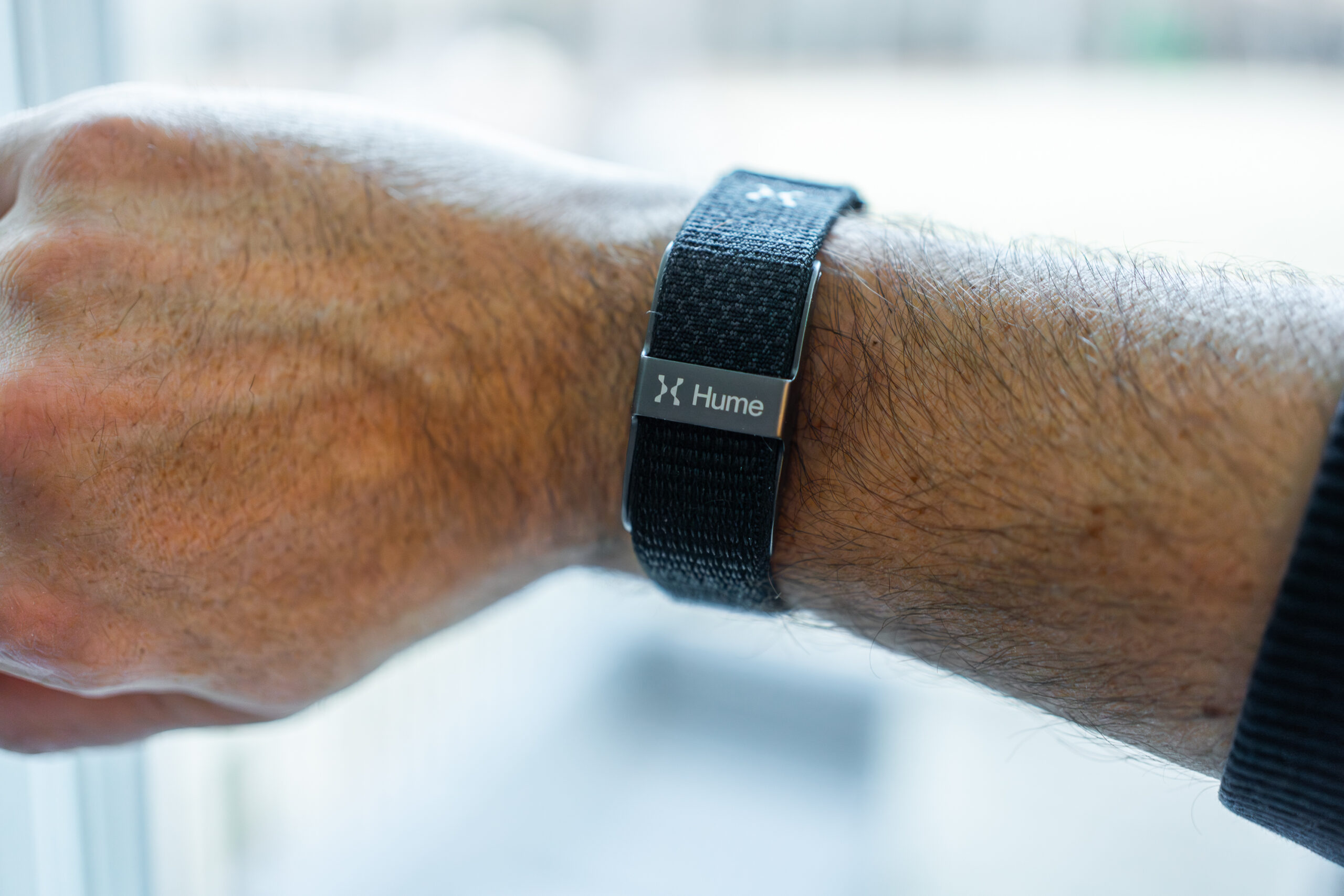
The band uses a “SuperKnit” material that is incredibly soft. In my testing, I found it significantly more comfortable than the standard silicone bands found on Fitbits or Garmins. It breathes well, which is crucial if you are wearing this 24/7 to track sleep.
The Clasp
The clasp mechanism is a velcro strap. It’s secure, but it can be a bit fiddly to adjust the tightness on the fly. You want it snug for accuracy (especially during workouts), but loose enough that it doesn’t cut off circulation while you sleep. Once you find that sweet spot, you generally don’t need to touch it again.
Durability
I’ve banged this thing against barbells and racks in the gym. The module itself is plastic but feels dense and durable. The fabric strap will likely show wear over time (sweat, chalk, dirt), but it is washable.
The “Metabolic” Approach: How the Hume Band Differs from Competitors
While most trackers are content to tell you how many calories you burned or how well you slept, Hume pivots the entire conversation to Metabolic Health and Longevity.
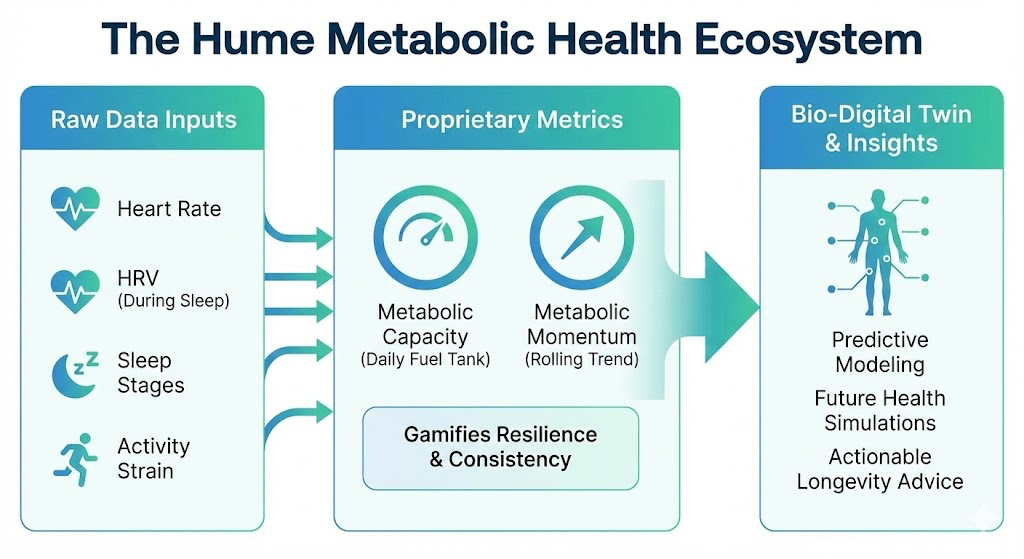
This is not just marketing semantics. The Hume Band repackages the raw data (Heart Rate, HRV, Sleep) into two proprietary metrics that change how you view your daily habits: Metabolic Capacity and Metabolic Momentum.
1. Metabolic Capacity: Your Daily “Fuel Tank”
Think of Metabolic Capacity as a more advanced version of Garmin’s “Body Battery” or Whoop’s “Recovery Score,” but with a focus on resilience rather than just rest.
- What it measures: It combines your Heart Rate Variability (HRV), Sleep Efficiency (not just duration), and recent Activity Strain.
- The Goal: It answers the question, “How much stress can my body handle today without breaking down?”
- The Difference: A high recovery score on Whoop simply means you are “ready to train.” A high Metabolic Capacity on Hume implies your body is effectively generating and using energy at a cellular level. It gamifies the concept of “biological age”—consistently high capacity suggests you are aging slower than your chronological years.
2. Metabolic Momentum: The “Anti-Anxiety” Metric
This is, in my opinion, the most brilliant feature of the Hume ecosystem. One of the biggest problems with health trackers is that they can cause anxiety. You have one bad night of sleep, your score tanks, and you feel like a failure.
Metabolic Momentum solves this by zooming out.
- How it works: Instead of looking at a 24-hour snapshot, it analyzes a rolling trend (typically 7–14 days) of your habits.
- The “Speedometer” Effect: It treats your health like a moving vehicle. One bad meal or one late night doesn’t stop the car; it just slightly taps the brakes. As long as your Momentum is positive, you are “gaining days” of life.
- Why it matters: It stops you from obsessing over daily micro-fluctuations and forces you to focus on consistency. If your Momentum is “High,” you are compounding positive health effects, even if you had a mediocre workout today.
3. The “Bio-Digital Twin”
Hume pushes the metabolic angle further with its AI concept called the Bio-Digital Twin.
- What it is: The app constructs a virtual model of your biology based on the data flow from the band (and smart scale, if you have it).
- The Function: It’s not just a fancy avatar; it’s a predictive engine. It runs simulations to show you potential futures. For example, it might predict how maintaining your current sleep consistency for 30 days will impact your visceral fat or resting heart rate. It moves the experience from “Here is what you did” (Rearview Mirror) to “Here is what will happen” (Windshield).
The Bottom Line: If Whoop is for the athlete trying to peak for a race, and Oura is for the biohacker trying to optimize sleep, Hume is for the person trying to slow down aging. It’s a subtle but distinct shift in mindset.
Hume Band Review: Tracking Performance & Accuracy
As a reviewer, I don’t care about marketing claims; I care about raw data and consistency. After wearing the Hume Band alongside an Oura Ring (Gen 4) and a Garmin chest strap, here is the unvarnished truth about its performance.
1. Sleep Tracking
Sleep tracking is the primary use case for a form factor like this.
- The Good: The staging (REM vs. Deep vs. Light) generally aligned with my Oura Ring data. It was able to detect sleep onset and wake times with reasonable accuracy (usually within 10-15 minutes of the Oura).
- The Bad (Sensitivity): Like many wrist-based optical sensors, it struggles to differentiate between “lying still” and “sleeping.” If I lay in bed reading or scrolling on my phone for 30 minutes, Hume often flagged that as “Light Sleep,” which artificially inflated my recovery scores.
- The “Gap” Issue: This is a known quirk I experienced and confirmed on several user forums. If the band isn’t worn very snugly, the sensor can lose contact with the skin during the night. I had two nights where the app showed a 90-minute “gap” in data because the band shifted while I slept.
- Pro Tip: To fix this, I had to wear the band tighter than I normally would with a Whoop strap. Some users even report better accuracy by spinning the sensor to the inside of the wrist before bed.
2. Heart Rate & HIIT
Optical heart rate sensors on the wrist all suffer from the same physics problem: movement and muscle tension obscure blood flow.
- Steady State Cardio: For running, cycling, or walking (Zone 2/3), the Hume Band is solid. It stayed within 2-3 beats per minute (BPM) of my chest strap average.
- Weightlifting/CrossFit: Here, the Hume Band struggles, just like the Whoop and Apple Watch do. When you grip a barbell tightly (deadlifts, pull-ups), the muscles in your wrist flex and block the optical sensor.
- The Lag: During a heavy set of squats, my chest strap read 165 BPM. The Hume Band hovered at 110 BPM during the set, then shot up to 160 BPM about 20 seconds after I racked the bar. This is typical for wrist wearables, but it means your “Strain” score for lifting might be slightly under-reported.
- Resting Heart Rate (RHR) Quirk: Interestingly, I found the Hume Band tended to read my RHR slightly higher (approx. 5-8 bpm) than my Garmin or Oura. It seems to have a higher sensitivity threshold, which is something to keep in mind if you are obsessed with lowering that specific number.
3. Heart Rate Variability (HRV)
HRV is the gold standard metric for recovery, and it is notoriously hard to measure accurately.
- Consistency is Key: While the raw numbers were sometimes different from my Oura (e.g., Oura said 45ms, Hume said 52ms), the trends were identical. If Oura said my HRV tanked because of a late meal, Hume said the same thing.
- Confidence: Because Hume calculates the “Metabolic Capacity” score largely based on this HRV trend, I found the daily scores to be reliable actionable advice. If the band told me to take a rest day, I usually felt like I needed one.
4. The “Connection” Gaps
A unique frustration with the Hume is data syncing. Unlike the seamless background sync of an Apple Watch, the Hume app sometimes requires a “force close and reopen” to pull in the latest data from the band. Occasionally, users have reported that if the battery dies overnight (which can happen due to the 4-day battery life), the band often loses the entirenight’s sleep data rather than saving what it recorded before shutting down.
Verdict: Keep it charged. Do not let it drop below 15%.
Hume Band Review: The App Experience & “The Digital Twin”
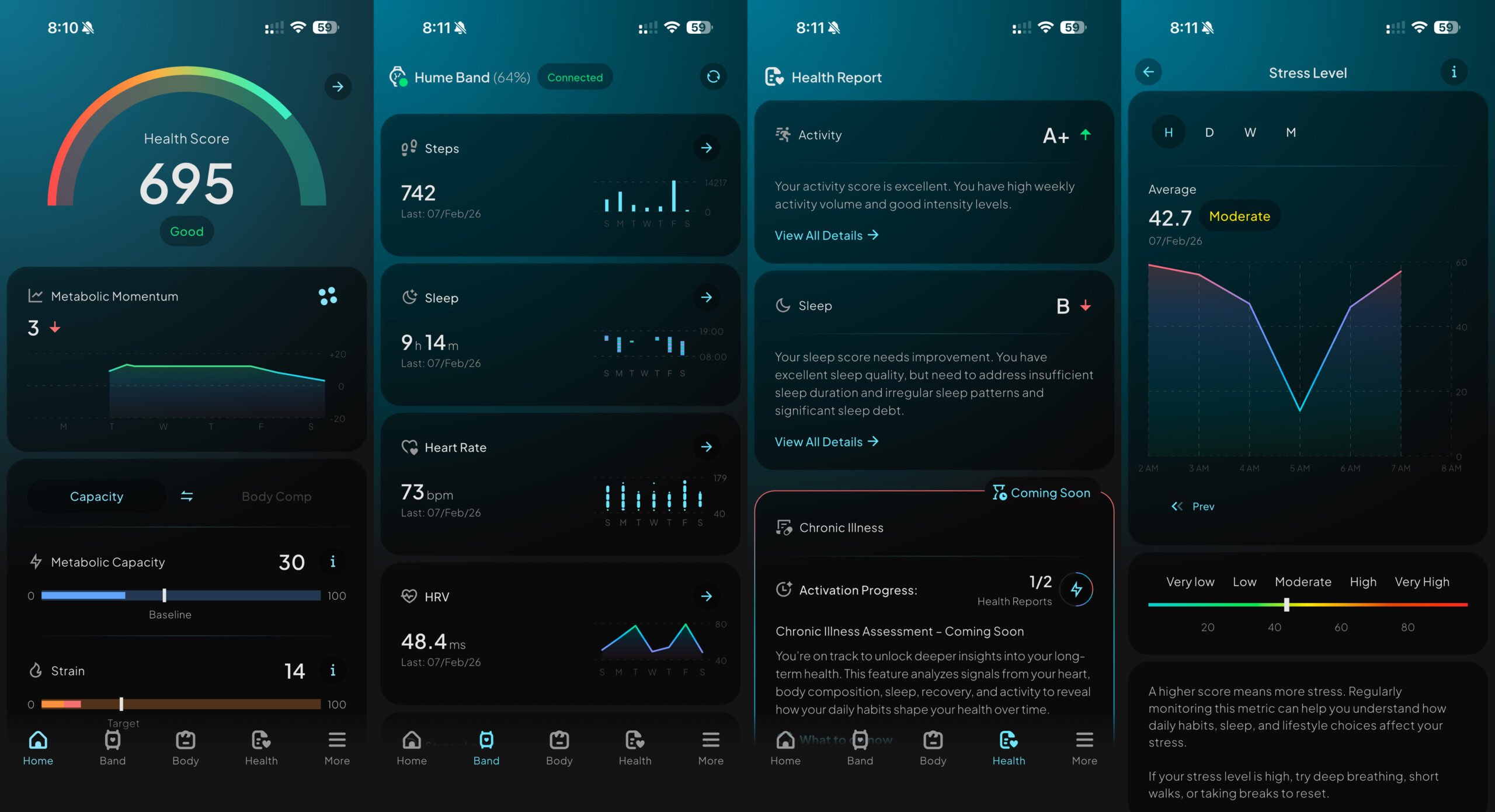
The Hume Health app is clean, modern, and distinctively different from the “Data Overload” of Garmin.
The Dashboard
The home screen doesn’t bombard you with numbers. It gives you your Health Score (0-100). This is a gamified aggregate of your sleep, activity, and body composition (if you use their scale).
The Digital Twin
This is Hume’s AI concept. The idea is that the app builds a digital version of you. As you feed it data (weight, sleep, heart rate), the “Twin” evolves. It uses this to predict how certain behaviors will affect your health.
- Reality Check: Right now, this feels largely like a fancy visualization for “Trends.” It is cool to look at, but functionally, it is similar to the “Insights” tab on other apps.
The Subscription Controversy (Hume Plus)
While the band is marketed as subscription-free, there is a “Hume Plus” membership.
- Free Version: You get all your daily data. Heart rate, sleep score, steps, and current data are free.
- Paid Version: Some of the deeper, long-term historical trends and “Coaching” advice are locked behind the paywall.
- My Take: The free version is perfectly adequate for 90% of users. Unlike Whoop, which becomes a paperweight if you stop paying, the Hume Band remains a fully functional tracker without the sub.
The Subscription Controversy (Premium)
While the band is marketed as subscription-free, there is an optional Premium membership.
Free Version: You get your daily data and core scores.
Paid Version: Premium adds coaching and deeper AI-style guidance (features may evolve over time).
My Take: The free version is perfectly adequate for most users. Unlike Whoop, the band remains functional even if you never subscribe.
Battery Life: The Achilles Heel?
Hume claims “up to 7 days” of battery life. In my testing, with 24/7 tracking enabled, I was getting closer to 4 to 5 days. This is not bad—it beats the Apple Watch (1 day) easily—but it falls short of the Oura Ring (5-7 days) and is about on par with the Whoop 4.0. The good news is that it charges fast. You can drop it on the charger while you shower and get enough juice for the next 24 hours.
Competitor Comparison
Who should buy this over the big three?
Hume Band vs. Whoop
Cost: Whoop is membership-based (tiered annual pricing). Hume is a one-time purchase with optional Premium.
Data: Whoop is more granular for elite athletes. Hume is better for general health/longevity framing.
Verdict: If you plan to track long-term, Hume can be materially cheaper than an ongoing membership. If you are a pro athlete who needs the absolute cutting edge in recovery algorithms, Whoop still holds the crown.
Hume Band vs. Oura Ring
Form Factor: Ring vs. Wrist. This is personal preference. I find the ring harder to wear while lifting weights (it scratches bars and pinches skin). The fabric band of the Hume is gym-friendly.
Subscription: Oura charges a membership fee. Hume is functional without one.
Verdict: Lifters should get Hume. Sleep-only trackers should get Oura.
Hume Band vs. Apple Watch
Function: Apple Watch is a smartwatch (apps, texts, GPS). Hume is a passive tracker.
Sleep: Hume is vastly superior for sleep simply because the battery lasts days, not hours, and it doesn’t emit light.
Verdict: They serve different purposes. I wear both (Apple Watch on left, Hume on right).
Pros and Cons
Pros:
- NO Monthly Subscription for core features (Massive win).
- Comfort: The SuperKnit strap is all-day comfortable.
- Focus on Longevity: Metabolic Momentum is a healthier way to view fitness than just “burning calories.”
- Price: With the discount code, it is very competitive.
- Ecosystem: Integrates well if you already own the Hume Body Pod scale.
Cons:
- Battery Life: Falls short of the 7-day claim (expect 4-5 days).
- App Polish: The app is newer than Fitbit/Whoop and occasionally has sync bugs or crashes.
- Sleep Accuracy: Sensitive to still-but-awake time.
- Support: Online reports suggest customer service can be slow to respond.
FAQ
Q: Do I really need the subscription (Hume Plus)? A: No. Unlike Whoop, the device works and shows you your data without it. The Plus subscription is for advanced coaching and deep historical analysis.
Q: Is it accurate for lifting weights? A: It tracks the strain of lifting reasonably well, but like all wrist wearables, it may lag on detecting peak heart rates during super-heavy sets.
Q: Can I wear it in the shower/sauna? A: Shower and swim? Yes (IP68). Sauna? I generally advise against wearing anybattery-powered device in a high-heat sauna as it degrades battery health over time, though it can technically survive short durations.
Q: Does it have GPS? A: No. It uses your phone’s GPS if you go for a run.
Final Verdict: Who is the Hume Band For?
Who is it for?
- The Subscription Hater: If you refuse to pay a monthly rent for your health data, this is the best alternative to Whoop on the market.
- The “Hybrid” Athlete: You lift weights, you sleep, you work in an office. You want 24/7 data but don’t want a screen distraction.
- The Longevity Focused: You care more about your long-term health trends (HRV, Sleep) than just how many steps you took today.
Who is it NOT for?
- The Marathon Runner: You need a Garmin with dedicated GPS and pacing.
- The Smartwatch Seeker: If you want texts and apps on your wrist, get an Apple Watch.
- The “Set it and Forget it” Battery User: If charging every 4-5 days annoys you, you might prefer a standard watch with a 2-week battery (like some Amazfit or Garmin models).
Closing Thoughts
The Hume Band is a disruptor because it attacks the part of the wearable industry people are increasingly fed up with: the idea that your baseline health data is a subscription product. Most screenless trackers have converged on the same playbook—sell the “hardware” at breakeven, then monetize the user indefinitely. It works for companies. It’s miserable for consumers.
Hume flips that model. The band is still a modern tracker with a clean app and proprietary scoring (Metabolic Capacity and Metabolic Momentum), but the core proposition is philosophical as much as financial: you buy the device, and you keep access to your tracking. Premium coaching can exist as an upgrade, but the product doesn’t turn into a paperweight if you stop paying.
Now, this isn’t a perfect device. The app still feels like a younger ecosystem—occasional sync weirdness, a few rough edges in the UX, and battery life that lands closer to 4–5 days than “set-and-forget.” But that’s the trade you’re making: you’re choosing a hardware-first ownership model with an improving software layer, instead of a software-first membership model that never stops billing.
Where the Hume Band Wins
For a lot of people, the math is simple. If you’re looking at a membership-based tracker at roughly $239–$359 per yeardepending on tier, you’re effectively paying for the device every year forever. With Hume, you can own the hardware outright for about the cost of a year of membership, and then your ongoing cost drops to optional instead of mandatory.
So the question isn’t “Is Hume the most advanced athlete platform on earth?” It’s: Do you want a calm, long-term health tracker you can actually own—one that nudges you toward consistency instead of turning your wellness into a monthly obligation? If yes, the Hume Band nails the assignment.
If you decide to pick one up, use the code below to save 20%. It helps support the detailed testing we do here.
Get 20% Off Hume Band: Code “ROBBSUTTON” Link: HumeHealth.com/pages/hume-band
Disclaimer: This review is based on real-world usage and research. Using the affiliate links and codes above supports the content creation. Always consult with a medical professional regarding health metrics; this device is for informational purposes only.