
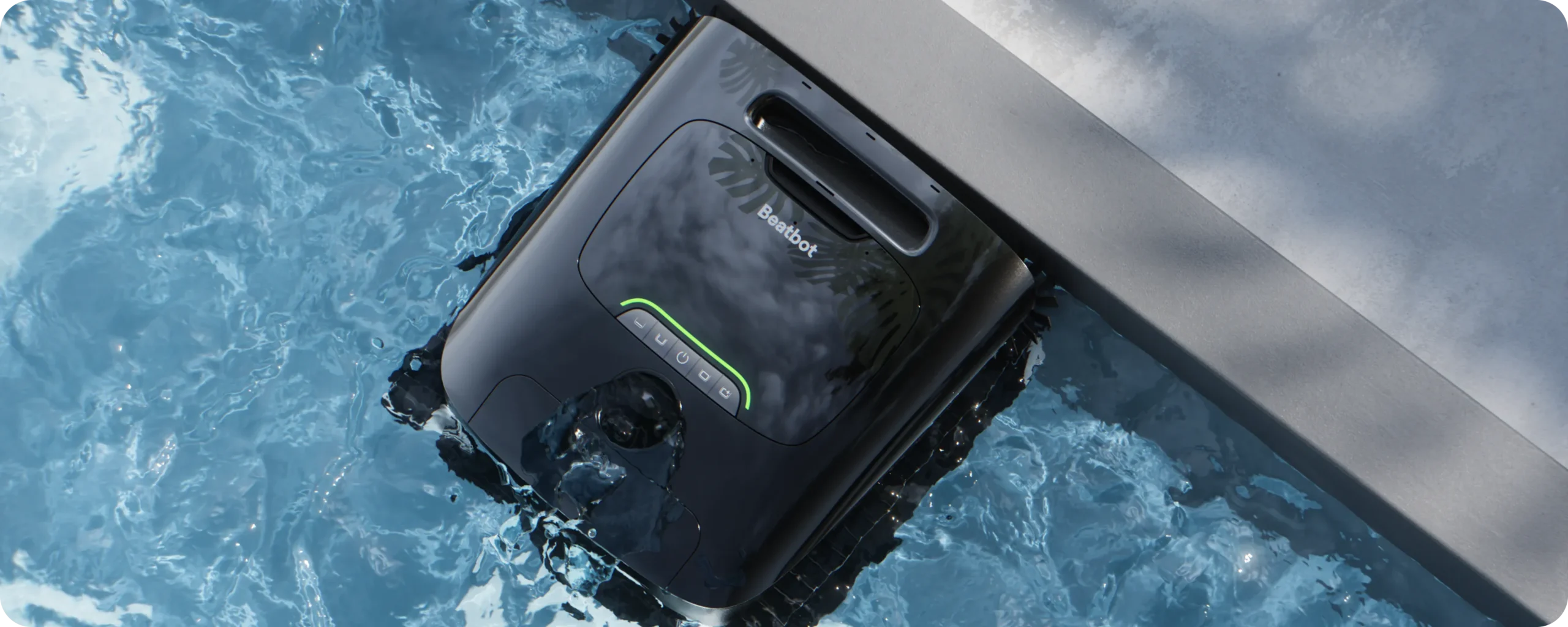
One machine promises to vacuum the floor, scrub the walls, skim the surface, manage your water chemistry, and clean itself — without you touching it. The engineering is genuinely impressive. The price is genuinely insane. Here’s what you actually need to know.
Aquasense Pool Cleaners – Shop on Amazon
Aquasense X – Beatbot Official Website
For decades, the robotic pool cleaner industry has been quietly lying to homeowners. The promise was automation. The reality was a tethered, corded machine that bumped its way around the deep end in random patterns, died halfway through the job, and left you standing poolside with a dripping filter basket full of wet leaves and dead bugs to rinse out with a garden hose. Every single time.
The high-end cordless robots that came after improved the suction and ditched the cord. But the maintenance ritual remained. When the machine finished its work, your work started. Pull it out of the water. Unlatch the chassis. Extract the basket. Hose it out. Try not to gag. The promise of true hands-free pool care has been dangled in front of homeowners for years without anyone actually delivering it.
The Beatbot AquaSense X is the most serious attempt yet to make good on that promise. Priced at a staggering $4,250, it’s not marketed as a pool accessory. It’s marketed as a complete replacement for human pool service labor — consolidating floor vacuuming, wall scrubbing, surface skimming, chemical dosing, and automated filter self-cleaning into a single hardware ecosystem. This review examines whether the engineering behind that claim is real, where the machine actually falls short, and whether any homeowner should spend this kind of money on it.
“Beatbot didn’t just build a better pool robot. They built a dock that makes the robot irrelevant to maintain. That’s the actual product.”
The Market Problem AquaSense X Is Trying to Solve
To understand what the AquaSense X represents, you need to understand how broken the status quo has been.
Legacy pool cleaning breaks into three categories, none of them satisfying. Pressure-side hydraulic cleaners and suction-side vacuums strain your primary pump, require constant human supervision, and address only the floor. Traditional battery robots brought autonomy to the category but introduced a new failure mode: random navigation algorithms that waste battery covering already-clean sections while missing dirty corners entirely, paired with tiny filter baskets that clog after a single windy afternoon.
The so-called “premium” cordless robots of the past five years improved suction power and added app connectivity. But they never solved the manual maintenance problem. Every cycle ended the same way — with the user on their knees at the pool edge, hosing out a basket of decomposing organic matter.
Beatbot’s thesis is that the dirty filter basket is not a feature of robotic pool cleaning. It’s a design failure. The AquaSense X and its AstroRinse self-cleaning station are built around eliminating that failure entirely.
| Feature | Beatbot AquaSense X | Aiper Scuba X1 Pro Max | Maytronics Dolphin Liberty 400 |
|---|---|---|---|
| Price (MSRP) | $4,250 | $1,799 – $2,299 | Premium |
| Suction (Flow Rate) | 6,800 GPH | 8,500 GPH | 4,000 GPH |
| Self-Cleaning Station | Yes — 3-min auto backflush to 22L bin | No — manual extraction required | No — manual top-load basket |
| Surface Skimming | Yes | Yes | No — strictly benthic |
| Navigation System | HybridSense AI — 29 sensors + camera | OmniSense 2.0 — 40 sensors | Gyroscopic algorithmic sweep |
| Chemical Dispenser | Yes — ClearWater clarifier integration | No | No |
| Battery | 13,400 mAh | Not disclosed | Rapid-cycle, ~1.5 hrs |
| Max Runtime (Floor) | Up to 5 hours | Up to 5 hours | ~1.5 hours |
| Max Runtime (Surface) | Up to 10 hours | Up to 10 hours | N/A |
| Pool Coverage | Up to 3,875 sq ft | Not disclosed | Not disclosed |
| Robot Weight | Heavy | 26 lbs | 17.9 lbs |
| Waterproof Rating | IP68 to 3.0m | Not disclosed | Standard |
| Saltwater Rated | Yes — up to 5,000 PPM | Yes | Yes |
The Navigation System: What HybridSense AI Actually Does
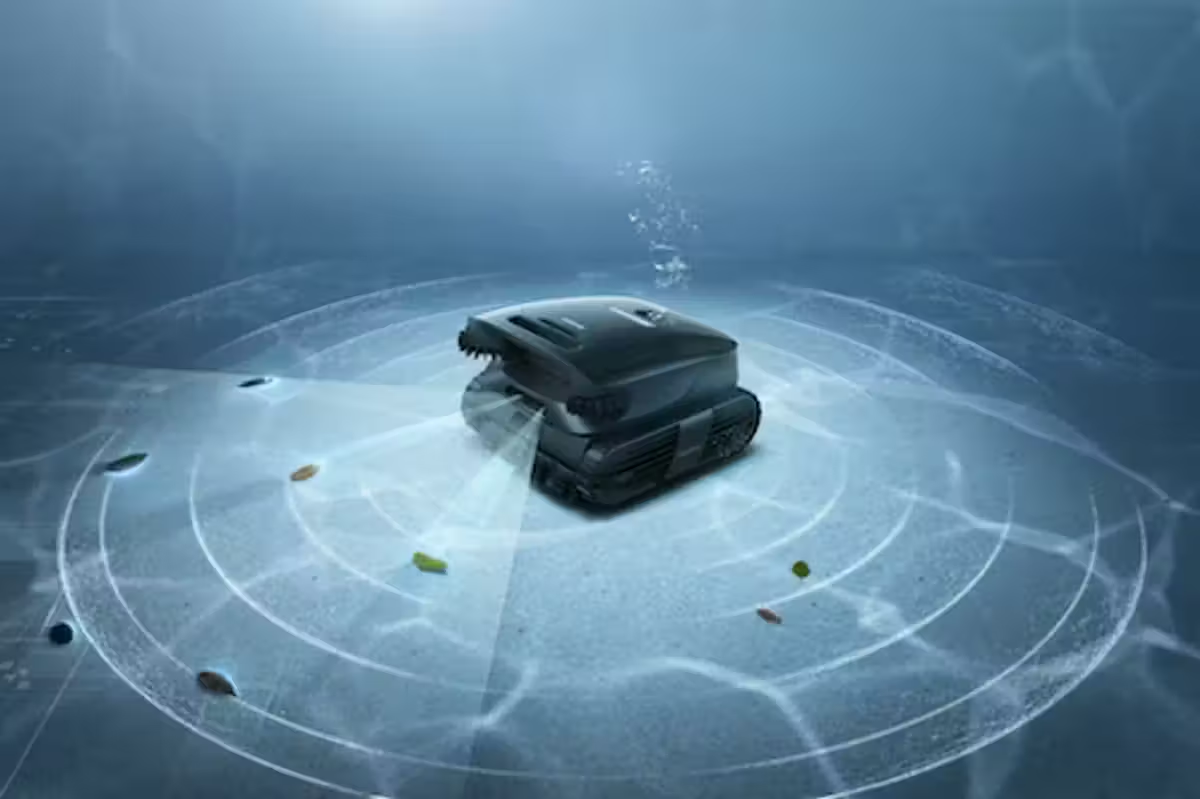
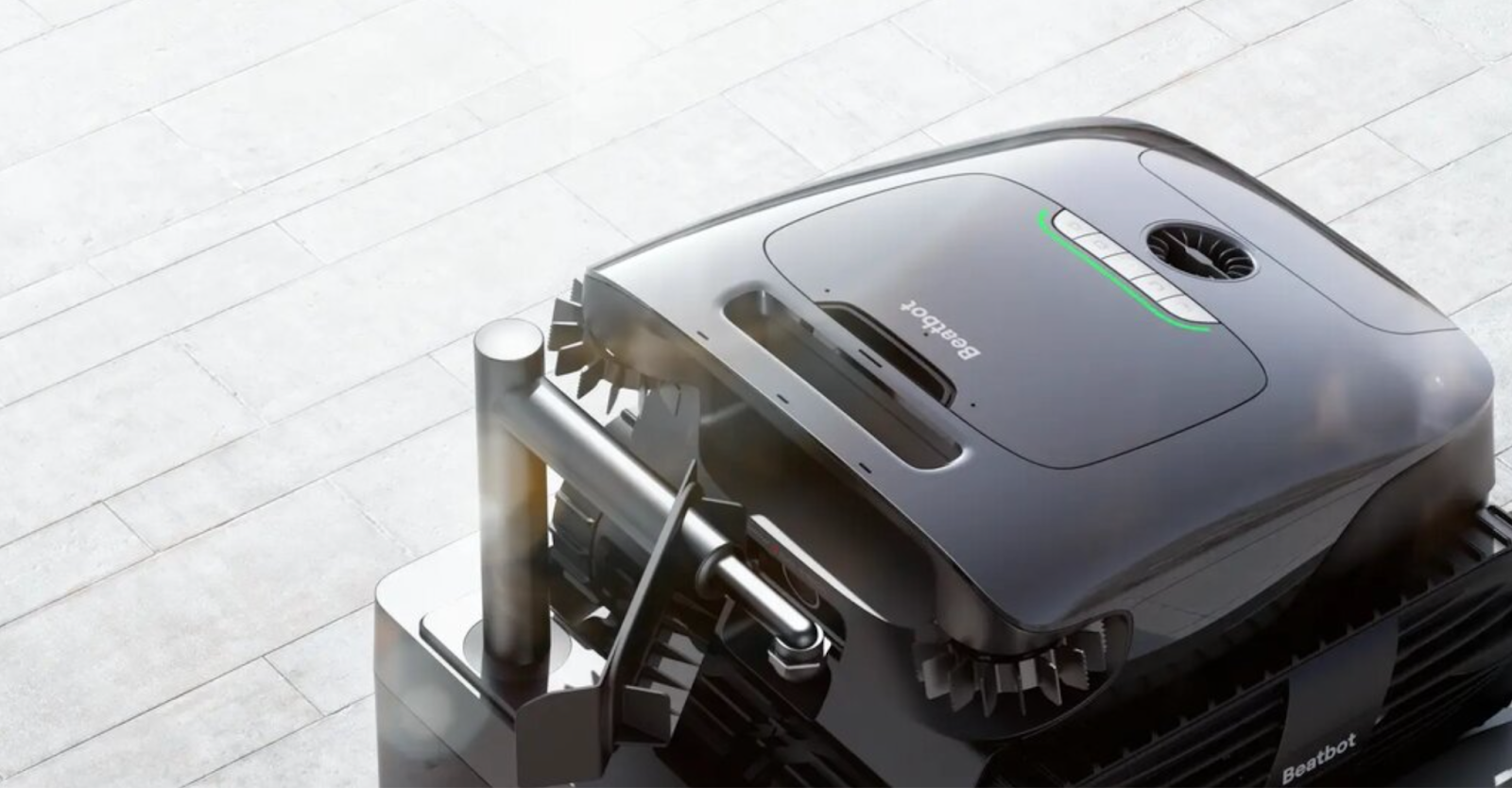
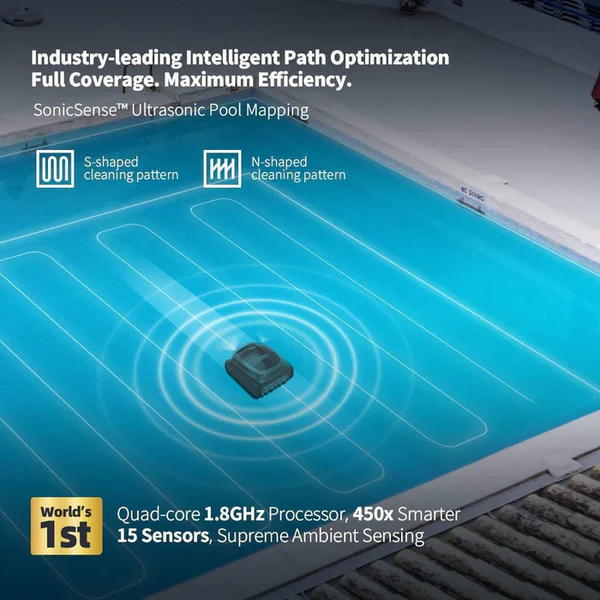
Traditional robotic pool cleaners navigate the way a Roomba did in 2008 — bump into a wall, turn, repeat. The AquaSense X discards this entirely in favor of a proprietary navigation suite called HybridSense AI, powered by an industrial-grade quad-core Cortex-A7 processor with dedicated DDR RAM and onboard flash storage.
The physical sensor array feeding that processor is unprecedented in the consumer pool category. Twenty-nine discrete sensors, combining an integrated AI vision camera, dual bottom ultrasonic sensors, and infrared detectors. The camera sees the pool. The ultrasonic sensors feel it — providing acoustic feedback that allows the robot to detect the edge of a step, the drop-off into the deep end, or the boundary of a tanning ledge with millimeter precision, regardless of water clarity.
The practical result of all this is a machine that actively maps your pool’s three-dimensional topography and builds a real-time cleaning route around what it finds. If wind drops a load of leaves into the deep end mid-cycle, the AI detects the debris concentration and navigates to it. It doesn’t waste battery covering already-clean areas. It doesn’t get trapped in geometric corners. It classifies over 40 distinct types of debris and adjusts its priorities accordingly.
There’s also an AI Quick Mode that calculates the highest-impact path for rapid debris removal — the equivalent of a targeted cleaning sprint rather than a full sweep. Dual front-mounted LED lights activate automatically based on ambient sensors, maintaining full navigational fidelity during overnight cycles. You can run an exhaustive 5-hour cleaning at 2am and have a pristine pool by morning without disrupting a single daytime swim.
The second-order benefit here matters as much as the navigation itself. By eliminating redundant movement, the AI conserves battery for the actual work — high-torque suction, aggressive wall scrubbing, and surface skimming. Fewer wasted cycles means less mechanical wear on the drive tracks and more runtime where it counts.
Five Functions in One Machine: The Seven Cleaning Modes
Managing buoyancy in an aquatic robot is not a trivial engineering problem. Most traditional robots are negatively buoyant — they’re floor machines, permanently bound to the bottom. The AquaSense X uses active buoyancy control to operate as a true five-in-one system: floor, walls, waterline, surface, and shallow platforms.
Seven discrete cleaning modes give the user granular control over how that capability gets deployed:
Quick Mode executes a rapid single-pass floor clean. Standard Mode works through floor, walls, and waterline in sequence. Pro Mode adds an extended surface skimming pass at the end of a full floor-and-wall cycle. ECO Mode runs an automatic every-other-day floor maintenance pass to hold a baseline level of cleanliness. Custom Mode lets you configure specific zones and durations through the app.
The transition between these modes is governed by an internal ballast system. To skim the surface, the robot purges internal water weight and floats to the top, where its upper suction ports draw in floating debris. To scrub the floor or scale a wall, it intakes water to increase density and drives its brushless motor tracks at full torque up vertical surfaces — including true 90-degree walls.
The shallow platform capability deserves specific attention. Modern residential pools frequently feature tanning ledges and Baja shelves at depths too shallow for primary circulation to push debris toward the skimmers. Fine silt and wind-blown leaves accumulate on these surfaces and stay there, ruining the visual appeal of an otherwise clean pool. The AquaSense X uses its ultrasonic sensor array to locate, navigate, and climb onto these elevated platforms, provided they’re at least 14 inches deep and offer a continuous unobstructed area of at least 3.3 by 3.3 feet. Traditional robots don’t touch these zones. This one does.
Surface Skimming: The Physics of Prevention
Surface skimming is not a convenience feature. It’s preventative chemistry management. Every leaf, pollen grain, and insect that gets captured at the water surface before it sinks is one less organic load breaking down at the bottom, consuming your active chlorine, shifting your pH, and feeding algae growth.
The AquaSense X executes surface skimming by adjusting internal buoyancy to float level with the waterline, then uses its propulsion tracks to navigate while drawing floating debris into the internal basket. Because surface mode demands significantly less torque than wall climbing or benthic scrubbing, the 13,400 mAh battery sustains it for up to 10 continuous hours — effectively all-day surface coverage on a single charge.
That said, be clear-eyed about the physics of a multi-purpose machine. If a strong gust deposits a massive load of leaves into the pool while the AquaSense X is in the middle of a 5-hour floor cycle at the bottom of the deep end, those leaves are going to become waterlogged and sink before the robot surfaces to skim them. Beta testers have reported occasional leftover leaves post-cycle, and this isn’t a software problem. It’s chronological physics. The 5-in-1 machine cleans everything sequentially. A dedicated surface skimmer — solar-powered, running 24/7 — cleans the surface continuously.
For pools under heavy, constant tree canopy, the AquaSense X is powerful but not infallible. It’s an excellent surface management tool. It is not a replacement for a dedicated continuous skimmer in extreme debris environments.
Aquasense Pool Cleaners – Shop on Amazon
Aquasense X – Beatbot Official Website
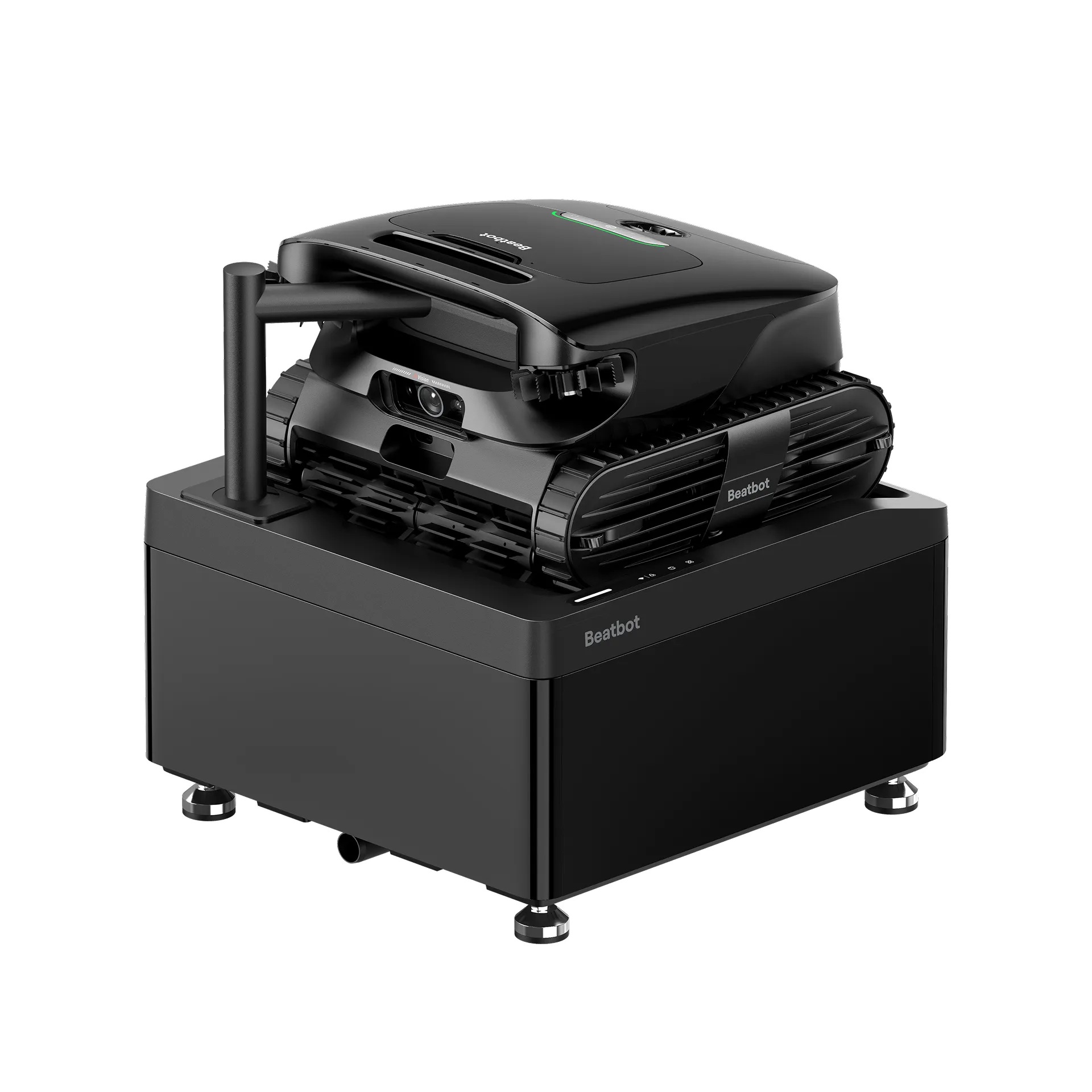
The AstroRinse Station: Why This Is the Actual Product
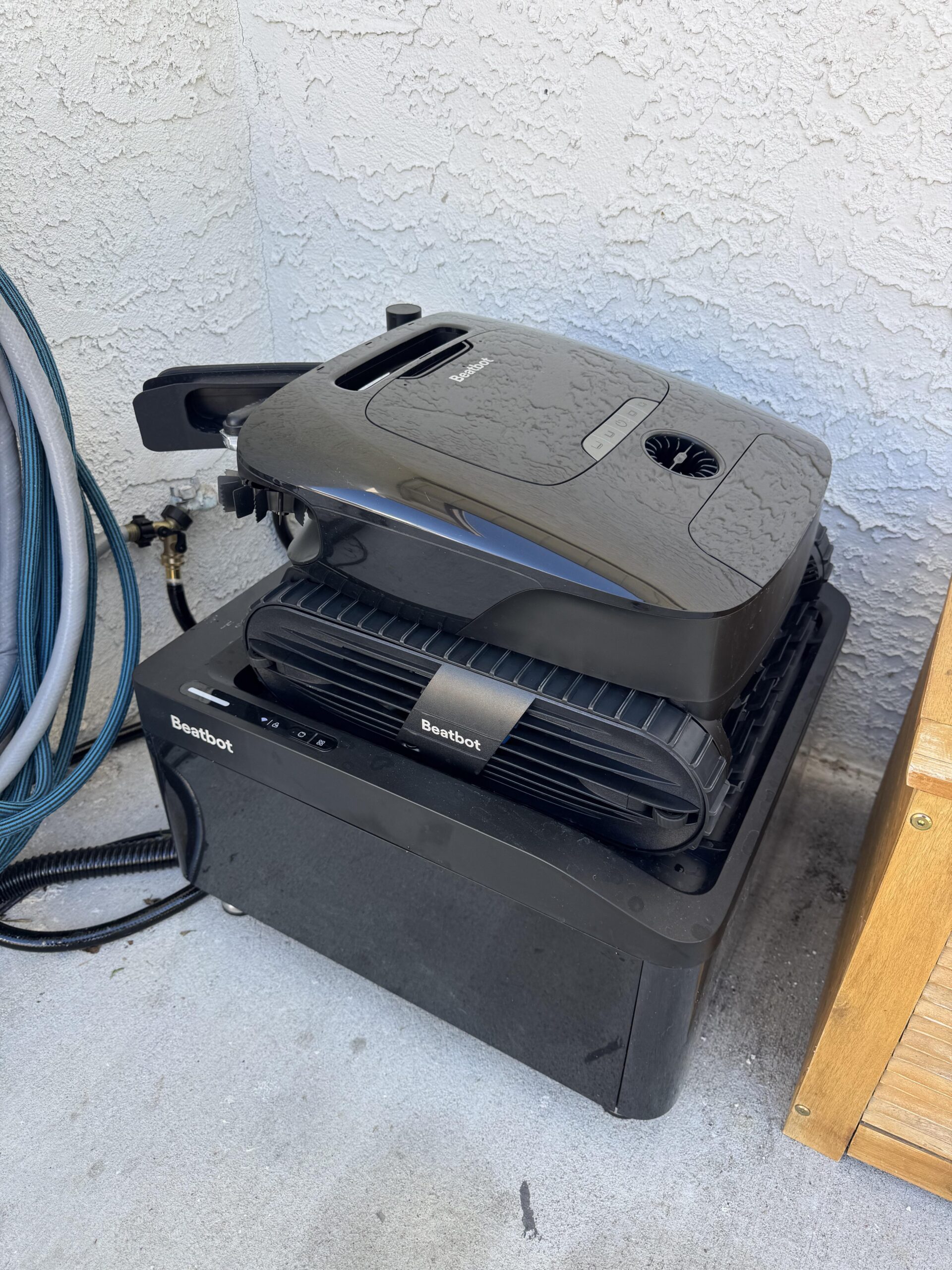
If the AquaSense X robot is impressive, the AstroRinse self-cleaning station is the reason the system costs $4,250. This is where Beatbot separates itself from every competitor on the consumer market.
Here’s how the full automation cycle works. When the robot completes its scheduled cleaning cycle — or when onboard battery sensors hit a low threshold — it initiates Smart Parking. The HybridSense AI navigates the robot to the pool edge, adjusts buoyancy to float at the surface, and docks itself against the wall. Simultaneously, the SmartDrain system purges the robot’s internal water ballast, significantly reducing its lifting weight before the user picks it up.
The user lifts the robot from the water and places it on the AstroRinse dock on the pool deck. From that point forward, they’re done. The station detects the robot’s presence and immediately initiates a high-pressure backflushing sequence. Targeted internal water jets forcefully blast through the robot’s dual-layer filtration basket — capturing particles down to 150 microns — stripping trapped organic matter, sand, and sediment from the media. That wastewater and debris slurry gets evacuated into the station’s 22-liter external debris receptacle.
The entire backflush cycle takes approximately three minutes. Zero hands-on effort. The 22-liter capacity is specifically sized to handle heavy autumn leaf loads, and Beatbot claims the bin can go up to two months without requiring the user to empty it. When it does need emptying, the station supports disposable sealed dust bags — lift out the sealed bag, drop it in the trash, never touch wet decaying leaves. The manufacturer reports no noticeable odor from the sealed bin even after weeks of organic accumulation.
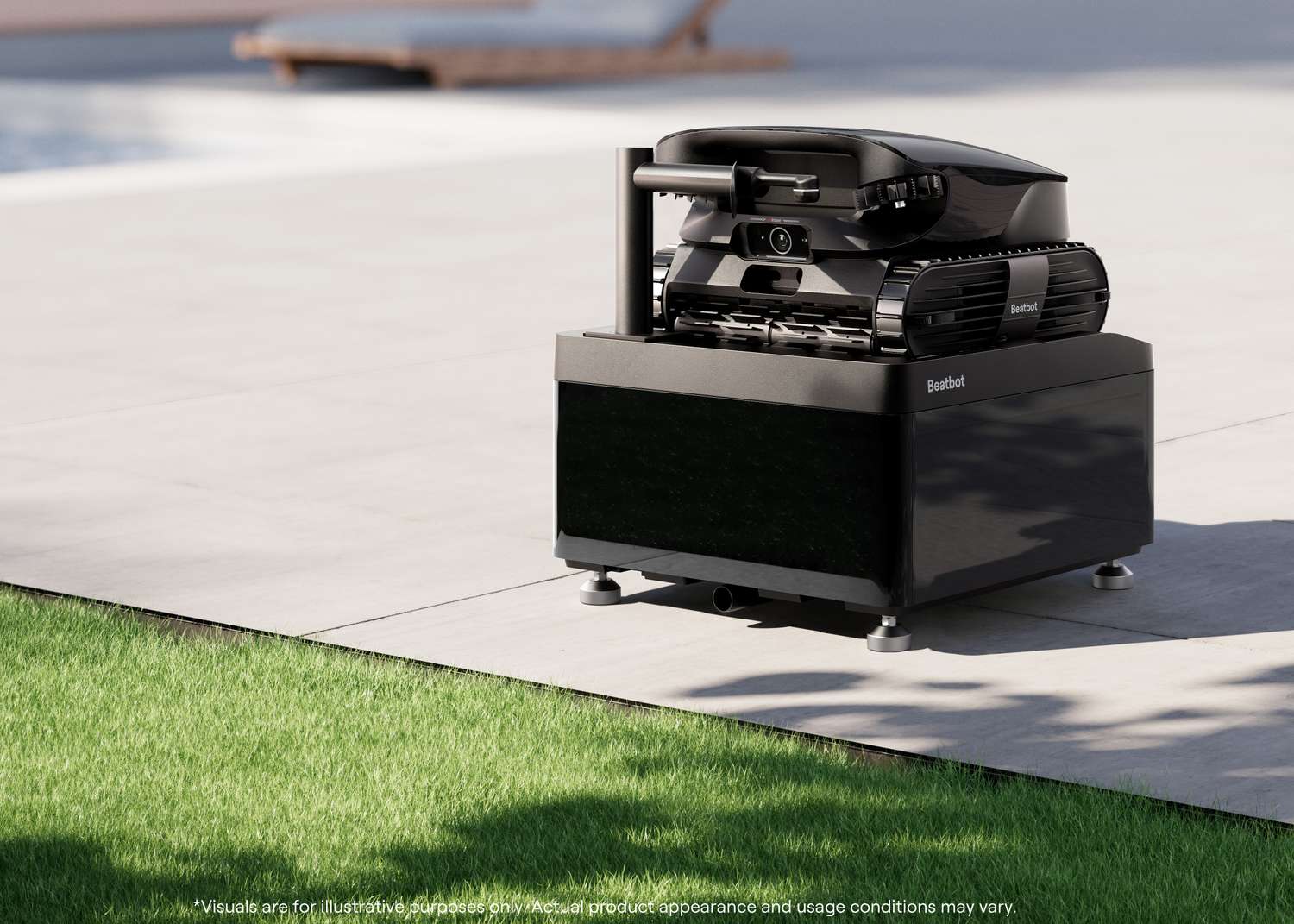
The station itself is built as a permanent outdoor appliance, not a plastic prop. The housing features UV-resistant automotive-grade IMR coating. The base is heat-insulated, corrosion-resistant against pool chemicals and saltwater, and engineered for freeze-thaw cycles. Wireless inductive charging for the robot’s battery is integrated into the dock — no wet charging pins to align, no external power bricks.
However, the AstroRinse station requires deliberate infrastructure planning. This is not something you unbox and plug into a wall outlet. The station weighs 41.9 pounds and measures roughly 25 by 21 by 22 inches. It ships with a 12-foot water inlet hose with a standard 3/4-inch internal thread connector, which must be attached to a continuous outdoor water spigot or a diverted return line from the main pool equipment pad. It also ships with a 6-foot corrugated drain hose (1.26-inch inner diameter) that must route to a garden bed, French drain, or sewer cleanout. It needs level ground, adequate ventilation, a GFCI-protected power outlet, and strong Wi-Fi coverage.
This is a weekend installation project, not an afternoon one. Go in knowing that.
AstroRinse Installation Readiness Checklist
Before you purchase, verify your pool environment can actually support the station. If you check every box, installation will be straightforward. If you can’t check even one, factor in what it will cost to resolve it.
| Requirement | What You Need |
|---|---|
| Power | GFCI-protected outdoor outlet within reach of the station placement |
| Water source | Continuous outdoor spigot or pressurized pool return line — 3/4-inch thread connection, within 12 feet of the station |
| Drain routing | Garden bed, French drain, or sewer cleanout within 6 feet — the 1.26-inch corrugated drain hose must terminate somewhere |
| Level ground | Flat, stable surface — the station’s internal plumbing requires level placement to function correctly |
| Clearance | Minimum 3.3 feet from walls on all sides for airflow, heat dissipation, and hose routing |
| Wi-Fi coverage | Strong 2.4GHz or 5GHz signal at the pool deck location — the station needs network connectivity for app integration |
| Pool edge proximity | Station must be close enough to the pool edge that the robot’s Smart Parking protocol can dock against the wall and be retrieved without a long carry |
ClearWater Clarification: Automated Chemistry Management
Beyond mechanical debris removal, the AquaSense X directly manages your pool’s water chemistry through its integrated ClearWater clarification system. The robot carries an onboard dispensing mechanism that automatically distributes a proprietary AquaRefine clarifying agent throughout the pool during floor cleaning cycles.
The chemistry here is genuinely interesting. Rather than traditional aluminum sulfate or synthetic polymer flocculants, the AquaRefine clarifier is formulated from recycled crustacean byproducts — specifically chitosan, the active biological compound found in crab shells. Chitosan carries a positive electrical charge that attracts and binds the negatively charged microscopic particles — suspended silt, dead algae cells, fine debris — that are too small for standard filtration to catch. Once bound into larger clusters through a process called flocculation, those particles become large enough for the AquaSense X’s 150-micron filter or your primary pool filter to capture. Water that was chronically hazy becomes visibly clear.
The formulation also removes heavy metal ions — iron, copper, manganese, mercury, lead — preventing the staining and discoloration that ruins pool plaster. It acts as a scale inhibitor against calcium buildup on tiles and protects against metal corrosion inside heaters and saltwater chlorine generators.
By distributing the agent automatically as the robot navigates the floor, the system achieves perfectly even dynamic distribution — no localized clouding from dumping clarifier into the deep end by hand.
The honest cost reality: the AquaRefine Kit costs $49.99 and lasts approximately one month at weekly automated dosing, treating up to 99,000 gallons. That’s a recurring $600 annual operating cost on top of the $4,250 purchase price. Generic liquid chitosan clarifiers are available in bulk from traditional pool supply retailers at roughly half that price. The proprietary dispenser is a classic razor-and-blades business model. If the automated distribution convenience is worth the premium to you, factor it in from the start.
Battery Life and Power Architecture
The AquaSense X runs on a 24-cell, 13,400 mAh lithium-ion battery pack — a capacity that vastly outclasses anything in the entry or mid-tier cordless pool robot category. The resulting endurance numbers are genuinely impressive.
Surface skimming mode: up to 10 continuous hours on a single charge. Floor cleaning: up to 5 hours. Wall and waterline scrubbing: up to 5 hours. Total pool bottom coverage per charge: up to 3,875 square feet. At those numbers, mid-cycle battery death in the deep end — one of the most frustrating failure modes of cheaper cordless units — simply isn’t a realistic concern.
Full recharge via the AstroRinse dock’s wireless inductive charging takes 3.5 to 4.5 hours from a fully depleted battery. The wireless charging integration means no wet charging pins to align and no manual power connections after every cycle.
The 6,800 GPH brushless main-pump motor that drives all this suction demands significant electrical draw. The quad-core AI processor and 29 active sensors add to that demand. The 13,400 mAh pack is sized to support all of it simultaneously — which is why the battery is as large as it is, and why the weight of the machine is what it is.
The App, Connectivity, and One Significant Caveat
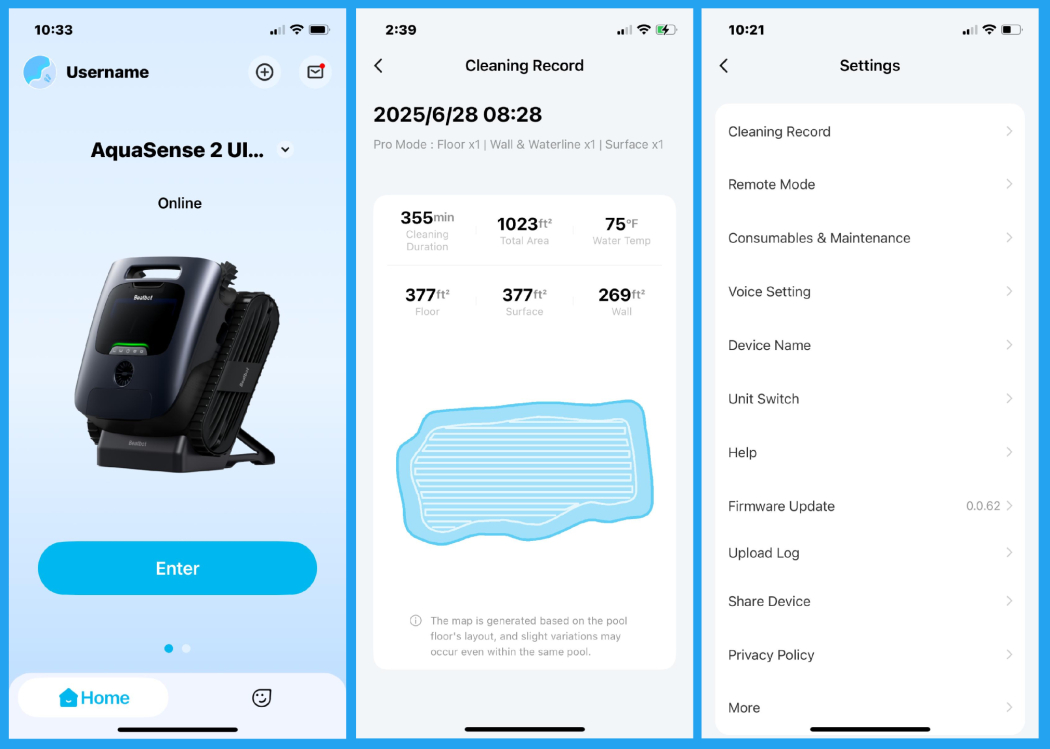
The Beatbot mobile app serves as the central command hub for both the robot and the AstroRinse station. The system connects via both 2.4GHz and 5GHz Wi-Fi for home integration and Bluetooth for close-proximity pairing and initial setup. Google Home, Amazon Alexa, and Apple Siri integrations allow full voice control — start a cycle, trigger the backflush, check battery status from the kitchen without touching your phone.
Post-cleaning, the app delivers a detailed telemetry upload: a visual map of the cleaned area, exact square footage covered, total time elapsed, remaining battery life, and maintenance reminders for the AstroRinse bin. The data visualization is robust.
Now for the caveat you need to know before you expect live remote control: the app goes dark the moment the robot submerges. Real-time steering, live camera feeds, and instant mode switching are unavailable while the robot is cleaning underwater. This is not a software bug. It is an immutable law of physics. High-frequency electromagnetic signals at 2.4GHz and 5GHz are rapidly absorbed by dense liquid water — the signal cannot penetrate more than a few inches below the surface. When submerged, the robot relies entirely on its onboard HybridSense AI. App connectivity and remote control resume when the robot surfaces.
There are also legitimate complaints about the software experience itself. Early adopters have flagged that OTA firmware updates can completely block access to the remote control and mode selection screens until the update is forced through — highly disruptive if you simply want to start a quick cycle. The interface can feel clunky. These are software problems, not hardware ones, and Beatbot’s OTA architecture means they can push fixes over the life of the machine. But go in with calibrated expectations about the app experience at launch.
Aquasense Pool Cleaners – Shop on Amazon
Aquasense X – Beatbot Official Website
The Honest Part
The AquaSense X presents a series of genuine engineering triumphs. It also presents specific, non-trivial limitations that a $4,250 purchasing decision requires you to understand clearly.
Where it excels:
The raw suction throughput of 6,800 GPH handles dense, waterlogged debris — oak acorns, wet twigs, soaked leaf piles — that lower-powered robots simply pass over. The dual-layer 250/150-micron filtration separates large organic matter from fine silt without choking the motor.
The AstroRinse station is the most significant quality-of-life advancement the pool robot category has seen. By automating the dirty filter extraction chore and housing collected debris in a sealed 22-liter bin for up to two months, Beatbot has delivered the closest approximation to genuinely hands-free pool care currently on the market.
The nocturnal cleaning capability is practical and underrated. Dual LED lights enable full visual navigation fidelity in complete darkness. Schedule an exhaustive overnight cycle, have a pristine pool at sunrise, sacrifice nothing during daylight hours.
The shallow platform capability closes a gap that traditional robots have ignored entirely. Tanning ledges and Baja shelves accumulate fine silt that primary circulation never captures. This robot addresses those zones specifically, provided they meet the minimum depth and clearance requirements.
Where it struggles:
The physical retrieval problem is real and underacknowledged in the marketing. Smart Parking navigates the robot to the edge. SmartDrain purges the water ballast to reduce weight. But the user still has to physically bend over the pool coping, grip a large piece of hardware, and lift it out of the water onto the AstroRinse dock at a potentially awkward angle. For elderly users or anyone with physical mobility limitations, this mandatory heavy lift is a meaningful friction point that “zero-effort” marketing language papers over.
The economic total cost of ownership is brutal. The $4,250 purchase price is more than three times the cost of highly capable premium robots. Add $49.99 per month in proprietary AquaRefine clarifier. At year three, you’ve spent over $6,000. Independent reviewers have been direct about the chitosan clarifier premium — the same active ingredient is available generically for significantly less. The closed ecosystem is deliberate, and buyers should price it accordingly.
The consolidation risk is the most serious structural argument against the AquaSense X. A 5-in-1 system is a single point of failure. If the main drive motor, battery pack, or AI processor fails, you instantly lose all automated pool maintenance simultaneously — surface skimming, floor cleaning, wall scrubbing, and chemical management go dark at the same time. A parallel approach — a dedicated $1,000 floor robot and a $400 continuous solar surface skimmer — provides better redundancy, 24/7 uninterrupted surface coverage, and total system cost well below the AquaSense X. Some pool service professionals argue this split architecture is the more rational choice. It’s a legitimate counterargument worth considering.
AquaSense X vs. Aiper Scuba X1 Pro Max
The Aiper Scuba X1 Pro Max is the closest direct competitor to the AquaSense X on raw performance specifications, and it approaches the problem from a fundamentally different economic angle.
On paper, the Aiper actually edges out the Beatbot in suction power — 8,500 GPH versus 6,800 GPH, driven by a 9-motor architecture and a 40-sensor OmniSense 2.0 array. It is also substantially less expensive, coming in between $1,799 and $2,299.
Where the experience diverges is maintenance. The Aiper relies on a traditional 5-liter internal basket. Five liters is generous by category standards, but in a heavy debris environment, the user still manually extracts, opens, and rinses that basket with a hose. The Beatbot eliminates that chore entirely. The entire $2,000+ price premium between these two machines can be traced back to one thing: the AstroRinse station.
Both units are comparably heavy, presenting identical physical retrieval challenges. Neither has a meaningful advantage over the other on pool coverage, runtime, or surface skimming duration. The question reduces to whether completely automating the weekly filter cleaning task is worth doubling the capital expenditure.
AquaSense X vs. Maytronics Dolphin Liberty 400
Maytronics has been the gold standard in robotic pool cleaning for decades, and the Dolphin Liberty 400 is their premium cordless entry. It is a fundamentally different class of machine than the Beatbot — built for precision scrubbing reliability rather than massive debris hauling.
At 17.9 pounds, the Liberty 400 is significantly lighter than the AquaSense X, making poolside retrieval substantially easier. Its battery is sized for rapid, highly efficient 1.5-hour cleaning sprints rather than marathon 5-hour cycles. Suction is considerably lower at 4,000 GPH. The Liberty 400 does not offer surface skimming of any kind — it is strictly a floor and wall machine.
What it does deliver is decades of highly refined scrubbing algorithms and exceptionally durable active PVC brushing mechanics that consistently leave pool plaster in flawless condition. The Magnetic Connect inductive charger is elegant and convenient. What it entirely lacks is automated filter evacuation and the 22-liter AstroRinse debris storage.
The Liberty 400 is a reliable daily maintainer for homeowners who don’t mind regular manual filter intervention. The AquaSense X is a system for homeowners who want to eliminate that intervention entirely and have pools large enough to justify the machine’s marathon capability. These are different tools for different priorities.
Pool Size, Surface Compatibility, and Operational Requirements
Stop doing the math. Here’s what you actually need to know about operational parameters.
| Parameter | Specification |
|---|---|
| Max pool coverage (per charge) | Up to 3,875 sq ft of pool bottom area |
| Compatible pool shapes | Rectangular, round, kidney, freeform |
| Compatible surface materials | Concrete, gunite, plaster, tile, fiberglass, vinyl liner |
| Minimum operating depth | 0.5 meters (1.64 ft) |
| Maximum operating depth | 3.0 meters (9.84 ft) |
| Minimum depth for ledge/shelf cleaning | 14 inches |
| Minimum ledge/shelf area for cleaning | 3.3 x 3.3 ft unobstructed |
| Saltwater rated | Yes — up to 5,000 PPM |
| AstroRinse station weight | 41.9 lbs |
| AstroRinse water inlet | 12-ft hose, 3/4-inch internal thread |
| AstroRinse drain hose | 6-ft corrugated, 1.26-inch inner diameter |
| External debris bin capacity | 22 liters (5.8 gallons) |
| Backflush cycle time | ~3 minutes, fully automated |
| Full battery recharge time | 3.5 to 4.5 hours |
| AquaRefine kit cost | $49.99 / ~1 month at weekly dosing |
The 5,000 PPM saltwater rating comfortably covers the vast majority of residential salt chlorine generator systems, which typically operate between 3,000 and 4,000 PPM.
Does It Actually Pay for Itself? The TCO Math
At $4,250, the question every homeowner should be asking is a simple one: compared to what? The most direct competitor to the AquaSense X isn’t the Aiper or the Maytronics — it’s a professional weekly pool service. Stop doing the math in your head.
| Scenario | Year 1 | Year 2 | Year 3 | 3-Year Total |
|---|---|---|---|---|
| AquaSense X + AquaRefine clarifier | $4,850 ($4,250 hardware + $600 clarifier) | $600 | $600 | $6,050 |
| AquaSense X + generic clarifier (~$25/mo) | $4,550 ($4,250 hardware + $300 clarifier) | $300 | $300 | $5,150 |
| Professional weekly pool service (low estimate — $100/mo) | $1,200 | $1,200 | $1,200 | $3,600 |
| Professional weekly pool service (mid estimate — $150/mo) | $1,800 | $1,800 | $1,800 | $5,400 |
| Professional weekly pool service (high estimate — $200/mo) | $2,400 | $2,400 | $2,400 | $7,200 |
| Aiper Scuba X1 Pro Max (no recurring costs) | $2,049 | $0 | $0 | $2,049 |
A few things jump out immediately. Against professional service at $150/month or more — which is not unusual in most metros — the AquaSense X with proprietary clarifier breaks even somewhere around year three and runs cheaper from year four onward. Against low-cost pool service at $100/month, it never pays for itself in a straightforward financial comparison.
What the math doesn’t capture is scope. Professional weekly service typically means one visit per week. The AquaSense X runs daily ECO maintenance cycles, cleans overnight on demand, addresses surface debris that a weekly service can’t, and dispenses clarifier continuously. You’re not buying equivalent service — you’re buying more frequent, more consistent coverage.
The honest framing: if you’re paying $150+ per month for professional service and your primary frustration is that you can’t control the schedule or the consistency, the AquaSense X is a financially defensible decision. If you’re paying $100/month and mostly satisfied, it is not. The AstroRinse automation is a convenience purchase at those numbers, not a cost-saving one.
Who Should Buy the AquaSense X
Buy the AquaSense X if you have a large pool — 2,000 square feet or more of pool bottom area — in a high-debris environment, and the defining friction in your pool ownership experience is the manual maintenance ritual after cleaning cycles. If you’ve spent years pulling a waterlogged robot out of your pool, unkinking cables, prying open filter baskets, and hosing out wet leaves, the AstroRinse station directly eliminates the thing you hate most about pool ownership. Add in a property where tanning ledges and Baja shelves have perpetually defeated your previous robot, and the AquaSense X’s coverage capabilities become genuinely irreplaceable.
Do not buy the AquaSense X if your budget is $2,500 or less, your pool is under 1,500 square feet, you have any physical mobility limitations that make lifting a heavy machine from the pool edge a real concern, or you’re prepared to manually rinse a filter basket once a week. At that point, the Aiper Scuba X1 Pro Max delivers comparable raw cleaning performance for less than half the price, and the $2,000+ you save is difficult to justify spending on an automation convenience you’ve already demonstrated you’ll tolerate doing manually.
Frequently Asked Questions
Is the AquaSense X suitable for freeform pools with complex shapes? Yes, without reservation. The HybridSense AI builds a live three-dimensional topographic map of your pool and calculates its cleaning route from that map — it doesn’t execute a pre-programmed geometric sweep. Kidney, freeform, L-shaped, and highly irregular pool designs are handled the same way a rectangular pool is. The 29-sensor array provides the spatial awareness required to navigate complex geometry, and the ultrasonic sensors prevent the robot from getting trapped in architectural corners or beached on unexpected ledges.
Can the AstroRinse station connect to a pool return line instead of a garden spigot? Yes. The 12-foot water inlet hose with the standard 3/4-inch internal thread connector can attach directly to a diverted, pressurized return line from your main pool equipment pad as an alternative to an outdoor garden spigot. This can be a cleaner permanent installation option if your equipment pad is near the pool edge. Either way, a continuous pressurized water source is required — this is not optional infrastructure for the backflush system to function.
Does the app really go dark while the robot is cleaning? Yes, and it’s worth setting this expectation clearly before purchase. Wi-Fi and Bluetooth signals at 2.4GHz and 5GHz cannot penetrate water more than a few inches. While the robot is submerged, the Beatbot app cannot provide live camera feeds, real-time remote steering, or instant mode switching. The HybridSense AI handles all navigation decisions autonomously while underwater. App connectivity, remote control, and post-cycle telemetry maps are all available when the robot surfaces. If you want the ability to watch your pool robot navigate in real-time the way you’d track a Roomba on a floorplan, this machine cannot do that.
How often does the 22-liter AstroRinse bin actually need to be emptied? Beatbot’s specification under standard operating conditions is up to two months between bin empties. In reality, this depends heavily on your debris load. A pool under a dense, actively shedding tree canopy in autumn may fill the bin in three to four weeks. A pool in a minimally landscaped yard with modest debris load may realistically reach the two-month figure. The disposable sealed dust bag system means that when the bin does fill, the emptying process is lifting out a sealed bag and dropping it in the trash — no direct contact with wet organic matter.
Is the AquaRefine clarifier actually necessary, or can I use a generic chitosan product? The clarifier is not mechanically necessary for the robot to clean the pool. The AquaSense X’s suction, filtration, and navigation systems operate fully without it. The ClearWater system is an add-on for water chemistry management — flocculation of fine suspended particles, heavy metal binding, and scale inhibition. Generic liquid chitosan clarifiers are available from traditional pool supply retailers at roughly half the per-treatment cost of the proprietary AquaRefine kits. The proprietary dispenser mechanism in the robot is designed specifically for the Beatbot cartridge format. Running generic product requires manual application outside the automated dispensing system, which sacrifices the even dynamic distribution benefit.
What happens if the robot fails while submerged? The AquaSense X carries an IP68 waterproof certification to a depth of 3.0 meters. In the event of a software fault, the onboard fail-safe protocol commands the buoyancy system to surface the robot automatically. It will float to the top where you can retrieve it. For hardware failures — motor, battery, or processor — the unit would need to be retrieved manually with a pool hook. Given the machine consolidates all pool cleaning functions into a single chassis, any hardware failure that takes the robot offline simultaneously eliminates floor vacuuming, wall scrubbing, surface skimming, and chemical dosing until the unit is repaired or replaced. This is the core structural risk of the 5-in-1 consolidation approach, and it’s the most compelling argument for maintaining a backup cleaning method.
What is the warranty, and what happens if the AstroRinse station fails? Beatbot covers the AquaSense X robot with a limited manufacturer’s warranty — verify the current terms directly with Beatbot before purchase, as coverage periods can change. What matters more than the headline period is what the warranty actually covers. For a machine with semi-permanent plumbing integration and a proprietary backflush system, confirm specifically whether the AstroRinse station’s internal water jets, inlet plumbing, and drain system are covered under the same terms as the robot itself, or whether they fall under separate accessory coverage. For a $4,250 ecosystem with a single point of failure architecture, you want clarity on what Beatbot does if the station’s backflush mechanism fails at month 14 — whether that means depot repair, replacement parts, or an on-site service dispatch. Ask that question directly before you commit.
How do you winterize the AstroRinse station in a freeze-thaw climate? The station’s housing is engineered with anti-freeze properties to handle seasonal temperature cycles, but the internal plumbing is not designed to survive a hard freeze with water sitting in the lines. In climates where overnight temperatures regularly drop below freezing, the station needs to be winterized before cold weather arrives. That means shutting off the water inlet supply, running a short backflush cycle to evacuate residual water from the internal jets and hoses, disconnecting and draining both the inlet and drain hoses, and — if temperatures will be severe — bringing the station indoors or covering it with a weatherproof housing. The robot itself should be stored indoors during extended off-season periods to protect the lithium-ion battery from repeated deep cold exposure, which degrades cell capacity over time. If your pool is in a climate where you’re closing it for four to six months every year, factor that seasonal maintenance step into your ownership picture. It’s not complicated, but it’s real — and it’s a step that a wall-plug charger on a competing machine doesn’t require.
The Beatbot AquaSense X doesn’t reimagine the pool robot. It reimagines what happens after the pool robot finishes — and that turns out to be where the real problem was all along.
Aquasense Pool Cleaners – Shop on Amazon
Aquasense X – Beatbot Official Website
